Roofing and siding
Roll-formed profiles, standing-seam roofs, flashings, gutters and downpipes; 3003, 3105 and 5052 with SMP, HDP or PVDF.



Colour coated (pre-painted) aluminium sheet, coil and strip is rolled aluminium that has been cleaned, pre-treated and painted on a continuous coil-coating line before it is formed. Fabricators receive a finished, durable surface and only need to cut, bend or roll-form it. This guide compares alloys and paint systems (PE, HDP, PVDF), lists typical specifications and tests, and explains how to choose for roofing, cladding, signage, ceilings and transport.
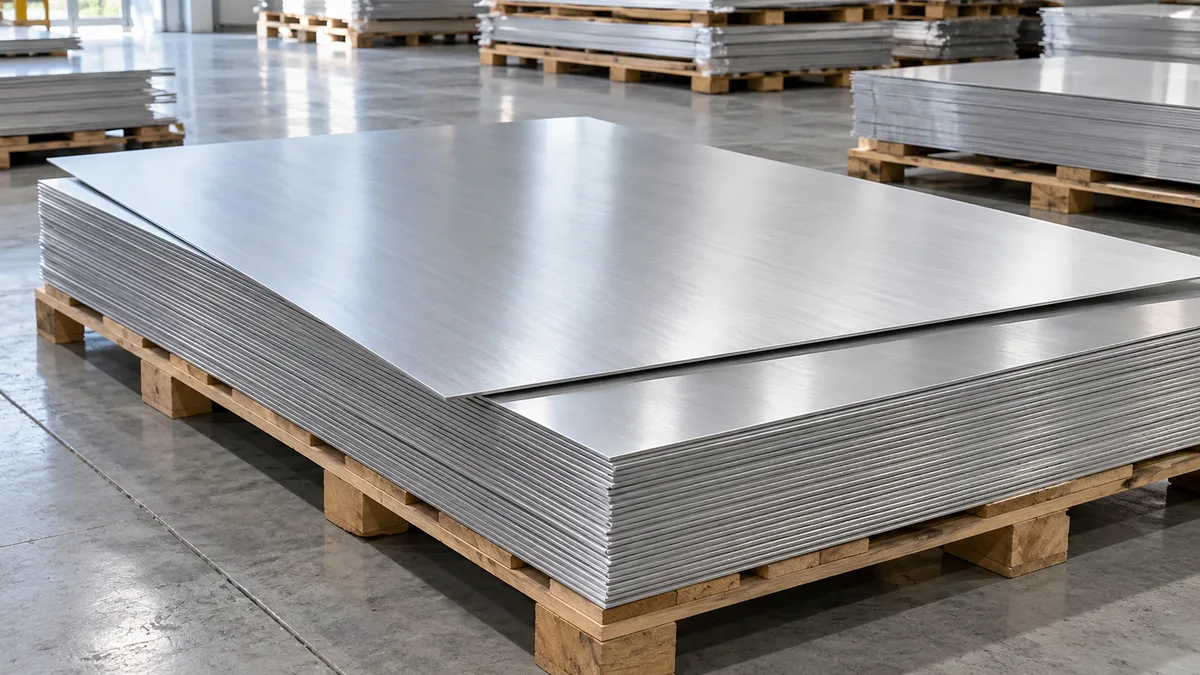
Painting aluminium after fabrication is slow and inconsistent. Coil coating paints the metal while it is still a flat strip, at high speed and under factory control, so the film thickness, cure and colour are uniform along thousands of metres.
On a coil-coating line the strip is unwound, degreased and given a chemical conversion layer (chromium-free systems are now standard in many markets) to anchor the paint and resist corrosion. A primer is roller-applied and cured, then a finish coat; the reverse side usually gets a thinner back coat. Each layer passes through an oven for a few seconds at a peak metal temperature typically above 200 °C. The coil is then cooled, optionally covered with protective film and rewound.
The result is a pre-finished material that can be slit into strip, cut into sheets, roll-formed into roofing and gutters, folded into cassette panels or bonded into composite panels, with the coating flexing with the metal.
| Alloy | Character | Typical tempers | Common uses |
|---|---|---|---|
| 1050 / 1060 / 1070 / 1100 | Commercially pure, very formable, good reflectivity | O, H14, H16, H18 | Ceilings, signage, caps, light reflectors, interior panels |
| 3003 | Al-Mn, about 20 % stronger than pure grades, good corrosion resistance | H14, H16, H24, H26 | Roofing, gutters, cladding, composite panel skins |
| 3004 / 3105 | Al-Mn-Mg, stronger and stiffer than 3003 | H24, H26, H46 | Roofing, siding, rainwater goods, closures |
| 5005 | Al-Mg, good anodising and weathering, flat appearance | H14, H24, H34 | Facade panels, architectural trim, vehicle interiors |
| 5052 | Al-Mg, high strength, excellent marine corrosion resistance | H32, H34 | Coastal cladding, transport bodies, marine panels |
For most roofing and cladding, 3003 or 3105 in a half-hard H24 or H26 temper is the economical choice. Choose 5005 when appearance flatness matters on facade panels, and 5052 for coastal and transport applications where strength and corrosion resistance justify the extra cost. Pure grades suit interiors and deeply formed parts.
| System | Typical dry film (top side) | Weathering | Flexibility | Typical uses |
|---|---|---|---|---|
| Polyester (PE) | About 18 – 25 µm | Good for interiors and moderate exteriors | Very good | Ceilings, interior panels, signage, roller shutters |
| Silicone-modified polyester (SMP) | About 20 – 25 µm | Better gloss and colour retention than PE | Good | Roofing and siding in moderate climates |
| High-durability polyester (HDP) | About 20 – 30 µm | Much better UV resistance than standard PE | Good | Roofing and cladding where PVDF is not required |
| PVDF (fluorocarbon, 70 % resin) | About 25 µm (2-coat) to 35 µm (3-coat) | Highest colour and gloss retention, chalk resistance | Very good | Facades, curtain wall panels, premium roofing, coastal sites |
| Epoxy / polyester back coat | About 5 – 10 µm | Protects the reverse side | Good | Reverse of all panels; adhesion layer for composite cores |
Film thicknesses are typical market values. The paint manufacturer's data sheet and the project specification set the actual requirement.
PVDF coatings based on 70 % fluoropolymer resin are the usual requirement where a performance standard such as AAMA 2605 (now published by FGIA) is specified for high-performance exterior architectural coatings. AAMA 2604 and 2603 describe progressively lower performance levels, which HDP and PE systems are typically designed to meet. In Europe, coil-coated aluminium sheet and strip is supplied to EN 1396, and coating performance is tested to the EN 13523 series of methods developed with the European Coil Coating Association.
Weight of painted aluminium is effectively the same as bare sheet, 2.70 kg per square metre per millimetre; paint adds only a few tens of grams per square metre.
| Thickness (mm) | kg per m² | 1220 × 2440 mm sheet (kg) | 1250 × 2500 mm sheet (kg) |
|---|---|---|---|
| 0.5 | 1.35 | 4.0 | 4.2 |
| 0.7 | 1.89 | 5.6 | 5.9 |
| 0.8 | 2.16 | 6.4 | 6.8 |
| 1 | 2.70 | 8.0 | 8.4 |
| 1.5 | 4.05 | 12.1 | 12.7 |
| 2 | 5.40 | 16.1 | 16.9 |
| 2.5 | 6.75 | 20.1 | 21.1 |
| 3 | 8.10 | 24.1 | 25.3 |
| Test | Purpose | Common method |
|---|---|---|
| Dry film thickness | Confirms the specified paint build | EN 13523-1 / ASTM D7091 |
| Gloss | Appearance consistency | EN 13523-2 / ASTM D523, at 60° |
| Colour difference ΔE | Matches the master within tolerance | EN 13523-3 / ASTM D2244 |
| Pencil hardness | Scratch resistance | EN 13523-4 / ASTM D3363 |
| Reverse impact | Adhesion and flexibility under sudden deformation | EN 13523-5 / ASTM D2794 |
| T-bend | Coating flexibility on tight bends | EN 13523-7 / ASTM D4145 |
| Cross-cut adhesion | Bond to the metal | ISO 2409 / ASTM D3359 |
| Solvent (MEK) resistance | Degree of cure | EN 13523-11 / ASTM D5402 |
| Salt spray | Corrosion resistance at edges and scribes | EN 13523-8 / ASTM B117 |
| Accelerated weathering | Colour and gloss retention under UV | EN 13523-10 / ASTM G154 |
| Boiling water, acid and alkali | Resistance to cleaning and chemical exposure | As agreed, e.g. AAMA 2605 methods |
Roll-formed profiles, standing-seam roofs, flashings, gutters and downpipes; 3003, 3105 and 5052 with SMP, HDP or PVDF.
Cassette panels and composite panel skins on public buildings, airports and stations; PVDF on 3003, 5005 or 5052.
Lay-in tiles, linear ceilings, partitions, kitchen and bathroom panels; PE on pure grades or 3003.
Sign blanks, shopfronts, billboards and exhibition panels; high-gloss PE or PVDF.
Truck and trailer bodies, caravan and RV walls, rail and bus interiors; 5052 and 3105.
Appliance housings, roller shutters, insulation jacketing and cold-room panels.
Metline supplies the coated aluminium sheet, coil and strip for these products. Fabricators and system companies form, assemble and install the finished roofing, cladding, ceilings and signage.
Polyester (PE) is economical and flexible, suited to interiors and moderate exteriors. PVDF, based on fluoropolymer resin, holds its colour and gloss far longer under sunlight and is the usual choice for facades and premium exterior work.
3003 or 3105 in H24 or H26 temper for most roofs; 5052 near the coast or where higher strength is needed.
Typically 18 – 25 µm for polyester top coats and about 25 – 35 µm for 2- and 3-coat PVDF, with a 5 – 10 µm back coat on the reverse side.
Yes, within the T-bend rating of the coating and the minimum bend radius of the alloy and temper. Form above about 10 °C and use the right tooling.
No. Composite panel bonds two thin coated aluminium skins to a polymer or mineral core. Colour coated coil is the material used for those skins, and is also used on its own as solid sheet.
Yes. Colours can be matched to RAL, Pantone or a physical sample within an agreed ΔE, subject to the paint system and minimum run size for the coating line.
Send the alloy, thickness, paint system and colour. We will reply with suitable options and a delivered quotation.





