6061-O
Annealed. Best for deep drawing, spinning and severe stamping. Parts must be solution-treated and aged afterwards to gain strength, which adds a furnace step and some distortion risk.



6061 coil is the heat-treatable aluminium-magnesium-silicon alloy in rolled, coiled form: soft enough in O and T4 temper to stamp and form, and strong after ageing to T6. Buyers use it where a part needs more strength than 5052 can give, or where formed blanks are aged after forming. Metline supplies 6061 coil, slit strip and cut-to-length sheet in O, T4 and T6 to ASTM B209, AMS and EN 485, to customers worldwide.
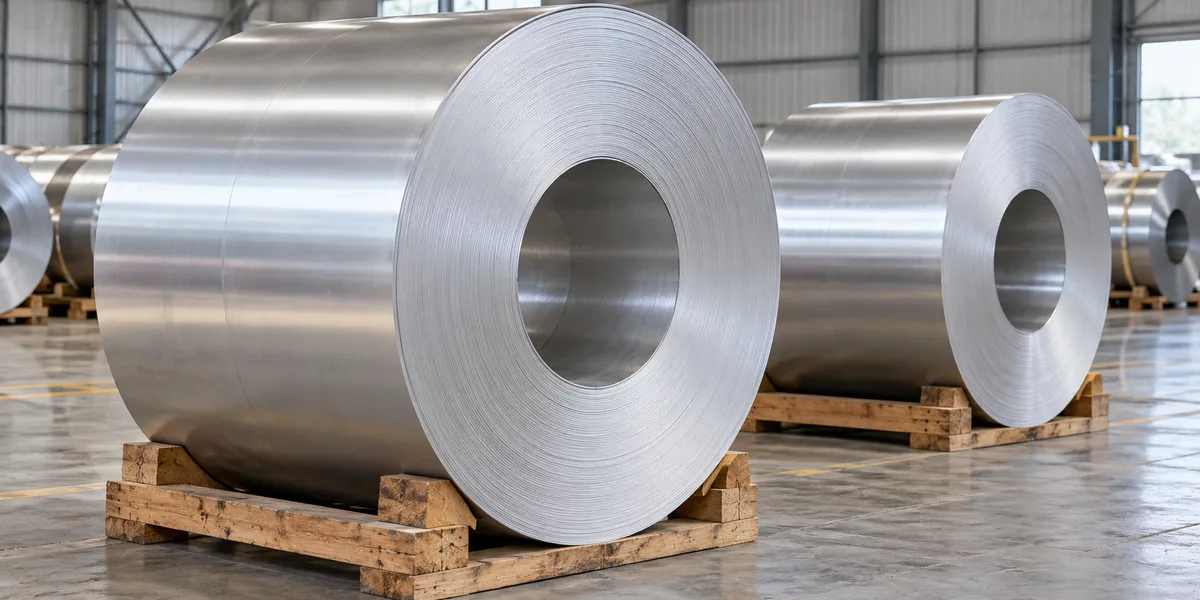
Most 6061 is sold as plate, bar and extrusions. Coil and strip are a narrower market, but an important one: they let a press shop stamp, roll-form or deep-draw a heat-treatable alloy and then age the parts to near-T6 strength.
6061 gets its strength from magnesium silicide (Mg2Si) precipitates formed during solution heat treatment and ageing, with a small copper addition that raises strength further and chromium that controls grain growth. In coil, the temper you order decides how the material behaves on your line far more than the alloy number does.
O-temper (annealed) coil is the softest and forms almost like 5052-O, though it is weaker. T4 coil has been solution-treated and naturally aged; it is noticeably stronger but still bends well, and it will reach T6-level strength if your formed parts are artificially aged at about 160 – 175 °C. T6 coil is fully aged and strongest, but it bends poorly and is mostly used flat or with generous radii. The certification of a part that you age yourself is normally T62 or T42, which tells the inspector that the temper was produced by the user rather than the mill.
| Element | Minimum | Maximum |
|---|---|---|
| Silicon (Si) | 0.40 | 0.8 |
| Iron (Fe) | — | 0.7 |
| Copper (Cu) | 0.15 | 0.40 |
| Manganese (Mn) | — | 0.15 |
| Magnesium (Mg) | 0.8 | 1.2 |
| Chromium (Cr) | 0.04 | 0.35 |
| Zinc (Zn) | — | 0.25 |
| Titanium (Ti) | — | 0.15 |
| Others, each / total | — | 0.05 / 0.15 |
| Aluminium (Al) | Remainder |
Aluminum Association registered limits, also used in ASTM B209 and EN 573-3 (EN AW-6061 / EN AW-AlMg1SiCu).
| Temper | Tensile (typical) | Yield (typical) | Elongation (typical) | ASTM B209 minimum (tensile / yield) |
|---|---|---|---|---|
| O | 125 MPa | 55 MPa | 25 % | 152 MPa max tensile; 83 MPa max yield |
| T4 / T42 | 240 MPa | 145 MPa | 22 % | 207 / 110 MPa |
| T6 / T62 | 310 MPa | 275 MPa | 12 % | 290 / 240 MPa |
Typical values from Aluminum Association and ASM data. ASTM B209 minimums shown are for sheet in the common thickness range; elongation minimums depend on gauge (for T6, 8 % below 0.50 mm and 10 % from 0.50 mm). O temper is specified by maximum, not minimum, strength. The 3.1 certificate gives the result for your lot.
Annealed. Best for deep drawing, spinning and severe stamping. Parts must be solution-treated and aged afterwards to gain strength, which adds a furnace step and some distortion risk.
Solution-treated and naturally aged. The usual choice for formed parts that will be aged later: it bends to roughly 1 – 2 × thickness in thin gauges and ages to T62 at about 160 – 175 °C for 8 – 18 hours.
Fully aged; highest strength. Use for flat blanks, gentle bends and machined strip. Minimum bend radii are much larger than in T4, and cracks appear on tight bends across the grain.
Tempers produced by the user from O or T4 material. Specify these when your drawing or inspector needs to know who did the heat treatment.
A practical tip: T4 strip continues to age slowly at room temperature, so plan to form it within a reasonable time of receipt. If a long gap is unavoidable, ask us about storage and test the bend radius on a sample before running production.
| System | Designation | Product standard |
|---|---|---|
| Aluminum Association / ASTM | 6061 | ASTM B209 / B209M (ASME SB-209) |
| UNS | A96061 | — |
| Aerospace (SAE AMS) | 6061-O / T4 / T6 | AMS 4025 (O), AMS 4026 (T4), AMS 4027 (T6) |
| European (EN) | EN AW-6061 / EN AW-AlMg1SiCu | EN 485-1/-2/-4, EN 573-3 |
| German Werkstoff | 3.3211 | DIN EN 485 |
| ISO | AlMg1SiCu | ISO 6361 |
| Japan (JIS) | A6061P | JIS H4000 |
| China (GB) | 6061 | GB/T 3880 |
| India (IS) | 65032 (nearest) | IS 737 |
Quote the standard and edition on your purchase order. An alloy number alone does not define tolerances, test frequency or temper limits, and EN 485-2 and ASTM B209 minimums differ slightly at some thicknesses.
Approximate weight of a 6061 coil wound on a 508 mm core, at 2.70 g/cm³:
| Coil width (mm) | OD 1000 mm (kg) | OD 1200 mm (kg) | OD 1500 mm (kg) |
|---|---|---|---|
| 500 | 787 | 1253 | 2112 |
| 1000 | 1573 | 2506 | 4224 |
| 1250 | 1967 | 3133 | 5280 |
| 1500 | 2360 | 3760 | 6336 |
Linear weight of strip is simpler: kg per metre = thickness (mm) × width (mm) × 0.0027. A 1.5 mm × 100 mm strip weighs 0.405 kg/m.
Thickness, width and flatness tolerances follow ANSI H35.2 when ordered to ASTM B209, or EN 485-4 for cold-rolled strip in Europe. Heat-treated strip carries more residual stress and shape than non-heat-treatable coil, because it has been quenched; tension levelling after heat treatment improves flatness and is worth requesting for blanks that must lie flat on a press bed or fixture.
| Check | Method | Reported on |
|---|---|---|
| Chemistry | Spectrometer analysis of the cast | EN 10204 3.1 certificate |
| Tensile, yield, elongation | Per lot to ASTM B557 or EN ISO 6892-1 | EN 10204 3.1 certificate |
| Temper confirmation | Conductivity or hardness check where required | Inspection report on request |
| Dimensions | Thickness gauge, width and edge camber | Inspection report |
| Surface | Visual inspection for scratches, roll marks, stains | Packing list remarks |
Form in O or T4 and age afterwards when strength matters. In T6, use bend radii of several times thickness and bend across rather than along the rolling direction where possible.
TIG and MIG with ER4043 or ER5356 filler. The heat-affected zone of T6 drops towards T4-level strength, so design welded joints with welded-condition allowables or re-heat-treat the assembly.
T6 machines well with sharp carbide tools; O and T4 tend to smear and form built-up edge.
Anodises well (clear and colour), and takes paint and powder coat after conversion coating. Avoid 4043-welded areas on parts that will be anodised, as they darken.
| Property | 5052-H32 | 6061-T6 | 6082-T6 | 7075-T6 |
|---|---|---|---|---|
| Typical tensile strength | 230 MPa | 310 MPa | 340 MPa | 570 MPa |
| Formability in supplied temper | Very good | Limited | Limited | Poor |
| Heat-treatable | No | Yes | Yes | Yes |
| Seawater resistance | Excellent | Good | Good | Fair |
| Weldability | Very good | Good | Good | Not for fusion welding |
If a part only needs moderate strength and plenty of forming, 5052 is simpler because there is no ageing step. 6082 is the European counterpart of 6061 and slightly stronger. See 6061 vs 6082 for a detailed comparison.
It is available in coil and slit strip, mainly in thinner gauges and in O and T4 tempers. T6 is supplied in coil for thin gauges, but much T6 material is sold as cut sheet because the fully aged alloy is stiff to recoil.
If the part has tight bends, buy T4 and age the formed parts to T62 at about 160 – 175 °C. If the part is flat or only gently bent, T6 saves you a heat-treatment step.
Both are solution-treated and artificially aged. T6 is produced by the mill; T62 is produced by the user from O or T4 material, and the minimum properties are similar.
Weight = width × π/4 × (OD² − ID²) × 2.70 g/cm³. A 1000 mm wide coil with a 1200 mm OD on a 508 mm core weighs about 2.5 tonnes.
Yes, with ER4043 or ER5356 filler. Expect lower strength next to the weld in T6 material unless the assembly is heat-treated again.
An EN 10204 3.1 mill test certificate with chemical analysis and tensile results for the lot, traceable to the coil numbers.
Send thickness, width, temper, coil size and destination. We will confirm availability and quote a delivered price.





