Smooth (mill finish)
Clean, bright appearance, the lowest cost and easy to keep clean. Shows dents and scratches more than textured finishes.



Aluminium jacketing coil is thin sheet, usually 0.4 – 0.8 mm, that is wrapped over thermal insulation on pipes, vessels, ducts and tanks to keep out rain, protect the insulation from damage and give a clean finish. The usual specification is 3003 or 3105 in H14 temper with a factory-laminated moisture barrier, classified under ASTM C1729. This guide explains how to choose alloy, thickness, surface and barrier, and how to store the coils so they arrive and stay in good condition.
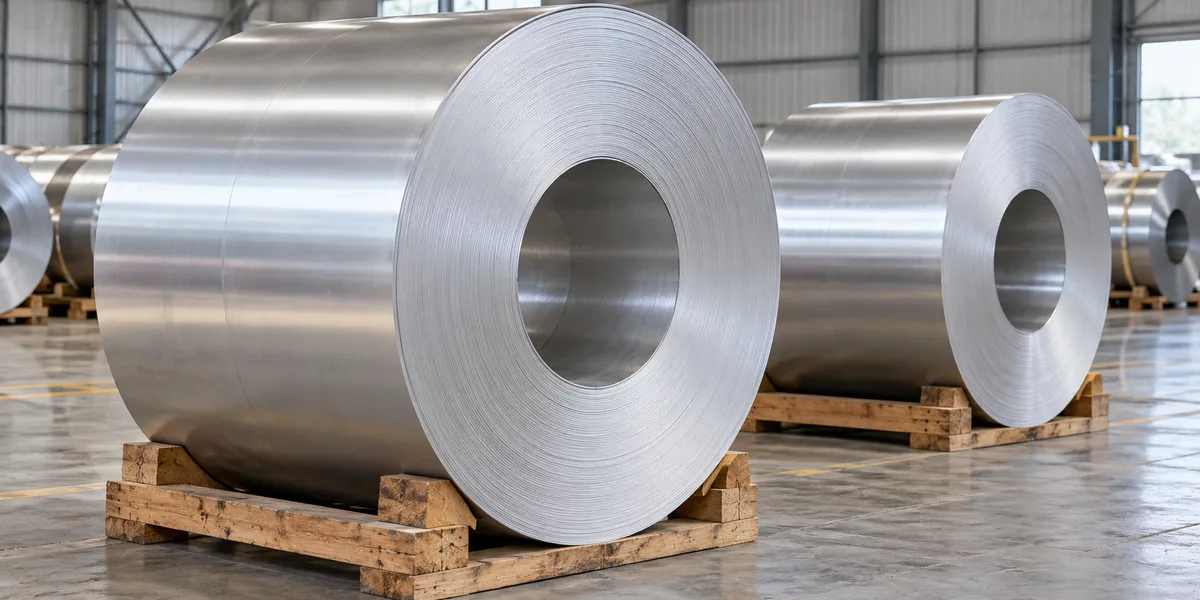
Insulation only works while it stays dry. Mineral wool, calcium silicate, cellular glass and foam insulations lose much of their thermal value when wet, and water trapped against a hot or cold steel pipe drives corrosion under insulation (CUI), one of the costliest maintenance problems in refineries, chemical plants and power stations.
The jacket is the weather barrier. It sheds rain and wash-down water, resists foot traffic, ladders and tools, blocks ultraviolet light that degrades foam, and gives the plant a uniform, easy-to-inspect surface. Aluminium is the most common jacketing metal because it is light, easy to cut and roll on site, resists atmospheric corrosion well and costs less than stainless steel. Stainless jacketing is generally reserved for fire-rated systems and areas with specific chemical exposure, because aluminium melts at about 660 °C.
Jacketing coil is bought in rolls and either cut and rolled on site, or pre-formed in a workshop into cylinders, elbow gores and end caps. Metline supplies the aluminium coil and sheet; insulation contractors carry out fabrication and installation.
Outer diameter follows the roll weight requested; small site rolls are often coreless.
| Alloy | Character | Where it fits |
|---|---|---|
| 1100 / 1050 / 1060 | Commercially pure, very formable, lowest cost | Indoor and light-duty jacketing, buildings, sheltered pipework |
| 3003 | Al-Mn; about 20 % stronger than 1100, good corrosion resistance | Standard industrial pipe and equipment jacketing |
| 3105 | Al-Mn-Mg; slightly stronger than 3003, takes paint well | Standard jacketing and painted jacketing; widely specified with 3003 |
| 5005 | Al-Mg; good anodising and corrosion resistance | Architectural or visible jacketing, coastal sites |
| 5052 | Al-Mg; highest strength and seawater resistance of the group | Marine and offshore jacketing, high-abuse areas |
ASTM C1729 is the North American specification for aluminium jacketing used over thermal insulation, and it is increasingly quoted on international projects. It classifies jacketing by three choices, so a specification line reads like "Type I, Grade 1, Class A".
| Classification | What it defines | Examples |
|---|---|---|
| Type | Outer surface treatment and emittance | Bare (mill finish or embossed) or painted outer surface |
| Grade | Alloy and temper, which must meet ASTM B209 | e.g. 3003 or 3105 in H14; heavier-duty H12 versions |
| Class | Interior moisture retarder | e.g. polyfilm moisture barrier, polykraft, or other retarders |
A widely used default is bare 3003 or 3105-H14 with a 3 mil polyfilm moisture barrier at about 0.016 – 0.024 in (0.40 – 0.60 mm). Thicker jacketing, around 0.032 in (0.80 mm) and above, is used on large diameters, soft (non-rigid) insulation that cannot support the jacket, and areas exposed to impact or foot traffic. Check the thickness table in the current edition of the standard and in the project specification, which may be stricter.
ASTM C1729 also covers emittance, because the surface finish affects the jacket's surface temperature; see the emittance note below.
Clean, bright appearance, the lowest cost and easy to keep clean. Shows dents and scratches more than textured finishes.
An orange-peel pattern that hides minor handling marks, reduces glare and slightly stiffens the sheet. Very common on process pipework and equipment.
Small or deep corrugations add stiffness for large vessels, tanks and ducts, and allow for thermal movement around large diameters.
Coil-coated colours for identification, appearance or higher surface emittance. Specify colour, paint system and film thickness.
A thin coextruded polyethylene / Surlyn film heat-laminated to the inside face. Blocks crevice and pitting corrosion on the jacket's inner surface and isolates it from the pipe; absorbs almost no water.
Kraft paper with a polyethylene layer. Low cost and a long track record, but the paper can absorb water and deteriorate if the jacket leaks, so polyfilm is preferred outdoors.
Why a moisture barrier matters: condensation or rain that gets behind the jacket can sit against the bare inner face, especially on cold lines and at overlaps. Without a barrier, aluminium in contact with wet insulation containing chlorides, or with a steel pipe, can pit or corrode galvanically. Most specifications now call for a factory-applied polyfilm barrier on all outdoor aluminium jacketing. For more on textured finishes see our stucco embossed coil guide.
Bare aluminium reflects most infrared radiation, which means it also radiates heat poorly: its emittance is low compared with painted surfaces. On a hot line, a bare aluminium jacket therefore runs at a higher surface temperature than a painted or dull jacket over the same insulation, while heat loss changes only slightly. This matters when insulation is sized for personnel protection (keeping touchable surfaces below a safe temperature) or for condensation control on cold lines.
Insulation thickness calculations, for example to ASTM C680, use the emittance of the jacket as an input. If the calculation assumed a painted jacket and the site installs bare aluminium, surface temperatures can be higher than designed. Stating the jacket finish in the insulation calculation avoids this.
Aluminium sheet weighs about 2.71 kg per m² per millimetre of thickness. The table gives calculated metal weights for 100 ft (30.48 m) rolls; a moisture barrier adds a small amount.
| Thickness (mm) | Approx. (in) | kg per m² | 914 mm × 30.48 m roll (kg) | 1219 mm × 30.48 m roll (kg) |
|---|---|---|---|---|
| 0.40 | 0.016 | 1.08 | 30.2 | 40.3 |
| 0.50 | 0.020 | 1.35 | 37.7 | 50.3 |
| 0.60 | 0.024 | 1.63 | 45.3 | 60.4 |
| 0.80 | 0.032 | 2.17 | 60.4 | 80.6 |
| 1.00 | 0.040 | 2.71 | 75.5 | 100.7 |
Use the sheet weight calculator for other sizes. On site, allow for overlaps (commonly about 50 mm on longitudinal and circumferential seams) when estimating area.
The main risk to aluminium jacketing in transit and storage is water staining ("white rust"): moisture trapped between tightly wound wraps forms a white or grey oxide stain that cannot be polished out. It is a surface defect, but it spoils the appearance of a new installation.
Price for jacketing is built up from the aluminium price (LME plus regional premium), conversion cost for the thickness and temper, any embossing, corrugating, painting and moisture barrier, packing, and freight to the destination.
About 0.40 – 0.60 mm (0.016 – 0.024 in) is typical for pipe and small equipment over rigid insulation. Use about 0.80 mm (0.032 in) or more for large diameters, soft insulation and areas with impact or foot traffic, and follow the project specification.
3003 or 3105 in H14 temper is the usual industrial choice. 1100 suits light-duty indoor work; 5005 and 5052 are used for coastal, marine or visible applications.
For outdoor work and cold or hot lines, yes. A factory-laminated polyfilm barrier prevents crevice, pitting and galvanic corrosion on the jacket's inner face and is called for by most current specifications.
Smooth jacketing has a bright, flat finish. Stucco embossed has an orange-peel texture that hides handling marks, reduces glare and is slightly stiffer.
No. Aluminium melts at about 660 °C, so where a jacket must survive a fire, stainless steel jacketing or a fire-rated system is normally specified instead.
Keep rolls dry, sealed and ventilated, avoid condensation from temperature changes, and re-wrap opened rolls. Water staining forms when moisture is trapped between wraps.
Send alloy, temper, thickness, width, surface, moisture barrier and quantities. We will confirm the specification and a delivered price.





