O (annealed)
Fully soft for deep drawing and spinning: pots, pans, lamp reflectors, containers.



3003 aluminium coil is rolled from the aluminium-manganese alloy that is about 20 % stronger than pure 1100 aluminium while keeping its excellent formability, corrosion resistance and brazeability. It is the standard coil for heat-exchanger fins and tubes, cookware, roofing, ductwork and insulation cladding. Metline supplies 3003 coil and slit strip from soft O to full-hard H18 tempers, to ASTM B209 and EN 485, worldwide.
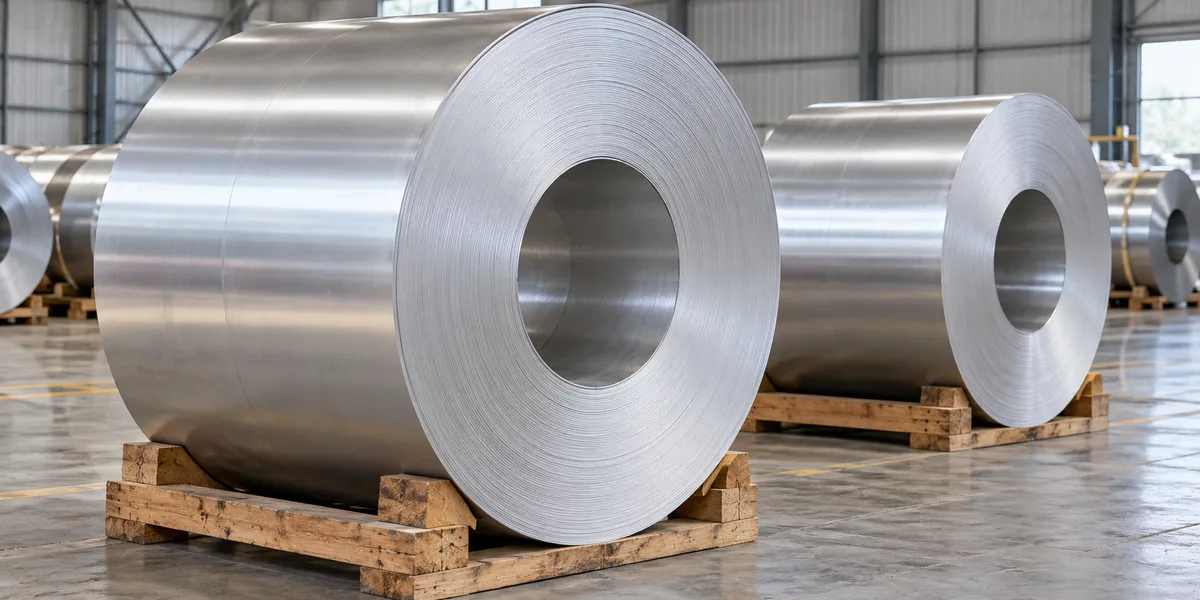
3003 is the most widely used of the non-heat-treatable 3xxx alloys. About 1.2 % manganese, with a little copper, strengthens the aluminium by solid solution and fine dispersoids, without sacrificing the ductility that makes pure aluminium easy to draw, spin and bend.
The result is a coil that forms almost as easily as 1100 but is noticeably stronger, resists atmospheric and fresh-water corrosion, and takes paint, anodising and roll-coating well. Because its melting range (about 643 – 654 °C) sits comfortably above aluminium brazing temperatures, 3003 is also the classic core alloy for brazed heat exchangers and the base for clad brazing sheet.
Strength comes from cold rolling, so the temper you order sets the balance between strength and formability: O is fully soft for deep drawing, H14 is half-hard for general sheet-metal work and fins, and H18 is full-hard for stiff, flat parts that are not bent tightly.
| Element | Minimum | Maximum | Role |
|---|---|---|---|
| Silicon (Si) | — | 0.6 | Impurity |
| Iron (Fe) | — | 0.7 | Impurity; forms Al-Fe-Mn particles |
| Copper (Cu) | 0.05 | 0.20 | Adds strength, makes corrosion more uniform |
| Manganese (Mn) | 1.0 | 1.5 | Main strengthening element |
| Zinc (Zn) | — | 0.10 | Impurity |
| Others, each / total | — | 0.05 / 0.15 | |
| Aluminium (Al) | Remainder | About 96.8 – 99 % |
Aluminum Association registered limits, followed by ASTM B209 and EN 573-3 (EN AW-3003 / EN AW-AlMn1Cu).
| Temper | Tensile strength (typical) | Yield strength (typical) | Elongation (typical) | Typical use |
|---|---|---|---|---|
| O | 110 MPa | 40 MPa | 30 – 40 % | Deep drawing, spinning, cookware |
| H12 / H22 | 130 MPa | 125 MPa | 10 – 15 % | Moderate forming |
| H14 / H24 | 150 MPa | 145 MPa | 8 – 12 % | General sheet metal, fins, ducting |
| H16 / H26 | 175 MPa | 170 MPa | 5 – 8 % | Stiffer panels, roofing |
| H18 | 200 MPa | 185 MPa | 4 – 5 % | Flat, stiff parts; fin stock |
Typical values from the Aluminum Association and ASM; specified minimums in ASTM B209 and EN 485-2 vary with thickness (e.g. EN 485-2 gives H14 tensile 145 – 185 MPa). Elongation is lower for thin gauges.
In H1x tempers (H12, H14, H16, H18) the coil is cold-rolled straight to the required hardness. In H2x tempers (H22, H24, H26) it is rolled harder and then partially annealed back to the same strength. H2x coil has a little more elongation at the same strength, so it bends and stretches better; H1x is slightly flatter and cheaper. For fins and roll-formed profiles, both are used; if you have had cracking at bends with H14, try H24.
Fully soft for deep drawing and spinning: pots, pans, lamp reflectors, containers.
The default general-purpose temper for ducting, insulation jacketing, signs, tanks and fins.
Higher stiffness for roofing and cladding sheet, trailer and truck panels.
Full hard for fin stock, packaging and parts that stay flat.
| System | Designation | Product standard |
|---|---|---|
| Aluminum Association / ASTM | 3003 | ASTM B209 (ASME SB-209) |
| UNS | A93003 | — |
| European (EN) | EN AW-3003 / EN AW-AlMn1Cu | EN 485-1/-2/-4, EN 573-3 |
| German Werkstoff | 3.0517 | DIN EN 485 |
| ISO | AlMn1Cu | ISO 6361 |
| Japan (JIS) | A3003P | JIS H4000 |
| China (GB) | 3003 (formerly close to 3A21) | GB/T 3880 |
| India (IS) | 31000 | IS 737 |
Approximate weight of a 3003 coil on a 508 mm core, at a density of 2.73 g/cm³. Use the coil weight calculator for exact figures.
| Coil width (mm) | OD 1000 mm (kg) | OD 1200 mm (kg) | OD 1500 mm (kg) |
|---|---|---|---|
| 500 | 795 | 1267 | 2135 |
| 1000 | 1591 | 2534 | 4271 |
| 1250 | 1989 | 3168 | 5339 |
| 1500 | 2386 | 3801 | 6406 |
O temper can be bent flat on itself; H14 bends to about 0 – 1 × thickness for thin gauges. Spinning, deep drawing and roll forming are all routine.
Melting range is well above the 577 – 600 °C used for Al-Si brazing, so 3003 is the standard core alloy and tube alloy for brazed heat exchangers.
Readily welded by TIG and MIG with ER1100 or ER4043 filler. The heat-affected zone softens to O-temper strength.
Paints and roll-coats well. Anodised finishes are protective but slightly grey because of the manganese; use 5005 or 1050 for decorative anodising.
| Property | 1100 H14 | 3003 H14 | 3105 H14 | 5052 H32 |
|---|---|---|---|---|
| Typical tensile strength | 125 MPa | 150 MPa | 170 MPa | 230 MPa |
| Formability | Excellent | Excellent | Very good | Good |
| Corrosion resistance | Excellent | Very good | Very good | Excellent (marine) |
| Thermal conductivity | 218 W/m·K | 159 W/m·K | 172 W/m·K | 138 W/m·K |
| Typical use | Chemical, electrical | Fins, cookware, ducting | Building products, caps | Marine, tanks, panels |
Choose 1100 or 1050 where maximum conductivity or purity matters; 3003 for the best all-round balance; 5052 when you need clearly more strength or seawater resistance.
Both have about the same strength. H14 is cold-rolled directly to half-hard; H24 is rolled harder and then partially annealed, which gives a little more elongation and better bendability.
Yes. 3003-O is widely used for pots, pans and baking trays because it draws and spins well, is stronger than pure aluminium and resists corrosion from most foods.
Yes, for protection, but the film is slightly grey and less uniform than on 1050 or 5005. For decorative anodising choose an anodising-quality grade.
Weight = width × π/4 × (OD² − ID²) × 2.73 g/cm³. A 1000 mm wide coil with 1200 mm OD on a 508 mm core weighs about 2.5 tonnes.
3A21 is a Chinese grade close to 3003 but without the copper addition. The two are often interchangeable in non-critical uses; check the specification.
It resists marine atmospheres reasonably well, but for immersion or structural marine use 5052 or 5083 is better.
Send thickness, width, temper, coil size and destination. We will confirm availability and quote a delivered price.





