Hydrophilic coating
A thin water-loving layer (often blue or clear) that spreads condensate into a film so it drains instead of bridging between fins. Improves airflow, reduces noise and odour on evaporators.



Aluminium fin stock is thin strip, usually 0.05 – 0.4 mm, that heat-exchanger makers stamp or roll into fins to carry heat from tubes into air. Mechanically expanded HVAC coils use 1100, 1200, 8011 or 3102 fin, often with a hydrophilic or anti-corrosion coating; brazed automotive and micro-channel exchangers use zinc-bearing 3003-type fin, bare or clad. Metline supplies slit fin stock to EN 683 and ASTM B209 for coil makers worldwide.
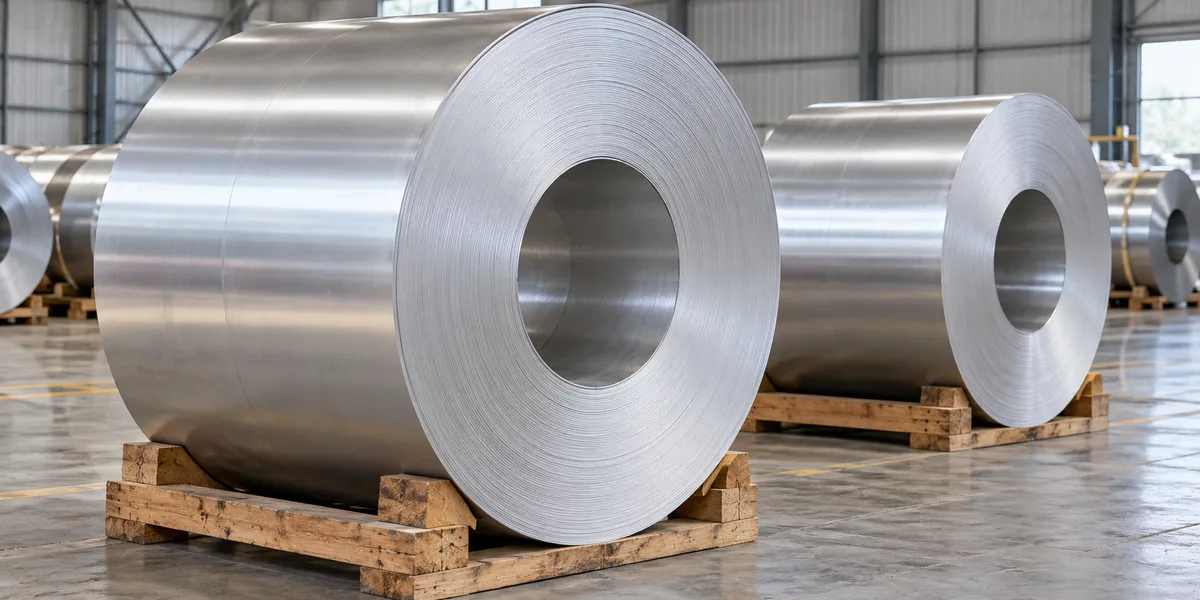
In an air-conditioner or radiator, most of the heat-transfer area is in the fins, not the tubes. Fins are thin, so a small change in gauge, temper or coating changes the coil's weight, cost and efficiency. Fin stock is therefore made to tight gauge, flatness and formability limits.
There are two main construction types. In mechanically expanded (tube-and-fin) coils, used in room air-conditioners, chillers and refrigeration, fins are stamped with collars on a high-speed press, stacked, and copper or aluminium tubes are pushed through and expanded to grip them. The fin must stretch into tall collars without cracking, so formability and a consistent temper matter most. In brazed exchangers, used in car radiators, condensers, charge-air coolers and micro-channel coils, corrugated fins are brazed to flat tubes in a furnace at around 600 °C. The fin must keep its shape at brazing temperature (sag resistance), have good strength after brazing, and be slightly anodic to the tube so it corrodes first and protects it.
Choosing fin stock is a balance between thermal conductivity, strength, formability, corrosion behaviour and cost. Pure 1xxx alloys conduct best; 3xxx and 8xxx alloys are stronger; zinc additions make fins sacrificial.
| Alloy | Typical tempers | Properties | Uses |
|---|---|---|---|
| 1100 / 1200 / 1050A | O, H22, H24, H26 | Highest conductivity, very formable | Room AC and refrigeration coils |
| 8011 | O, H22, H24, H26 | Stronger than 1100, good collar forming | AC evaporator and condenser fins, most common HVAC fin |
| 8006 | O, H22, H24 | Higher strength with good formability | Thin fins and containers |
| 3102 | H22, H24, H26 | Low-Mn, good conductivity and brazeability | Micro-channel and brazed HVAC fins |
| 3003 + Zn (modified) | H14, H24 | Sacrificial, sag-resistant after braze | Automotive radiators, condensers, charge-air coolers |
| Clad fin (4343 / 4045 on 3xxx) | H14, H24 | Braze filler on the fin surface | Brazed exchangers with bare tubes |
| 7072 clad / 7072 fin | H14, H18 | Zn-bearing, strongly anodic | Sacrificial cladding and fins |
Tempers matter more than usual. H22, H24 and H26 fins are strain hardened and partly annealed, giving a combination of strength and elongation that supports high collar drawing. Full-soft O temper is used for very deep collars or slit-and-louvre designs. For brazed fins, H14 or H24 starting tempers are chosen to give the right recrystallised grain structure and sag resistance after the braze cycle.
| Alloy and temper | Tensile strength | Elongation | Note |
|---|---|---|---|
| 1100-O | 75 – 105 MPa | ≥ 20 % | For very deep collars |
| 1100-H22 / 8011-H22 | 100 – 140 MPa | ≥ 15 – 20 % | High-collar stamped fins |
| 8011-H24 | 120 – 160 MPa | ≥ 8 – 12 % | General AC fin |
| 8011-H26 | 140 – 180 MPa | ≥ 4 – 6 % | Thin, stiff flat fins |
Indicative ranges for gauges around 0.10 – 0.15 mm; EN 683-2 gives specified limits by alloy, temper and thickness. Exact values should be agreed with your fin press and die design.
We confirm the alloy, temper, gauge, width and coating with each quotation.
A thin water-loving layer (often blue or clear) that spreads condensate into a film so it drains instead of bridging between fins. Improves airflow, reduces noise and odour on evaporators.
Epoxy or polyester coating for coastal, industrial or chemical atmospheres, often combined with a hydrophilic top layer.
Used for condensers and dry coils, and for all brazed fins where coatings would burn off.
| Check | Why it matters |
|---|---|
| Gauge and profile | Controls fin weight, pitch and heat-transfer area |
| Elongation and cup tests | Predicts collar cracking on stamped fins |
| Flatness and edge quality | Waves and burrs jam fin presses and fin mills |
| Surface cleanliness | Residual oil affects coating adhesion and press lubrication |
| Hydrophilic performance | Water contact angle, initially and after durability cycles |
| Coating adhesion and weight | Ensures coatings survive stamping and service |
| Post-braze strength and sag | For brazed fins: shape retention and strength after the furnace cycle |
| Corrosion potential | Fins must be anodic to tubes; verified by potential measurement or SWAAT tests |
| Standard | Scope |
|---|---|
| EN 683-1 / -2 / -3 | Finstock: delivery conditions, mechanical properties, tolerances (60 – 400 µm) |
| ASTM B209 | Sheet and strip properties for fin alloys ordered to ASTM |
| EN 573-3 | Chemical composition of wrought alloys |
| ASTM G85 Annex A3 (SWAAT) | Corrosion testing of brazed heat exchangers |
| EN 10204 | Type 3.1 inspection certificate |
8011 and 1100 (or 1200) in H22, H24 or H26 temper are the most common for stamped AC fins, typically 0.09 – 0.15 mm thick, often with hydrophilic coating on evaporators.
It makes condensed water spread into a thin film and drain away instead of forming droplets that bridge the fin gaps. That keeps airflow and heat transfer high and reduces noise, odour and water carry-over.
Zinc makes the fin electrochemically more active than the tube, so the fin corrodes preferentially and protects the thin tube wall from pitting leaks.
During brazing at around 600 °C, thin fins can soften and droop. Sag-resistant fin alloys and tempers keep their shape so fins stay bonded to the tubes at the right pitch.
EN 683 covers wrought aluminium finstock from 60 µm to 400 µm thick. Coated strip is outside its scope and is specified separately.
Send the alloy, temper, gauge, width, coating and monthly quantity. We will reply with availability, certification and a delivered price.





