Gauge and tolerance
Packaging lines are set to the micron. Specify nominal gauge, tolerance band and how it is measured: micrometer for sheet, weighing (g/m²) for foil.



Packaging aluminium is bought for what it does on a converting line and on a shelf: how it draws, irons, seals, prints and protects the product. The alloy is only the starting point. A complete specification fixes the temper, gauge and tolerance, surface condition, coating or laminate, and the food-contact or pharmaceutical evidence for the finished material system.
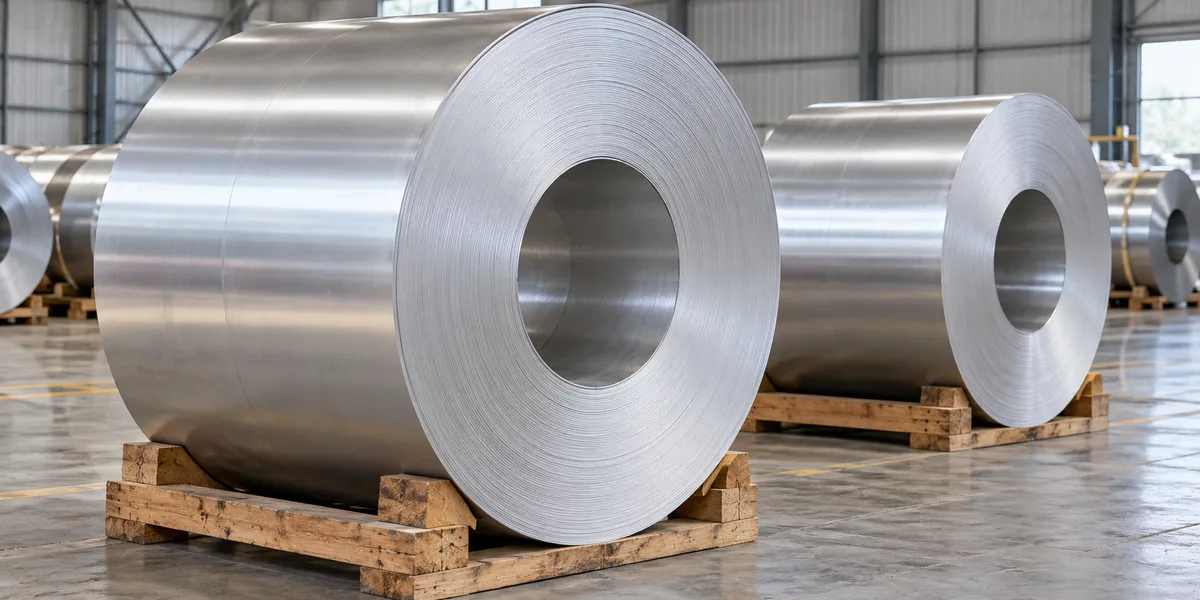
Aluminium is used in packaging because it is a complete barrier to light, oxygen and moisture at foil gauges, it forms into deep shapes at high speed, and it is infinitely recyclable. Each of those benefits depends on choosing the right alloy-temper-gauge combination for one specific process.
A beverage can body is drawn and wall-ironed from about 0.25 mm sheet at more than a thousand cans a minute; any inclusion, earing imbalance or gauge variation shows up as tear-offs on the bodymaker. A blister lid is pushed through by a patient's thumb, so it must be hard and brittle enough to rupture cleanly. A chocolate wrap needs dead-fold, staying where it is folded without springing back. These are different products even when two of them share an alloy number.
For food and drug contact, the base metal is rarely the part that touches the product. Lacquers, heat-seal coatings, adhesives and polymer films sit between the aluminium and the contents, and regulatory acceptance must be shown for that complete construction.
| Application | Common alloys | Usual temper | Typical gauge | What matters most |
|---|---|---|---|---|
| Beverage can body | 3104 | H19 (or equivalent) | ≈ 0.22 – 0.28 mm | Low earing, cleanliness, ironability |
| Can ends and tabs | 5182 (5052 for some food ends) | H19 / H48 | ≈ 0.20 – 0.25 mm | Strength for down-gauging, score integrity |
| Screw caps and ROPP closures | 8011, 3105 | H14 – H16, often pre-lacquered | ≈ 0.20 – 0.25 mm | Drawability, lacquer adhesion, print |
| Food containers and trays | 3003, 8011, 3004 | H22 – H24 or O | ≈ 30 – 200 µm | Wrinkle-free forming, rigidity |
| Household foil | 8011, 8079, 1235 | O (soft) | ≈ 9 – 25 µm | Strength and pinhole level |
| Flexible laminates (pouches, sachets) | 1235, 8079, 8011 | O | ≈ 6 – 12 µm | Pinholes, wettability, lamination bond |
| Pharma blister lidding | 8011, 8021 | H18 (hard) | ≈ 20 – 30 µm | Push-through, heat-seal lacquer |
| Cold-form blister base | 8021, 8079 | O | ≈ 45 – 60 µm | Elongation and formability in the laminate |
| Collapsible tubes, aerosol cans | 1050, 1070 slugs | Annealed slug | Slug thickness to design | Impact-extrusion ductility, purity |
Gauges are typical industry ranges for orientation, not specification limits. Converters set the final gauge to their tooling and package design.
| Standard or rule | What it covers |
|---|---|
| EN 541 | Rolled aluminium 0.150 – 0.500 mm for rigid cans, closures, lids and tabs: alloys, tempers, tolerances |
| EN 546 (parts 1 – 4) | Aluminium foil: delivery conditions, mechanical properties, dimensional tolerances, special properties such as wettability and pinholes |
| EN 602 | Chemical composition limits for wrought aluminium semi-finished products used in food-contact articles |
| EN 573-3 | Chemical composition of the alloys themselves |
| ASTM B479 | Annealed aluminium and aluminium-alloy foil for flexible barrier, food-contact and other applications |
| ASTM B209 | Sheet and plate, used for heavier packaging stock in US orders |
| Regulation (EC) 1935/2004 | EU framework for food-contact materials; supported by the Council of Europe technical guide for metals and alloys |
| US FDA 21 CFR | Coatings and adhesives used on food-contact aluminium (e.g. 175.300 resinous coatings) |
Packaging standards revise regularly, and EN 602 in particular has been under revision, so state the edition you require. For pharmaceutical foil, the drug-master file or pharmacopoeia requirements of your market sit on top of the material standard.
Packaging lines are set to the micron. Specify nominal gauge, tolerance band and how it is measured: micrometer for sheet, weighing (g/m²) for foil.
Tensile strength, proof strength and elongation for the temper; for can stock, earing percentage measured on a drawn cup.
Bright one side or both, degreased, wettability class for printing or lamination (often tested with water or brush methods).
Very thin foil contains microscopic pinholes; specify a maximum count per m² for the gauge, or rely on lamination for the barrier.
Lacquer type, weight (g/m²) and cure; heat-seal lacquer compatible with the container material (PVC, PP, PET).
Inner core diameter, outer diameter or coil weight, splice limits and winding tension to suit the slitter and converter.
Metline supplies aluminium sheet, coil and foil for packaging converters worldwide, slit to width and packed for export, with mill test certificates for each lot. Coated, printed and laminated stock is sourced to the customer's specification.
Can bodies are made from 3104 sheet in a hard temper, and the ends and tabs from 5182, which is stronger and allows thinner gauges. Both are supplied as coil to the can maker.
Both are aluminium-iron-silicon foil alloys. 8079 typically gives higher elongation and fewer pinholes at very thin gauges, which suits flexible laminates; 8011 is the general-purpose alloy for household, container, lidding and closure stock.
Aluminium foil and containers are widely accepted for food contact. Compliance is demonstrated for the finished material, including any lacquer or laminate, under rules such as Regulation (EC) 1935/2004; the metal composition is controlled by standards such as EN 602.
Push-through lidding foil is usually about 20 – 30 µm in hard temper with a heat-seal lacquer; cold-form base foil is thicker, around 45 – 60 µm in soft temper, laminated between polymer films.
At a few microns thick, tiny particles and rolling defects can pass right through the foil. The number falls sharply as gauge increases, and laminating with polymer films closes the barrier in flexible packaging.
Yes. Sheet, strip and foil are supplied in coil, slit to width, with core size and coil weight to your line, and with mill certificates for each lot.
Send the application, alloy, temper, gauge, width and coil requirements. We will reply with availability and documentation.





