


Household Aluminium Foil: Jumbo Rolls for Kitchen Foil Converters
Household (kitchen) aluminium foil is fully annealed O-temper foil, usually 9 – 25 µm thick, rolled from 8011, 1235, 8079 or 8006 alloy and supplied as large jumbo rolls that converters rewind into consumer rolls. This guide sets out the alloys, thicknesses, tolerances, pinhole limits and food-contact points a rewinder should put on a purchase order. Metline supplies the jumbo rolls worldwide; we do not make or sell the retail packs.
- Alloys
- 8011, 1235, 8079, 8006
- Temper
- O (fully annealed)
- Thickness
- 6 – 50 µm
- Width
- 100 – 1700 mm
What household aluminium foil is
Kitchen foil is the thinnest rolled aluminium most people ever handle. It is cold-rolled from coil down to a few hundredths of a millimetre and then annealed in a furnace so that it is soft, dead-fold and free of rolling oil.
Two properties make it useful in a kitchen. It is a near-perfect barrier to light, moisture, oxygen and odours once it is above about 20 µm, and below that the occasional pinhole has little practical effect on wrapping. It also folds and crimps around food without springing back, which is what the O temper provides. Annealing also burns off the rolling lubricant, so the surface is clean and wettable, which matters for food contact.
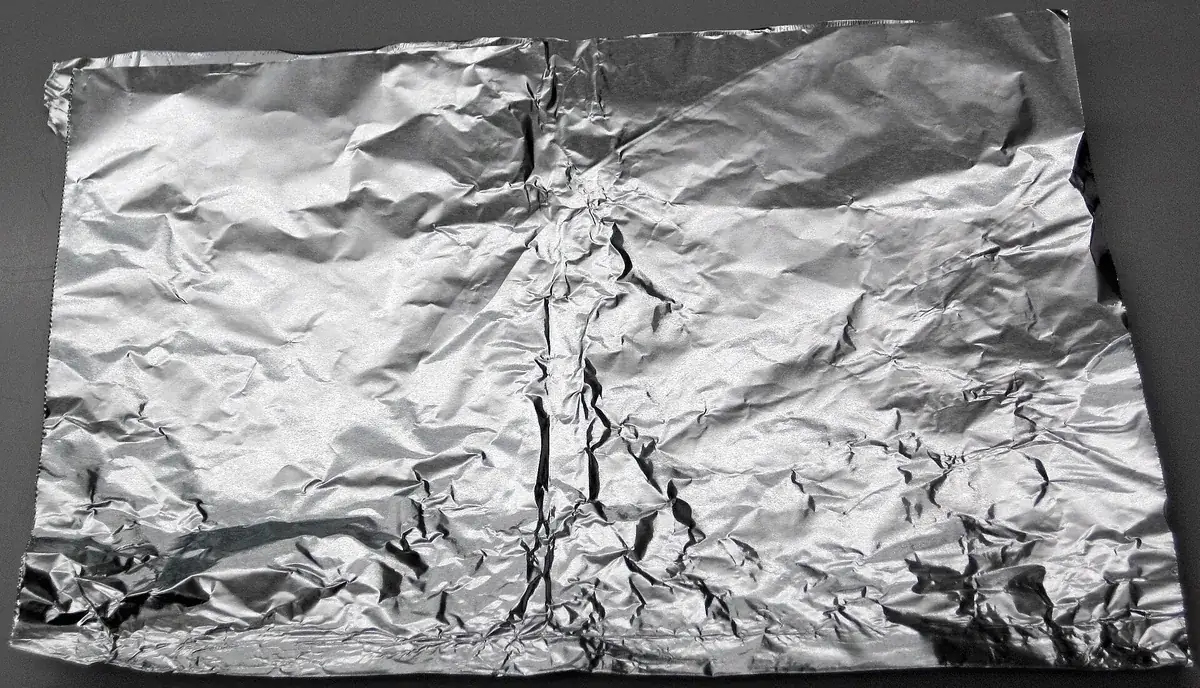
Foil below roughly 40 µm cannot be rolled economically as a single sheet in the final passes, so mills roll two foils together ("double rolling") and separate them afterwards. The faces that touched the work rolls come out bright; the faces that touched each other come out matte. That is why household foil has one bright side and one dull side, and why the difference has no meaningful effect on cooking.
Typical specification for household foil jumbo rolls
Supply range
- Alloys
- 8011, 1235, 8079, 8006 (EN AW-8011A, EN AW-1235, EN AW-8079, EN AW-8006)
- Temper
- O, fully annealed and oil-free
- Thickness
- 0.006 – 0.050 mm; most kitchen foil is 0.009 – 0.025 mm
- Width
- 100 – 1700 mm parent rolls, slit to the rewinder's width
- Core
- Aluminium or steel cores, 76 mm (3 in) or 152 mm (6 in) inner diameter
- Outer diameter
- Up to about 800 mm, to suit the rewinder's unwind stand
- Surface
- One side bright, one side matte (double-rolled); both sides bright on heavier gauges
- Joins
- Number of splices per roll agreed on order and flagged on the roll
Coloured or printed foils are lacquered products; specify colour and coating separately.
| Alloy | Main alloying elements | Why it is used for household foil |
|---|---|---|
| 8011 | Fe 0.6 – 1.0, Si 0.5 – 0.9 | The most common choice: good strength and puncture resistance in O temper, rolls well to thin gauges |
| 1235 | 99.35 % Al minimum | Very soft and pure, excellent for the thinnest gauges and dead-fold; slightly weaker than 8011 |
| 8079 | Fe 0.7 – 1.3, Si 0.05 – 0.30 | High elongation and fewer pinholes at thin gauges, a good fit for 6 – 12 µm foil |
| 8006 | Fe 1.2 – 2.0, Mn 0.3 – 1.0 | Stronger and stiffer; used for heavy-duty household foil and for foil containers |
Composition ranges are the main elements of the registered limits; the mill certificate reports the analysis of each lot.
Tolerances and pinhole limits
Thickness on thin foil is usually controlled as a percentage of nominal, and the tolerance tightens as the order quantity grows because the mill can set up a longer, steadier run. The values below are typical commercial limits for household foil; EN 546-3 and ASTM B479 give the standard tables, and many buyers set their own in a technical agreement.
| Order lot (coil weight) | Thickness tolerance |
|---|---|
| Up to 3 t | ±5 % of nominal |
| Over 3 t to 10 t | ±4 % of nominal |
| Over 10 t | ±3 % of nominal |
| Foil thickness (mm) | Typical maximum pinholes per m² |
|---|---|
| 0.0060 – 0.0120 | 100 |
| > 0.0120 – 0.0180 | 50 |
| > 0.0180 – 0.0200 | 30 |
| > 0.0200 – 0.0500 | 10 |
Width tolerance for slit rolls of 200 mm and wider is typically ±1.0 mm. Other points worth writing into the order are wettability (an annealed food foil should pass the brush or water-wetting test without beading, showing that the rolling oil has gone), roll hardness and telescoping limits, the number of joins per roll, and surface defects such as creases, oil stains and corrugations that cause breaks on a high-speed rewinder.
How many square metres per kilogram?
Converters buy foil by weight and sell it by length, so yield per kilogram drives the cost of every retail roll. Aluminium foil weighs about 2.71 g per m² for each micron of thickness. The table is calculated from that density; use the foil weight calculator for a specific roll.
| Thickness (µm) | g per m² | m² per kg |
|---|---|---|
| 6 | 16.3 | 61.5 |
| 8 | 21.7 | 46.1 |
| 9 | 24.4 | 41.0 |
| 10 | 27.1 | 36.9 |
| 11 | 29.8 | 33.5 |
| 12 | 32.5 | 30.8 |
| 13 | 35.2 | 28.4 |
| 15 | 40.6 | 24.6 |
| 18 | 48.8 | 20.5 |
| 20 | 54.2 | 18.5 |
| 24 | 65.0 | 15.4 |
| 30 | 81.3 | 12.3 |
| 40 | 108.4 | 9.2 |
| 50 | 135.5 | 7.4 |
A 300 mm wide retail roll of 10 m at 12 µm therefore contains 3 m² of foil, about 98 g. Small changes in gauge add up quickly: moving from 12 µm to 11 µm gives about 9 % more length per tonne, but also lowers puncture resistance, so the choice is a balance between cost and how the product feels in use.
Choosing the right gauge for a retail product
| Retail product type | Typical thickness | Usual alloy | Notes |
|---|---|---|---|
| Economy / standard kitchen foil | 9 – 12 µm | 8011 or 8079 | Wrapping, covering bowls, lining trays |
| Standard grade | 12 – 15 µm | 8011 | General cooking and food storage |
| Heavy duty | 18 – 25 µm | 8011 or 8006 | Grilling, roasting, freezing, lining barbecue grills |
| Catering rolls (wide, long) | 11 – 18 µm | 8011 | 300 – 450 mm wide, long lengths for food service |
| Pop-up / interfolded sheets | 11 – 15 µm | 8011 | Pre-cut sheets for food service |
These bands are market practice rather than a formal standard, and retailers in different regions name grades differently. A useful rule is to judge by mass per square metre: if two products have the same nominal length but one is 20 % lighter, it is thinner.
Food-contact rules and safe use
Aluminium for articles that touch food must meet composition limits such as those in EN 602 in Europe, and the finished article falls under the EU framework Regulation (EC) No 1935/2004 and its requirement for good manufacturing practice. Converters typically ask the foil supplier for a declaration of compliance and keep it with their own records. In North America, retail buyers commonly request an FDA food-contact compliance statement as part of supplier approval.
- Acidic and salty foods: tomatoes, citrus, vinegar marinades and heavily salted foods can attack foil and increase aluminium migration. Use foil for short contact or put baking paper between food and foil.
- Cooking and freezing: foil handles oven and grill temperatures easily (aluminium melts at about 660 °C) and protects frozen food from freezer burn when wrapped tightly.
- Microwave ovens: follow the oven maker's instructions; small smooth pieces are sometimes allowed for shielding, but crumpled foil and foil near the walls can spark.
- Shiny vs dull side: either side can face the food; the difference in reflectivity is too small to change cooking times.
Retail packs often print this guidance on the carton. For more on how consumers use foil, see our articles on uses of aluminium foil and aluminium foil vs tin foil.
How to order household foil jumbo rolls
- Define the productAlloy and temper (e.g. 8011-O), thickness and tolerance, width, core ID and maximum roll OD or weight.
- Set the quality limitsPinhole limit, wettability requirement, joins per roll, roll hardness and any surface requirements from your rewinder.
- Food-contact documentsState the declarations you need (EU, FDA or local) and whether third-party test reports are required.
- PackingRolls are packed with desiccant in sealed film, held on core supports in wooden cases so that the foil surface never takes the load.
- DeliveryMill test certificate to EN 10204 3.1, packing list, and shipment on EXW, FOB, CIF or DAP terms to your port.
References and standards
- EN 546-1 to -4 – Aluminium and aluminium alloys: foil (delivery conditions, mechanical properties, tolerances, special property requirements)
- EN 602 – Aluminium and aluminium alloys: wrought products, chemical composition of semi-products used for articles in contact with foodstuffs
- ASTM B479 – Standard Specification for Annealed Aluminum and Aluminum-Alloy Foil for Flexible Barrier, Food Contact and Other Applications
- Regulation (EC) No 1935/2004 on materials and articles intended to come into contact with food
- The Aluminum Association – International Alloy Designations and Chemical Composition Limits
Household aluminium (aluminum) foil: FAQ
Which alloy is best for household foil?
8011-O is the most widely used because it combines strength and good rolling behaviour. 1235-O and 8079-O are chosen for very thin gauges, and 8006-O for heavy-duty foil where stiffness and puncture resistance matter.
What thickness is standard kitchen foil?
Most standard kitchen foil is about 10 – 15 µm, heavy-duty foil about 18 – 25 µm. Economy rolls can go down to 9 µm or less.
Why does household foil have a shiny side and a dull side?
Thin foil is rolled two layers at a time. The sides against the polished rolls come out bright, and the sides pressed against each other come out matte. Either side can be used for cooking.
Are pinholes in thin foil a problem?
For household wrapping they are not significant, provided the count stays within the agreed limit. They matter more for barrier packaging, where thicker foil or lamination is used.
Do you supply finished retail rolls?
No. Metline supplies the annealed jumbo rolls to converters and rewinders, who cut, rewind and pack the retail product under their own brand.
What sizes of core and roll do you supply?
Jumbo rolls are wound on 76 mm or 152 mm cores, with outer diameters up to about 800 mm to suit the rewinder. Tell us your unwind stand limits and we match the roll weight to them.
Need household foil jumbo rolls?
Send alloy, gauge, width, core and roll size, monthly volume and destination. We will reply with specification, documents and a delivered price.






