


5182 and 5052 Aluminium Sheet and Coil for Can Ends
Can end stock is thin, high-magnesium aluminium coil, usually 5182 and sometimes 5052, that is lacquered and pressed into the lids, easy-open ends and tabs of beverage and food cans. It must be strong enough to hold internal pressure at a very thin gauge, form a reliable score line and rivet, and carry food-contact coatings that survive retort and filling. This guide covers alloys, tempers, properties, coatings and tolerances; Metline supplies bare and coated end stock to can and closure makers worldwide.
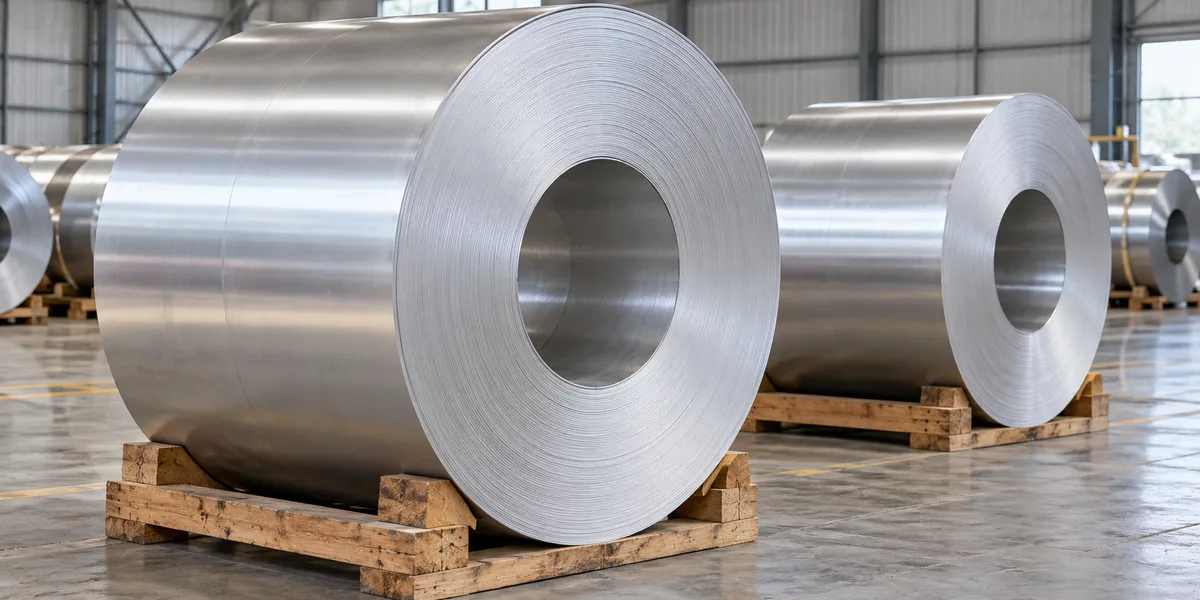
- Alloys
- 5182 (main), 5052
- Tempers
- H19 bare; H48 / H49 coated
- Gauge
- 0.20 – 0.50 mm
- Standard
- EN 541 · EN 573-3 · ASTM B209
Why can ends need a different alloy from bodies
The end of a beverage can is the most heavily engineered part of the package. It is flat, so it cannot rely on curvature for stiffness, yet it must resist internal pressures well above atmospheric in carbonated drinks, and in food cans it must survive retort sterilisation. It also carries an easy-open feature: a scored panel that must tear cleanly under a finger, but never leak, and a rivet that holds the tab.
These demands call for higher strength than the 3104 body alloy can give, so ends are made from 5182, an aluminium-magnesium alloy with about 4.5 % Mg. Magnesium in solid solution raises strength strongly when the alloy is cold-rolled, which lets end makers reduce gauge and metal weight while keeping buckle pressure.
End stock is almost always supplied pre-coated. The rolling mill or a coil coater applies the inside and outside lacquers and a wax lubricant, and the end maker presses ends straight from the coated coil. The coating bake changes the temper designation from H19 (bare) to H48 or H49 (coated), because the heat partly recovers the cold work.
5182 and 5052 chemical composition (wt %)
Registered limits below follow the Aluminum Association and EN 573-3. 5182 is the standard end and tab alloy; 5052 is used for some food can ends, closures and less demanding lids where its lower strength is sufficient.
| Element | 5182 | 5052 | Role |
|---|---|---|---|
| Magnesium (Mg) | 4.0 – 5.0 | 2.2 – 2.8 | Main strengthening element; higher Mg gives higher strength |
| Manganese (Mn) | 0.20 – 0.50 | ≤ 0.10 | Grain control and extra strength in 5182 |
| Chromium (Cr) | ≤ 0.10 | 0.15 – 0.35 | Grain control and stress-corrosion resistance in 5052 |
| Silicon (Si) | ≤ 0.20 | ≤ 0.25 | Impurity |
| Iron (Fe) | ≤ 0.35 | ≤ 0.40 | Impurity; kept low for formability |
| Copper (Cu) | ≤ 0.15 | ≤ 0.10 | Impurity |
| Zinc (Zn) | ≤ 0.25 | ≤ 0.10 | Impurity |
| Titanium (Ti) | ≤ 0.10 | — | Grain refiner |
| Others each / total | ≤ 0.05 / 0.15 | ≤ 0.05 / 0.15 | |
| Aluminium | Remainder | Remainder |
H19, H48 and related tempers
| Temper | Meaning | Typical use |
|---|---|---|
| H19 | Extra-hard, cold-rolled, no thermal treatment after rolling | Bare end and tab stock before coating |
| H18 / H38 | Full-hard; H38 is stabilised by a low-temperature treatment | Bare closure and lid stock |
| H36 / H46 | Three-quarter hard; H46 after lacquer bake | Ends and lids that need more formability |
| H48 | Full-hard, then lacquered or painted; the bake partially anneals the metal | Coated beverage and food can ends, tabs |
| H49 | Extra-hard, then lacquered; slightly higher strength than H48 | Thin-gauge ends where maximum strength is needed |
The H4x designations are defined in EN 515 and ANSI H35.1 for strain-hardened products that are subsequently heated during painting or lacquering. Because the bake lowers strength slightly, mills roll the bare strip a little harder than the target so that the coated coil meets the H48 window.
Mechanical properties of can end stock
As with body stock, end stock properties are usually specified as a strength window agreed with the end maker, because both too-soft and too-hard metal cause problems at the score and rivet. The ranges below are indicative for thin can-end gauges; the purchase specification governs.
| Alloy & temper | Tensile strength Rm | Yield strength Rp0.2 | Elongation A50 |
|---|---|---|---|
| 5182-H19 (bare) | ≈ 380 – 420 MPa | ≈ 340 – 395 MPa | About 3 – 6 % |
| 5182-H48 / H49 (coated) | ≈ 340 – 400 MPa | ≈ 290 – 350 MPa | About 4 – 8 % |
| 5052-H19 / H39 | ≈ 290 – 320 MPa | ≈ 240 – 290 MPa | About 2 – 5 % |
| 5052-H48 / H49 (coated) | ≈ 270 – 310 MPa | ≈ 220 – 270 MPa | About 3 – 6 % |
| 5052 / 5182 H36 / H46 | Lower and more formable; window to specification |
Indicative ranges collected from published can-end stock specifications and supplier data; values vary with gauge, rolling route and bake cycle. Every coil is supplied with a mill certificate showing actual results.
Physical properties (5182)
- Density
- 2.65 g/cm³
- Modulus of elasticity
- About 69.6 GPa
- Melting range
- About 577 – 638 °C
- Note on service temperature
- Like other high-Mg alloys, 5182 is not used for long periods above about 65 °C in structural service; this does not affect cans
Coatings and lubricant on coated end stock
The coating system protects the metal from the product inside, protects the outside during filling and handling, and lets the end be pressed without galling. Coatings must comply with the food-contact regulations of the market where the can is sold, such as the US FDA 21 CFR 175.300 and EU Regulation 1935/2004 frameworks.
| Layer | Typical film weight | Common chemistry | Purpose |
|---|---|---|---|
| Inside (product side) | About 10 – 13 g/m² | Epoxy, or BPA-free polyester, acrylic or vinyl systems | Barrier against acidic, sulphurous or salty contents |
| Outside (public side) | About 3 – 6 g/m² | Epoxy or polyester, clear or gold tinted | Abrasion and corrosion protection, appearance |
| Lubricant | About 40 – 100 mg/m² wax | Paraffin or synthetic wax | Smooth feed and forming in the shell press |
| Pre-treatment | Conversion coating under the lacquer | Chromium-free systems increasingly used | Adhesion of the lacquer to aluminium |
- Solvent resistance: coating withstands repeated solvent rubs (for example MEK double rubs) without exposing metal
- Sterilisation: no blush, loss of gloss, peeling or flaking after retort, for example 121 °C for 30 minutes
- Acid and sulphur resistance: inner coating unaffected after retort in acid or sulphur test solutions
- Adhesion: cross-hatch adhesion at the top rating
- Porosity: low enamel-rater readings on formed ends
Sizes and dimensional tolerances
Supply range
- Thickness
- About 0.20 – 0.50 mm; beverage ends usually at the thin end of this range
- Width
- About 500 – 1,600 mm for coil; narrow slit strip for tab stock
- Inner diameter
- 300, 350, 405 or 505 mm
- Sheet
- Coated sheets cut to length, for example 500 – 4,000 mm, for sheet-fed presses
- Coating colours
- Clear, gold and other tints
| Characteristic | Typical tolerance |
|---|---|
| Thickness 0.22 – 0.30 mm | ± 0.005 mm |
| Thickness 0.30 – 0.50 mm | ± 0.008 mm |
| Width ≤ 1,000 mm (coil) | ± 1.0 mm |
| Width > 1,000 mm (coil) | ± 1.5 mm |
| Slit strip ≤ 100 mm | ± 0.2 mm |
| Edge camber | About ≤ 0.5 mm over 2,000 mm |
| Flatness | Wave height and frequency limited per metre, for example ≤ 3 waves per metre |
| Telescoping of coil | About ≤ 5 mm; layer offset ≤ 2 mm |
Bare strip is normally supplied without joints; coated coils may contain a limited number of marked joints by agreement.
5182 vs 5052 for ends and lids
| Factor | 5182 | 5052 |
|---|---|---|
| Strength in H19 / H48 | Higher | Moderate |
| Typical use | Beverage ends and tabs, pressurised food ends | Food can ends, closures, lids, non-pressurised packs |
| Gauge reduction potential | Good: allows thinner ends | Limited |
| Formability at the same temper | Good | Slightly better |
| Recycling with 3104 bodies | Remelts into can-sheet compositions | Also compatible |
Both alloys have excellent corrosion resistance under lacquer. For pressurised beverage cans 5182 is the norm. For the can body itself, see our 3104 and 3004 can body stock guide.
Surface and coil quality requirements
- No serious blisters, missed coating, scratches, corrosion, oil spots, peeling, streaks, colour variation, roll marks or periodic defects
- Burr height on slit edges kept very small, typically within about 0.04 mm
- Clean, tight coil ends without loose wraps
- Even wax film across the width
- Tab stock without curl that would interfere with feeding
Typical lot tests include tensile properties, thickness profile, coating weight, coating cure (solvent rubs), adhesion, retort resistance and lubricant weight.
How to order can end stock
- SpecifyAlloy and temper, gauge, width or sheet size, ID, coating system, film weights, colour and lubricant, plus the end type.
- QualifyTrial coils are pressed into shells and converted ends to confirm score residual, buckle pressure and coating integrity.
- ContractWe confirm supply, test plan, packing and delivery terms (EXW, FOB, CIF or DAP).
- ShipCoils on wooden skids, wrapped against moisture and dust, with an EN 10204 3.1 certificate and coating test report.
References and standards
- EN 541 – Aluminium and aluminium alloys: rolled products for cans, closures and lids
- EN 515 – Aluminium and aluminium alloys: wrought products, temper designations
- ANSI H35.1 – American National Standard Alloy and Temper Designation Systems for Aluminum
- US FDA 21 CFR 175.300 – Resinous and polymeric coatings
- EN 573-3 – Chemical composition and form of wrought products
Can end aluminium (aluminum) stock: FAQ
Why are can ends made from 5182 and not 3104?
The end is flat and must resist internal pressure at a thin gauge, so it needs more strength than 3104 gives. 5182 contains about 4.5 % magnesium, which makes it much stronger after cold rolling.
What does H48 mean on coated end stock?
H48 is a full-hard strain-hardened temper that has then been heated during lacquering. The bake slightly softens the metal, so the mill rolls it harder to land in the H48 strength window after coating.
When is 5052 used for can lids?
For food can ends, closures and lids that are not highly pressurised, where its moderate strength is enough and good formability is useful. Pressurised beverage ends use 5182.
What inside coating is used on can ends?
Traditionally epoxy-based lacquers, now often replaced by BPA-free polyester, acrylic or vinyl systems. The coating is chosen for the contents and must comply with the food-contact rules of the destination market.
Can you supply bare H19 end stock for our own coil coating line?
Yes. Bare 5182-H19 and 5052-H19 coil can be supplied with a clean surface ready for pre-treatment and coating. Tell us the gauge, width, ID and target post-bake strength.
What thickness tolerance is typical?
About ± 0.005 mm for gauges up to 0.30 mm and ± 0.008 mm from 0.30 to 0.50 mm, or tighter by agreement.
Sourcing end and tab stock?
Send your specification, coating system and volumes. Metline will reply with matching 5182 or 5052 coil, test data and delivery options.





