H19
Extra-hard, cold-rolled temper with no final anneal. Highest strength, which lets can makers use thinner gauges. Standard for beverage can bodies.



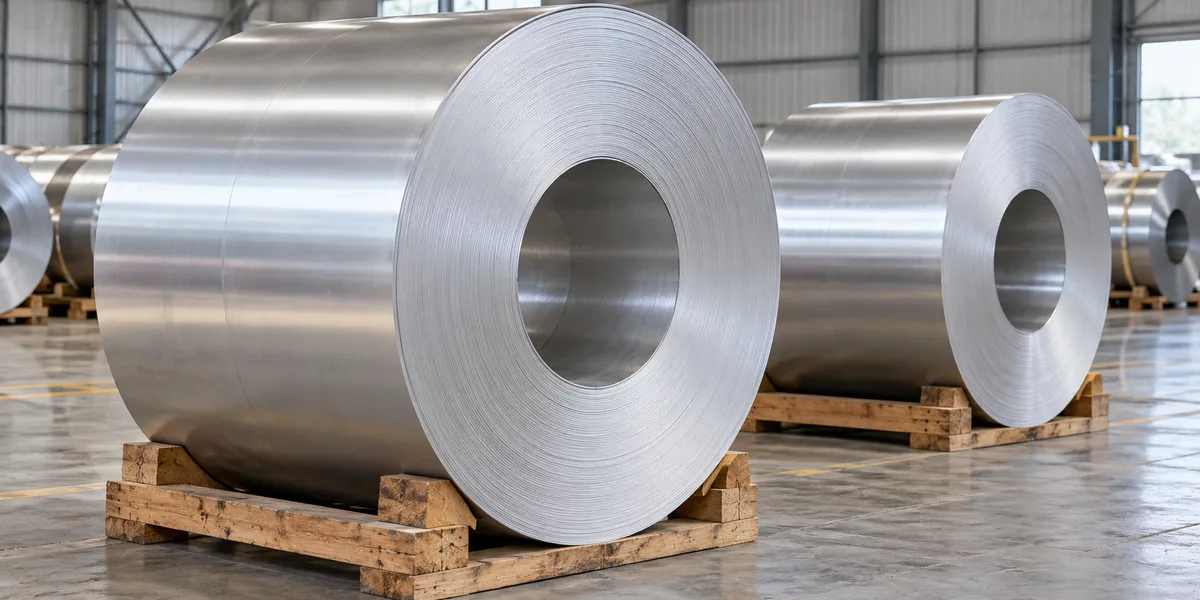
Can body stock is thin, fully hard (H19) aluminium coil in 3104 or 3004 that can makers blank, cup and draw-and-iron into the seamless body of a two-piece beverage or food can. It must combine high strength, low and predictable earing, a clean lubricated surface and very tight gauge control. This guide explains the alloys, properties, sizes and quality checks; Metline supplies can body coil to can makers worldwide.
A two-piece aluminium can has a seamless body and a separate end. The body starts as a flat coil about a quarter of a millimetre thick. In a cupping press the coil is lubricated, blanked into discs and drawn into shallow cups. A bodymaker then redraws each cup and pushes it through a series of ironing rings that thin the wall to roughly a third of the starting gauge, while the base keeps close to the original thickness.
After ironing, the can is trimmed to height, washed, coated inside and decorated outside, then necked and flanged to accept the end. Every step stresses the metal differently: the cupping step needs even flow in all directions, the ironing step needs the metal to thin without tearing, and the finished wall must resist buckling, internal pressure and the heat of the coating ovens.
This combination is why can body stock is a specialised product. The alloy is chosen for strength and ironing response, rolling and annealing are controlled to give a balanced crystallographic texture, and the surface is kept clean and evenly oiled so it does not gall the tooling at line speeds of thousands of cans per minute.
Both alloys are Al-Mn-Mg grades. 3104 allows wider iron and silicon limits, which makes it well suited to remelting used beverage cans; it is the standard body alloy today. 3004 has slightly tighter limits and is also used for body stock and for other deep-drawn products. Limits below are the registered values (EN 573-3 / Aluminum Association).
| Element | 3104 | 3004 | Role |
|---|---|---|---|
| Silicon (Si) | ≤ 0.6 | ≤ 0.30 | Forms intermetallics that help clean the ironing tools |
| Iron (Fe) | ≤ 0.8 | ≤ 0.7 | With Mn, forms the hard particles that prevent galling |
| Copper (Cu) | 0.05 – 0.25 | ≤ 0.25 | Adds strength and improves bake response |
| Manganese (Mn) | 0.8 – 1.4 | 1.0 – 1.5 | Main strengthening element; controls grain structure |
| Magnesium (Mg) | 0.8 – 1.3 | 0.8 – 1.3 | Solid-solution and work-hardening strength |
| Zinc (Zn) | ≤ 0.25 | ≤ 0.25 | Impurity |
| Titanium (Ti) | ≤ 0.10 | — | Grain refiner |
| Gallium / Vanadium | ≤ 0.05 each | — | Trace elements from recycled metal |
| Others each / total | ≤ 0.05 / 0.15 | ≤ 0.05 / 0.15 | |
| Aluminium | Remainder | Remainder |
The wider Fe and Si limits of 3104 let mills use a high share of recycled can scrap. A can body and end mix remelts close to 3104 composition, which is one reason the beverage can is so readily recycled.
Can body properties are agreed between the rolling mill and the can maker rather than taken from a general sheet table, because each bodymaker line and can design has its own targets. The figures below are typical ranges for H19 body stock in the as-rolled condition; strength falls slightly after the coating bake.
| Property | 3104-H19 typical | 3004-H19 typical | Comment |
|---|---|---|---|
| Tensile strength Rm | ≈ 280 – 310 MPa | ≈ 270 – 300 MPa | As-rolled, longitudinal |
| Yield strength Rp0.2 | ≈ 260 – 290 MPa | ≈ 250 – 280 MPa | Often specified as a window, not just a minimum |
| Elongation A50 | About 2 – 5 % | About 2 – 5 % | Low, as expected for full-hard temper |
| Earing (4 or 8 ears) | Typically ≤ 3 % | Typically ≤ 3 % | Measured on a cup drawn from the coil |
| Strength after bake | Drop of roughly 20 – 30 MPa | Similar | Simulated coating bake around 200 °C |
Ranges are indicative only and vary with gauge and process route. The purchase specification and mill certificate govern acceptance.
Extra-hard, cold-rolled temper with no final anneal. Highest strength, which lets can makers use thinner gauges. Standard for beverage can bodies.
Slightly softer full-hard tempers sometimes used for food cans, aerosol and specialty bodies that are drawn deeper but ironed less.
Half-hard tempers for shallow-drawn containers, lids and closures, not for drawn-and-ironed bodies.
Mills balance the cube texture from hot-rolling with the rolling texture from cold-rolling so the 0°/90° and 45° ears cancel out and earing is low.
Light-weighting has pushed body gauges down over the years; check which gauge your bodymaker tooling is set for.
Weight per square metre is easy to estimate: 3104 at 2.72 g/cm³ weighs about 0.71 kg/m² at 0.26 mm and 0.76 kg/m² at 0.28 mm. A 1,700 mm wide coil of 0.26 mm stock therefore carries roughly 830 m of strip per tonne.
Typical tests on each lot include tensile and yield strength, earing on a drawn cup, thickness profile, surface inspection and lubricant weight. EN 541 sets out the general requirements for rolled aluminium used for cans, closures and lids, and the detailed limits come from the customer specification.
| Part | Usual alloy | Temper | Why |
|---|---|---|---|
| Can body | 3104 (or 3004) | H19 | Strength after ironing, good recyclability, low earing |
| Can end (lid) | 5182 | H19 / H48 | Higher Mg gives strength for thin ends that resist pressure |
| Tab | 5182 or 5042 | H19 / H48 | Stiffness and formability for the rivet and lever |
| Food can body | 3104, 3004, 5052 | H18 / H19 | Drawn and redrawn rather than ironed |
| Closures and caps | 8011, 3105 | H14 – H16 | Formability for ROPP caps |
See our guide to 5052 and 5182 can end stock for the lid side of the can.
3104 contains magnesium as well as manganese, so it work-hardens to much higher strength in H19 temper. That strength lets can makers use a thinner gauge. Its wide iron and silicon limits also make it ideal for recycling used cans back into new body stock.
Most beverage can body stock is around 0.24 – 0.28 mm, with the full range running to about 0.38 mm for larger or specialty cans. The wall is ironed down to roughly a third of the starting gauge.
Earing is the wavy rim that forms when a disc is drawn into a cup because the metal flows unevenly in different directions. High earing means more metal is trimmed off as scrap and can cause jams. Can body stock is processed to keep earing low, typically within about 3 %.
They are very similar Al-Mn-Mg alloys. 3104 has higher allowable iron and silicon and a set copper range, which suits recycled metal; 3004 has a slightly higher manganese range. Both are used in H19 temper for can bodies.
No. Ends and tabs are usually 5182, which has higher magnesium for strength at thin gauges. The body is 3104. When cans are recycled the mix melts to a composition close to 3104.
Body stock is normally supplied bare and lubricated, because the can maker coats the can after forming. End stock is usually supplied pre-coated; ask for details on our can end guide.
Send your specification and volumes. Metline will reply with matching 3104 or 3004 coil, test data and logistics for your plant.





