Plain (bare) foil
Mill-finish foil with a clean, degreased surface, ready for printing, lacquering or lamination by the converter.



1235 aluminium foil is a 99.35 % pure, unalloyed foil that rolls down to the thinnest gauges with few pinholes, conducts heat and electricity very well and forms easily in the annealed condition. It is the standard alloy for thin packaging foil (6 – 9 µm), lithium-ion battery current collectors, cable shielding and capacitor foil. Metline supplies 1235 foil in coils and sheets, plain, coated or laminated, to converters worldwide.
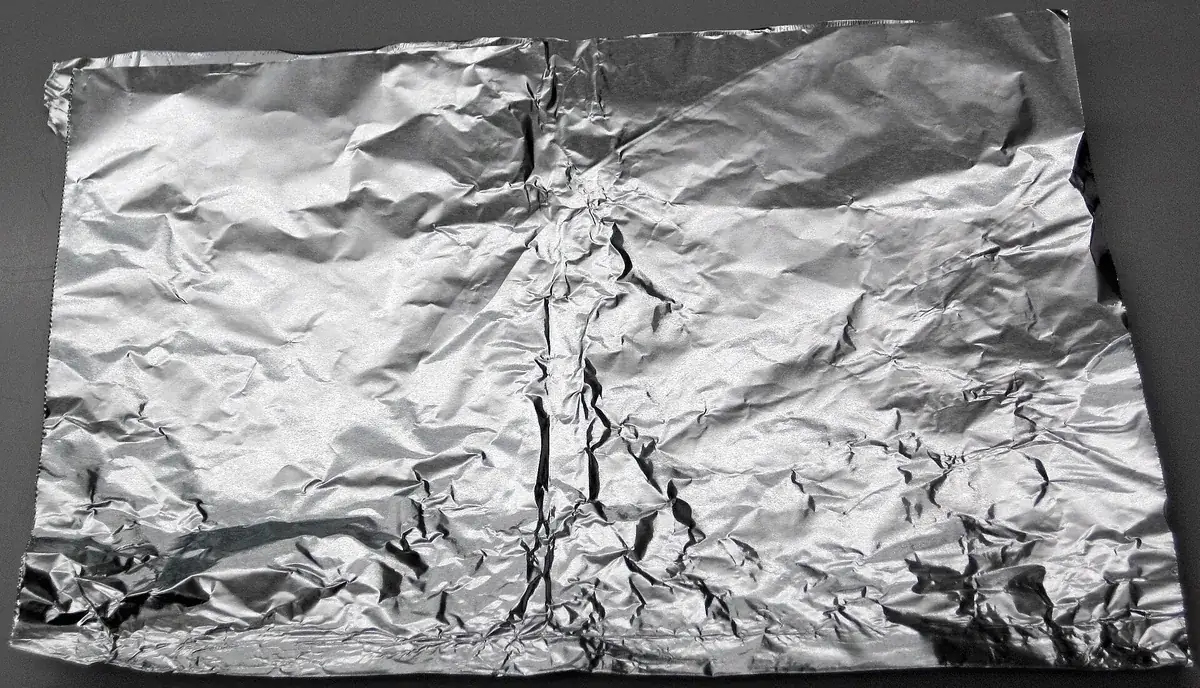
1235 is a 1xxx-series, commercially pure aluminium with at least 99.35 % Al. Unlike most alloys it has no single limit for silicon or iron; instead the combined Si + Fe is capped at 0.65 %, which gives mills flexibility to balance the two for the best rolling behaviour.
That high purity is what makes 1235 roll so well. With few hard intermetallic particles in the metal, foil can be reduced to 6 – 7 µm (about 0.00025 in) with a low pinhole count, which is why 1235 is the alloy of choice for the "double-zero" foil used in aseptic drink cartons, cigarette inner liners and laminated pouches. At these gauges, foil is rolled two sheets at a time: the sides that touch the rolls come out bright, and the sides that touch each other come out matte.
Heavier gauges of 1235 serve technical markets. Hard H18 foil of 10 – 20 µm is coated with cathode paste in lithium-ion cells; 0.1 – 0.2 mm foil laminated with plastic film shields data and power cables; and high-purity, clean-surface foil is etched to make electrolytic capacitor electrodes. Across all of these, buyers care most about gauge consistency, pinholes, surface cleanliness (wettability) and coil shape, more than raw strength.
Limits are the registered Aluminum Association values, also used for EN AW-1235 in EN 573-3. All values are maxima except aluminium.
| Element | Limit | Comment |
|---|---|---|
| Aluminium (Al) | 99.35 min. | By difference |
| Silicon + Iron (Si + Fe) | 0.65 max. combined | Typical mill practice balances Fe above Si for good rolling |
| Copper (Cu) | 0.05 max. | Kept low for conductivity and corrosion resistance |
| Manganese (Mn) | 0.05 max. | |
| Magnesium (Mg) | 0.05 max. | |
| Zinc (Zn) | 0.10 max. | |
| Vanadium (V) | 0.05 max. | Limited because it lowers conductivity |
| Titanium (Ti) | 0.06 max. | Grain refiner |
| Others, each | 0.03 max. |
For food-contact foil in Europe, the composition must also comply with EN 602; 1235 does. Ask for a declaration of compliance if your market requires one.
Foil strength and elongation depend strongly on gauge: thinner foil has lower elongation because a single defect can initiate failure across the whole thickness. Standards such as EN 546-2 and GB/T 3198 therefore set property ranges by temper and thickness band. The values below are indicative and should be confirmed against the standard named on your order.
| Temper | Condition | Tensile strength (indicative) | Elongation (indicative) | Typical use |
|---|---|---|---|---|
| O | Fully annealed, soft | About 60 – 105 MPa | From about 1 – 4 % at 6 – 20 µm, rising to 10 % or more above 0.1 mm | Packaging, household, laminates, cable foil |
| H14 / H24 | Half hard | About 105 – 145 MPa | Low, a few % | Lids, containers, some cable foil |
| H16 / H26 | Three-quarter hard | About 120 – 160 MPa | Low | Stiffer technical foil |
| H18 | Full hard | About 140 MPa and above; battery foil often 160 – 200 MPa | 1 – 3 % | Battery current collectors, capacitor foil |
Mill-finish foil with a clean, degreased surface, ready for printing, lacquering or lamination by the converter.
6 – 9 µm foil, one side bright and one matte, for aseptic cartons, pouches and tobacco liners. Supplied on cores for high-speed laminators.
H18 foil around 10 – 20 µm with tight gauge tolerance and high surface tension for cathode current collectors. Carbon-coated versions improve adhesion and lower contact resistance.
Heavier O-temper foil laminated with PE or copolymer film, used as a screen and moisture barrier in communication and power cables.
High-purity, clean-surface foil for etching into electrolytic capacitor anodes and cathodes.
Heat-seal lacquered, colour-coated, embossed, hydrophilic-coated or laminated to PET, PE and paper for packaging and insulation.
Foil is sold by weight, so it helps to know how much area a kilogram covers. At a density of 2.705 g/cm³, foil yield (m² per kg) is roughly 370 ÷ thickness in µm. The foil weight calculator works out coil weights for any width and length.
| Thickness (µm) | Thickness (in) | g per m² | m² per kg | Common use |
|---|---|---|---|---|
| 6.35 | 0.00025 | 17.2 | 58 | Aseptic carton and pouch laminates |
| 9 | 0.00035 | 24.3 | 41 | Laminates, household foil |
| 12 | 0.00047 | 32.5 | 31 | Battery foil, household foil |
| 15 | 0.00059 | 40.6 | 25 | Battery foil, kitchen foil |
| 20 | 0.00079 | 54.1 | 18 | Pharma, heavier household foil |
| 40 | 0.0016 | 108 | 9.2 | Lids, insulation facings |
| 100 | 0.0039 | 271 | 3.7 | Cable foil, technical foil |
| 200 | 0.0079 | 541 | 1.8 | Cable screens, heavy technical foil |
Most problems on converting lines come from the coil rather than the alloy: residual oil causing poor adhesion, loose winding leading to creases, or splices in the wrong place. Put your wettability class, splice allowance, maximum joins per coil and winding direction on the order, and inspect them at goods-in.
| Property | 1235 | 1145 | 1100 | 8011 |
|---|---|---|---|---|
| Aluminium content | ≥ 99.35 % | ≥ 99.45 % | ≥ 99.00 % | About 97 – 98.5 % (alloyed) |
| Key alloying | None; Si + Fe ≤ 0.65 % | None; Si + Fe ≤ 0.55 % | Cu 0.05 – 0.20 % | Fe 0.6 – 1.0 %, Si 0.5 – 0.9 % |
| Thinnest practical gauge | About 6 µm | About 6 µm | Heavier gauges | About 6 – 7 µm, more often 9 µm and above |
| Strength in O temper | Low | Low | Low–moderate | Higher |
| Conductivity | Very high | Very high | High | Lower |
| Typical uses | Double-zero packaging, battery, cable, capacitor | Capacitor, aerospace, cable | General foil and fin stock | Containers, lids, pharma, household |
1235 and 1145 are close enough that 1235 is widely accepted in place of 1145 for packaging and cable foil, but check any customer approval before substituting on technical or aerospace orders. Choose 8011 foil when you need more strength and puncture resistance, for example in food containers, pharmaceutical blister lids and bottle caps.
Both are commercially pure foil alloys. 1145 requires at least 99.45 % aluminium and 1235 at least 99.35 %, with slightly higher combined Si + Fe allowed in 1235. For most packaging and cable uses they perform the same, and 1235 is more widely available.
Yes. Its composition complies with EN 602 for food-contact aluminium, and annealed 1235 foil is widely used for household foil and food laminates. Ask for the declaration of compliance your market requires.
Cathode current collector foil is usually H18 temper between about 10 and 20 µm, with tight gauge tolerance and a clean, wettable surface. Carbon-coated variants are available.
Its high purity means fewer hard particles that cause pinholes and breaks during rolling, so it can be rolled to 6 – 7 µm reliably.
O means fully annealed: the foil is soft, has its highest elongation and folds without springing back. The final anneal also burns off rolling oil, improving wettability.
About 370 divided by the thickness in microns. A kilogram of 9 µm foil covers about 41 m²; a kilogram of 20 µm foil about 18 m².
Send gauge, width, temper, surface, core and coil details with your volume. We will reply with availability, documentation and a delivered price.






