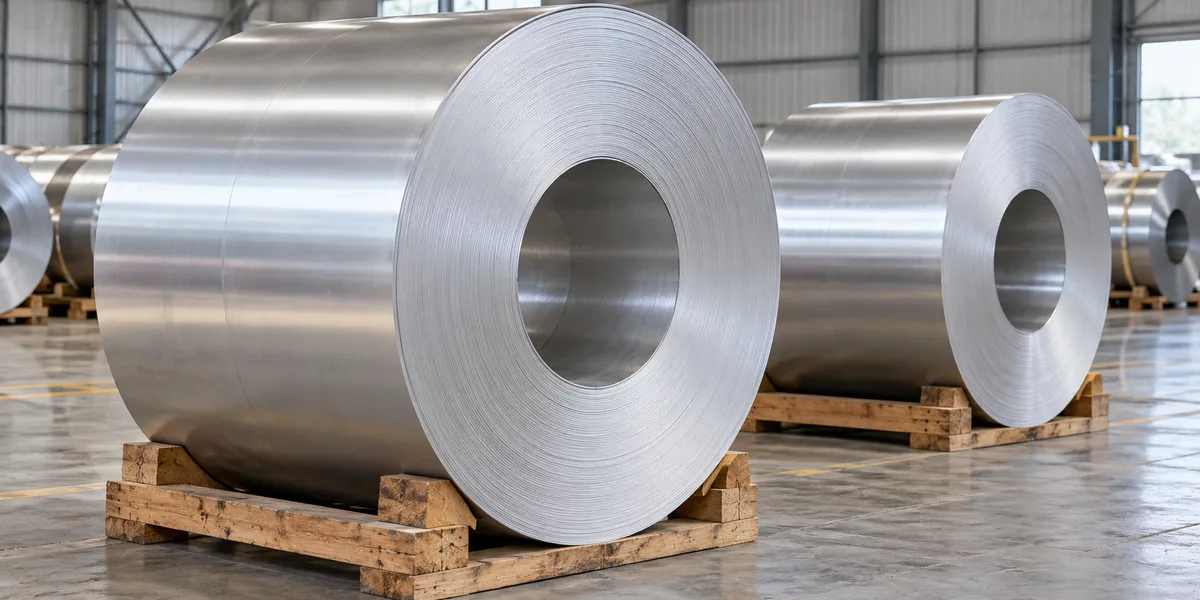
Most aluminium bottle caps, from 30 × 60 mm wine closures to 20 mm injection-vial seals, are deep-drawn from 8011 closure sheet in H14 or H16 temper, roughly 0.17 – 0.25 mm thick. The alloy combines enough strength to hold thread and torque with the low earing and clean drawing a high-speed cap press needs. This guide explains cap types, sizes, liners, material specifications and how to specify caps or cap stock, which Metline supplies to bottlers and closure makers worldwide.
An aluminium cap starts as a flat, lacquered sheet less than a quarter of a millimetre thick. It is punched into a disc, drawn into a cup, decorated, lined and, for roll-on caps, threaded on the bottle itself by the capping head. Every step depends on the sheet behaving the same way from coil to coil.
8011 is an aluminium-iron-silicon alloy. The iron and silicon form fine intermetallic particles that strengthen the metal and refine its grain without the need for heat treatment, so the sheet gains strength through cold rolling and partial annealing (the H14 and H16 tempers). Compared with pure 1xxx aluminium, 8011 is stiffer and more resistant to denting and stretching under capping loads; compared with 3105 or 5052, it is cheaper and draws with very low earing when the rolling and annealing schedule is controlled.
That is why 8011 has become the default closure alloy for roll-on pilfer-proof (ROPP) caps on wine, spirits, water and edible oil, and is widely used for pharmaceutical vial seals and twist-off lids. 3105 is the usual alternative where a cap maker wants a little more strength or a different drawing response; we cover it in our 3105 closure strip guide.
Product range
Types of aluminium bottle caps
The word "cap" covers several quite different closures. They share the same base metal but differ in how they seal, how they show tampering and which liner they carry.
ROPP caps (roll-on pilfer-proof)
Supplied as plain, unthreaded shells. The capping head presses the cap onto the bottle and rolls the thread and the tamper band into the metal so they follow the glass exactly. Used on still wine, spirits, water, juices and oils.
Long wine caps
The familiar 30 × 60 mm screw cap for still wine, with a long decorative skirt that imitates a capsule over a cork. The liner controls how much oxygen reaches the wine.
Pre-threaded screw caps
Caps with formed threads, applied by screwing rather than rolling. Common on small bottles, cosmetics and some food jars.
Vial seals and flip-off caps
Crimp seals for 13, 20 and 32 mm injection vials. A rubber stopper does the sealing; the aluminium skirt is crimped under the vial lip to hold it. Flip-off caps add a coloured plastic button.
Pull-ring and tear-off caps
Caps with a scored tear strip and ring, used on infusion bottles, sauces and some beverages where the cap is removed without tools.
Twist-off lids and easy-open ends
Wide-mouth closures for jars and cans, made from lacquered 8011 or 3xxx/5xxx strip depending on diameter and pressure.
Popular sizes
Common aluminium cap sizes and where they are used
Cap sizes are given as diameter × height in millimetres. The diameter must match the neck finish of the bottle; the height depends on the thread length and on how much decorative skirt the brand wants.
Cap size (mm)
Typical type
Usual application
13, 20, 32
Crimp seal, flip-off cap
Injection and infusion vials
18 × 12, 20 × 12, 22 × 15
ROPP / screw cap
Miniatures, small spirit and oil bottles, cosmetics
25 × 43
ROPP
Some spirit and liqueur bottles
28 × 15, 28 × 18
ROPP / screw cap
Mineral water, soft drinks, juices on glass or PET
28 × 32 to 28 × 44
ROPP
Spirits and premium waters
30 × 35
ROPP
Wine, fortified wine, spirits
30 × 60
Long wine cap
Still wine (Bordeaux and Burgundy style bottles)
31.5 × 44, 31.5 × 60
ROPP
Spirits, vodka, whisky and premium oils
35 – 38 mm
ROPP / screw cap
Juices, large water bottles, oil and syrup
Exact neck finishes are defined by bottle-industry drawings (for example the wine finishes used for 30 × 60 mm caps). Always send the bottle neck drawing with an enquiry so the cap height, thread and liner position can be matched.
Material specification
8011 closure sheet: composition and properties
The chemistry below is the registered Aluminum Association composition for 8011, which EN 573-3 also lists as EN AW-8011A with very similar limits. Food-contact closures are usually also required to meet EN 602, which limits certain elements in aluminium intended to touch food.
Element
Limit (wt %)
Effect
Silicon (Si)
0.50 – 0.90
Forms Al-Fe-Si particles with iron; strengthens and refines grain
Iron (Fe)
0.60 – 1.00
Main alloying element; raises strength and controls earing
Copper (Cu)
≤ 0.10
Impurity
Manganese (Mn)
≤ 0.20
Minor strengthening
Magnesium (Mg)
≤ 0.05
Impurity
Chromium (Cr)
≤ 0.05
Impurity
Zinc (Zn)
≤ 0.10
Impurity
Titanium (Ti)
≤ 0.08
Grain refiner
Others each / total
≤ 0.05 / 0.15
Aluminium
Remainder
About 97.3 – 98.9 %
Temper
Typical gauge (mm)
Tensile strength (MPa)
Earing
Typical use
8011-H14
0.17 – 0.25
125 – 165 (yield about 110 – 150)
≤ 2 – 3 %
ROPP caps for wine, spirits, water, oil
8011-H16
0.18 – 0.25
Higher than H14; limits per EN 485-2 or contract
≤ 3 % typical
Vial seals, stiffer caps, pull-ring caps
8011-H18
0.15 – 0.25
Highest of the three; per contract
As agreed
Flat lids, tear-off components
Ranges are typical closure-stock values from mill specifications and EN 485-2 / EN 546-2 limits; the exact contract figures, and whether they are measured before or after a paint-bake simulation, are agreed per order and reported on the mill certificate.
Metline supplies 8011 closure sheet and strip in coil or cut sheet, mill finish or pre-lacquered, to closure makers and cap producers. Bottlers and brand owners can share their cap specification with us so the cap stock is matched to it. Material is shipped worldwide from our base in Mumbai with full material certification.
Sealing
Cap structure and liner options
The aluminium shell holds the closure on and shows whether it has been opened, but the liner is what actually seals against the bottle lip. Choosing the right liner matters as much as choosing the metal.
Shell: a deep-drawn 8011 cup, often knurled on the skirt for grip, with a perforated tamper band on ROPP caps
Top panel: flat or slightly domed, carrying the brand print, embossing or hot-foil stamping
Thread zone: rolled onto the bottle during capping (ROPP) or pre-formed (screw caps)
Liner: a foam, film, foil or elastomer disc, or a flowed-in compound, chosen for the product and its processing
Liner type
Properties
Recommended for
PE / EPE foam
Cushioning, good leak-tightness, economical
Still water, juices, edible oil, sauces
PVDC-faced film (Saranex-type)
Moderate, controlled oxygen transmission
Wines intended for drinking within a few years
Tin-foil barrier (Saran-tin type)
Very low oxygen transmission
Wines for long cellar ageing, aroma-sensitive spirits
Induction foil liner
Hermetic seal welded to the lip; clear tamper evidence
Nutraceuticals, powders, condiments shipped long distances
Rubber / bromobutyl stopper
Pierceable, sterilisable, chemically inert
Injection vials (used with crimp seals)
PVC-free flowed compound
Seals under pressure and pasteurisation
Carbonated drinks, twist-off food jars
Liner choice also drives regulatory compliance: liners and lacquers that touch the product must be approved food-contact or pharmaceutical materials in the destination market, for example under US FDA 21 CFR or EU Regulation 1935/2004.
Customisation
Decoration, colour and finishing options
Colour and lacquer
Base coats in gold, silver, white, black or Pantone-matched colours; matt, gloss, metallic and soft-touch finishes. The inner lacquer protects the metal from the product.
Printing
Top and side printing by offset lithography on flat sheet before drawing, or by dry offset and screen on finished caps; multi-colour logos and batch codes.
Embossing and hot-foil
Raised or recessed logos on the top panel and hot-foil stamping for a premium look on wine and spirits caps.
Knurling
Vertical knurls on the skirt improve grip and hide minor marks; patterns vary by cap maker and brand.
Security features
Tamper bands, hidden marks and serialised printing help fight counterfeiting of high-value spirits.
Packing
Bulk cartons for hopper feeding, layer packing for automatic lines, or palletised and shrink-wrapped for export.
Applications
Which cap for which product
Market
Typical caps
What the closure must do
Still wine
30 × 60 mm long cap; 30 × 35 mm for some styles
Hold a consistent oxygen ingress rate over years of storage, upright or on its side
Spirits
31.5 × 44, 31.5 × 60, 28 – 30 mm ROPP
Prevent evaporation and leakage, resist alcohol, show tampering, look premium
Water and soft drinks
28 mm and 38 mm ROPP or screw caps
Run at high line speeds and, for carbonated drinks, hold CO2 pressure
Pharmaceuticals
13, 20, 32 mm crimp seals and flip-off caps
Hold a sterile stopper, survive autoclaving or terminal sterilisation, colour-code products
Edible oil and condiments
28 – 38 mm ROPP, often with a pourer
Resist fats, allow controlled pouring, guard against refilling
Food jars
Twist-off lids and easy-open ends
Keep a vacuum through pasteurisation and resist acidic foods
Aluminium caps also suit sustainability goals. Aluminium can be recycled repeatedly without losing its properties, and caps left on glass bottles are increasingly recovered in glass and metal sorting streams. Brands that move from a cork and capsule to an aluminium screw cap also remove a separate foil or PVC capsule.
Process
From 8011 closure sheet to finished cap
Rolling and annealingThe closure sheet is rolled to final gauge and partly annealed to H14 or H16, with the schedule set to give low earing.
Coating and printingSheet or coil is degreased, coated with inner and outer lacquers, printed and stoved, typically around 180 – 210 °C.
Blanking and drawingDiscs are punched and drawn in one or more stages into a cup of the required height; earing shows up here as an uneven rim.
Forming detailsKnurls, tamper-band perforations, beads and vent slots are formed, and the rim is trimmed.
LiningPre-cut liners are inserted, or compound is flowed in and cured.
Inspection and packingCaps are checked for height, diameter, coating adhesion, liner position and appearance, then packed for automatic feeding.
For cap makers, the main material-related causes of scrap are uneven earing, gauge variation across the coil width, poor flatness and lacquer adhesion failures. Ask for earing to be tested in the delivered (or paint-baked) condition and for gauge to be reported across the width, not just at the centre.
Specification checklist
How to specify aluminium caps or 8011 cap stock
Cap specification (agreed with your closure maker)
Product and how it is filled (still, carbonated, hot-fill, pasteurised, sterilised)
Bottle type and neck finish drawing (glass or PET)
Cap type and size, for example 30 × 60 mm ROPP
Liner type and any oxygen, CO2 or sterilisation requirements
Colours (Pantone references), print, embossing and hot-foil
Annual volume, trial quantity and destination
For 8011 cap stock
Alloy and temper (8011-H14, H16) and the governing standard
Gauge and tolerance, width and slit edge quality
Mechanical limits and earing, and whether measured after paint-bake
Surface: mill finish, degreased or pre-lacquered, with coating system
Coil inner diameter, outer diameter or coil weight, and packing
Certificates required (EN 10204 3.1, food-contact declarations)
Delivery terms are quoted EXW, FOB, CIF or DAP. Cap stock ships in coils on wooden pallets or in cases, eye-to-sky or eye-to-wall, wrapped against moisture.
Related products & guides
Related closure and foil materials
These pages cover the other alloys and foils used in closures and packaging:
Why is 8011 used for bottle caps instead of pure aluminium?
The iron and silicon in 8011 make it stronger and stiffer than 1xxx aluminium at the same gauge, so caps resist denting and hold their thread under capping load, while the alloy still draws cleanly with low earing. It is also economical and widely available as closure stock.
What thickness is aluminium cap stock?
Most ROPP and screw caps are drawn from sheet about 0.20 – 0.25 mm thick; small caps and vial seals often use about 0.17 – 0.20 mm. The exact gauge depends on cap diameter, height and the cap maker's tooling.
What is the difference between a ROPP cap and a screw cap?
A ROPP cap arrives as a plain shell; the capping machine rolls the thread and tamper band into it on the bottle, so it fits each neck exactly. A pre-threaded screw cap already has its thread and is screwed on.
Which liner should I use for wine screw caps?
For wines drunk within a few years, PVDC-faced film liners give a small, controlled oxygen ingress. For wines meant for long ageing, tin-foil barrier liners let in very little oxygen. Winemakers choose the liner to suit the wine style.
Are aluminum bottle caps safe for food and medicines?
Yes, when made from food-contact grade alloy (for example to EN 602) and coated with approved inner lacquers and liners. The product touches the lacquer and liner, not bare metal, and those materials must comply with the rules of the destination market.
Are aluminium caps recyclable?
Yes. Aluminium can be recycled repeatedly without loss of quality, and caps are recovered in metal sorting streams. Leaving the cap on the bottle often helps it get captured rather than lost as a small loose item.
Can Metline supply cap stock for my own cap line?
Yes. We supply 8011 closure sheet and strip in H14, H16 and other tempers, slit to your width, mill finish or pre-lacquered, with mill test certificates, to closure makers worldwide.
Sourcing 8011 cap stock?
Send your cap stock gauge, width, temper and coating, and the cap type it is for. Our team will reply with a material specification and delivered price.