Mill finish, degreased
For cap makers who lacquer and print in-house. Must be clean and dry for good lacquer adhesion.



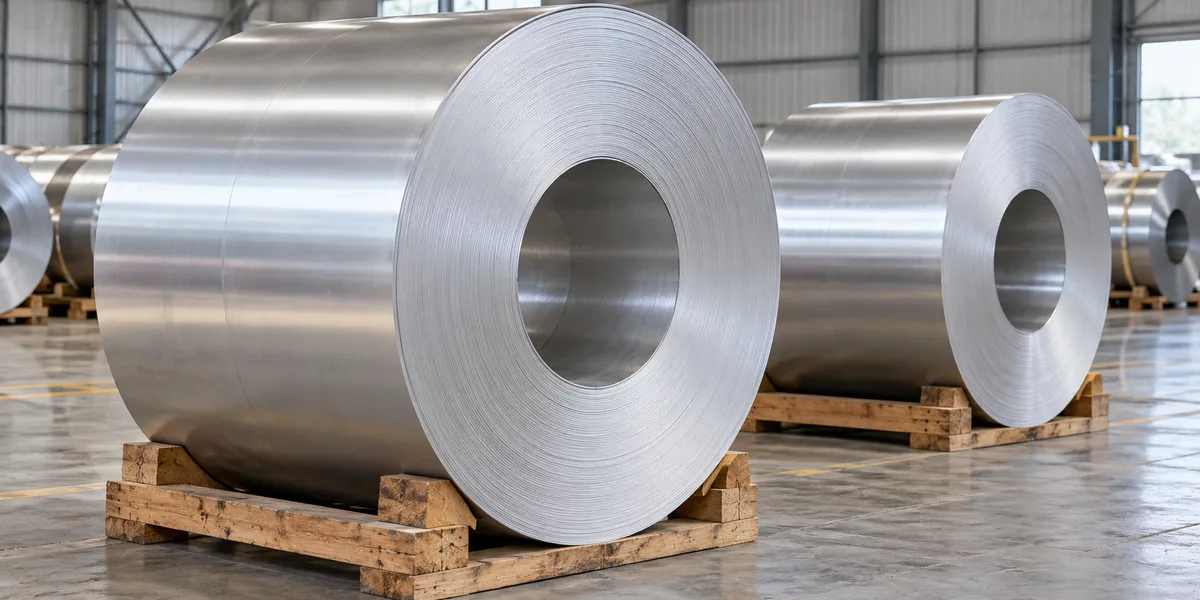
3105 is an aluminium-manganese-magnesium alloy rolled to about 0.15 – 0.5 mm and supplied in H14, H16 and H24 tempers as closure stock for roll-on pilfer-proof (ROPP) and screw caps on wine, spirits, water, oil and pharmaceutical bottles. Cap makers buy it for low earing, tight gauge control and a surface that takes lacquer and print evenly.
A ROPP cap starts as a lacquered, printed sheet. Discs are blanked and drawn into a shallow shell, a liner is inserted, and the capping head on the filling line rolls the thread and the tamper-evident band onto the bottle neck.
That sequence asks a lot of the metal. It must draw without tearing, keep an even rim height (low earing) so the band forms correctly, be stiff enough to hold torque, and soft enough for the capping head to roll threads into it. 3105, with about 0.5 % manganese and 0.5 % magnesium, sits in the right place: stronger and stiffer than 8011 or 1100 at the same gauge, more formable than 5xxx alloys. 8011 remains common for lower-cost caps; 3105 is chosen where thinner gauge, higher torque or more demanding shapes are needed.
| Element | Limit |
|---|---|
| Manganese (Mn) | 0.30 – 0.80 |
| Magnesium (Mg) | 0.20 – 0.80 |
| Silicon (Si) | ≤ 0.60 |
| Iron (Fe) | ≤ 0.70 |
| Copper (Cu) | ≤ 0.30 |
| Chromium (Cr) | ≤ 0.20 |
| Zinc (Zn) | ≤ 0.40 |
| Titanium (Ti) | ≤ 0.10 |
| Others each / total | 0.05 / 0.15 |
| Aluminium | Remainder (about 96 – 99 %) |
Closure mills usually work to a tighter internal window than these registered limits, because small shifts in manganese, iron and magnesium change earing and work-hardening. For food and beverage contact, the alloy also meets the composition limits of EN 602.
| Temper | Tensile strength (MPa) | Elongation (min, thin gauge) | When to choose it |
|---|---|---|---|
| H14 | 150 – 200 | about 1 – 2 % | General ROPP caps; good balance of draw and stiffness |
| H24 | 150 – 200 | about 3 – 4 % | Lacquered stock; partial anneal gives more ductility at the same strength |
| H16 | 175 – 225 | about 1 % | Higher torque, thinner gauge, larger diameters |
| H26 | 175 – 225 | about 3 % | Stiffer lacquered stock with better formability than H16 |
| H18 | ≥ 195 | about 1 % | Stiff stock for shallow parts |
Ranges follow the EN 485-2 bands for thin 3105 sheet; closure specifications often narrow them (for example 160 – 190 MPa for H14) to keep capping behaviour consistent. Agree the window with the mill.
Because the lacquer and print are cured in ovens, the strength the cap maker sees is the after-bake strength. Ask for properties both as-rolled and after a simulated bake cycle that matches your line.
| Characteristic | Typical closure-stock requirement | Why it matters |
|---|---|---|
| Earing (cup test) | H14 about ≤ 3 %; H16 / H24 / H26 about ≤ 4 % | Uneven rim height spoils the tamper band and wastes trim |
| Thickness tolerance | about ±0.005 mm up to 0.25 mm; ±0.010 mm to 0.50 mm | Gauge variation changes draw depth and capping torque |
| Width tolerance | +0.5 / 0 mm up to 800 mm; +1 / 0 mm above | Feeding in printing presses and blanking |
| Longitudinal flatness | Wave height about 2 – 3 mm max | Lacquering and printing need flat sheet |
| Camber | about ≤ 5 mm | Straight feeding into presses |
| Surface | Free of oil stains, roll marks, scratches and inclusions | Visible on the finished cap |
For cap makers who lacquer and print in-house. Must be clean and dry for good lacquer adhesion.
A conversion layer that improves lacquer adhesion and corrosion resistance under the liner.
Ready for printing; inside lacquer must suit the liner compound and product.
Gold, silver, white, black, red, blue and custom shades outside, protective lacquer inside.
A light lubricant film for drawing on some lines.
3105 is also rolled for other light-gauge products, such as shutter slats and PCB entry sheet, but closure stock carries the tightest earing and surface requirements.
3105 is stronger at the same gauge, so caps can be thinner or hold higher torque. 8011 is cheaper and is widely used for standard caps.
Earing is the wavy rim formed when a disc is drawn into a cup, caused by directional properties in the sheet. Low earing (about 3 – 4 % or less) keeps the cap skirt even so threads and tamper bands form correctly.
H24 is common for stock that will be lacquered because it has more elongation at the same strength. H14 suits caps formed from bare or pre-treated stock.
Usually about 0.20 – 0.25 mm for 28 – 31.5 mm caps, thicker for larger diameters or high-torque caps.
Yes, when the alloy meets EN 602 and the inside lacquer and liner are approved for the product.
Send gauge, width, temper, earing limit and surface requirements. We will confirm the specification and a delivered price.





