Mill finish, degreased
Bare clean surface for converters who apply their own pretreatment and lacquer. Must be free of rolling-oil residue so lacquer adheres.



Aluminium closure stock is thin, tightly controlled sheet and coil (usually 0.15 – 0.50 mm) that cap makers draw, thread and print into ROPP caps, screw caps, vial seals, twist-off lids and can ends. The right choice depends on the closure type: 8011 and 3105 in H14/H16 for caps, 1060 or 8011 for pharmaceutical seals, and 5052 or 5182 in H19/H48 for can ends. This guide explains how to select alloy, temper, gauge and coating, and what to put in the specification.
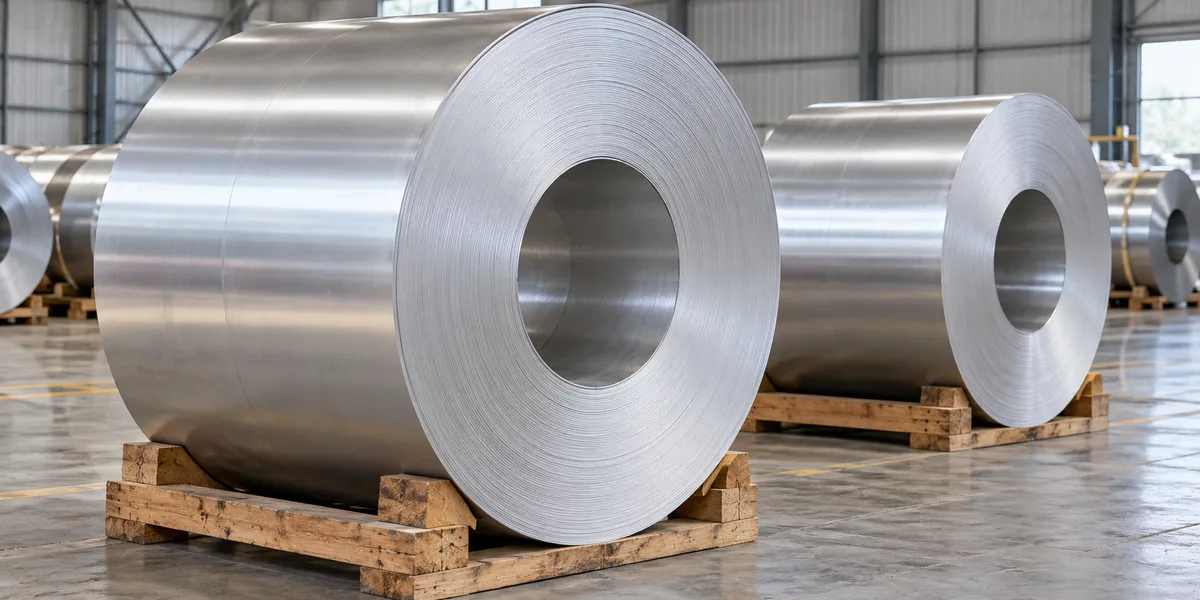
A closure is anything that seals a container: the roll-on pilfer-proof (ROPP) cap on a spirits or water bottle, the crimped seal on an antibiotic vial, the lug cap on a jam jar, or the end and ring-pull of a beverage can. Each starts as a coil of thin aluminium that is lacquered or printed, cut into blanks, drawn into a cup and then threaded, knurled or seamed.
Closure sheet looks simple but it is one of the most demanding flat-rolled products. Gauge must hold within a few microns so that cupping presses run without splits, the sheet must draw with very little earing so caps come out with an even skirt, and the surface must accept lacquer, ink and wax without blistering during pasteurisation or sterilisation. Mechanical strength has to be high enough to hold the thread and resist the torque applied on the capping line, yet low enough that the consumer can open the pack.
In Europe these requirements are set out in EN 541, the specification for rolled aluminium products for cans, closures and lids in the 0.150 – 0.500 mm range. Outside Europe, buyers usually order to ASTM B209 or the equivalent national sheet standard, plus a closure-specific technical agreement covering earing, coating weight and surface condition.
Most closures use a small group of alloys. The table matches each closure type to the alloys and tempers normally specified and the reason they are chosen.
| Closure type | Typical alloys | Typical tempers | Gauge (mm) | Why |
|---|---|---|---|---|
| ROPP caps (spirits, wine, water, oil) | 8011, 3105 | H14, H16, H24, H26 | 0.20 – 0.25 | Draws well, threads cleanly on the bottle, low earing |
| Screw caps for carbonated drinks | 3105, 8011 | H16, H26, H46 | 0.20 – 0.25 | Higher strength holds pressure and resists doming |
| Pharmaceutical vial seals (flip-off, tear-off) | 1060, 8011 | H14, H24, O | 0.15 – 0.30 | Very soft and clean; crimps tightly over rubber stoppers |
| Twist-off and lug caps for jars | 8011, 5182 | H14, H16 | 0.20 – 0.25 | Good balance of drawability and lug strength |
| Easy-open and peel-off ends | 5052, 5182, 8011 | H14, H16, H19 | 0.20 – 0.30 | Scoring and peeling performance, stiffness |
| Beverage can ends and tabs | 5182, 5052 | H19, H48 | 0.20 – 0.30 | High strength lets the end be thinner and resist internal pressure |
| Cosmetic caps, lipstick and perfume shells | 1070, 1080, 5005, 5657 | H18, H22 – H26 | 0.20 – 2.0 | Bright-anodising and chemical-brightening response |
The 8011 and 3105 choice for caps is mostly a trade-off between cost and strength. 8011 (Al-Fe-Si) is economical and draws very consistently; 3105 (Al-Mn-Mg) is stronger, so it is favoured where a cap must hold carbonation or a high application torque. 5182 (about 4.5 % Mg) is the standard end alloy because its strength allows down-gauging, while 5052 is used for smaller or lower-pressure ends.
Closure stock is supplied in strain-hardened tempers. H1x tempers are cold-rolled to strength; H2x tempers are rolled harder and partially annealed, giving the same strength with more elongation; H4x tempers are cold-rolled and then lacquered, where the curing oven provides the partial anneal. That last point matters: if you buy bare stock and lacquer it yourself, the oven cycle will lower the strength, so the mill needs to know.
| Alloy and temper | Tensile strength Rm | 0.2 % proof Rp0.2 | Notes |
|---|---|---|---|
| 8011A-H14 | 125 – 165 MPa | ≥ 110 MPa | EN 485-2 range for thin sheet |
| 3105-H14 | 150 – 200 MPa | ≥ 130 MPa | EN 485-2 range for thin sheet |
| 3105-H16 | 175 – 215 MPa | ≥ 160 MPa | EN 485-2 range for thin sheet |
| 5182-H19 (can end) | about 420 MPa typical | about 395 MPa typical | Aluminum Association typical values; lacquer cure lowers them slightly |
Closure stock is usually ordered to a tighter, customer-agreed strength window inside these limits, and mills differ by 10 – 20 MPa in what they offer. Treat the table as orientation; the agreed window and the mill certificate govern.
Earing is the second key property. When a round blank is drawn into a cup, the anisotropy of the rolled sheet makes the rim wavy, forming "ears" at 0/90° or 45° to the rolling direction. Ears waste metal at trimming and can cause uneven skirts or failed threads. Good closure sheet keeps earing to about 2 – 3 %, achieved by balancing hot-rolling, annealing and cold reduction.
Bare clean surface for converters who apply their own pretreatment and lacquer. Must be free of rolling-oil residue so lacquer adheres.
A conversion coating improves lacquer adhesion and corrosion resistance. Chrome-free (Ti/Zr) systems are increasingly required to meet regulations.
Epoxy, polyester or PVC-organosol lacquer protects the product and the outside of the cap. Typical film weights are a few g/m² per side.
Gold, white, red, blue or black outside coating, with a protective clear inside. Coloured and white coats are heavier than gold tints.
Lithographed decoration applied on coil or sheet before cupping, so flatness and dimensional stability are critical.
A light film of wax or dioctyl sebacate (DOS) on the surface helps drawing and threading. Typical DOS levels are measured in mg/m².
Coated closure stock is tested for adhesion, solvent resistance (for example, repeated rubs with methyl ethyl ketone or acetone) and resistance to pasteurisation or retort sterilisation at about 121 °C. For food and beverage contact the coating must comply with the relevant regulations in the destination market, such as EU Regulation 1935/2004 and US FDA 21 CFR 175.300, and should be BPA-NI (bisphenol A not intentionally added) where customers require it.
Exact gauge, width and coating combinations are confirmed against the closure drawing and the converter's line.
Common mistakes we see are ordering on a minimum strength only (which allows sheet too hard to draw), ignoring the effect of the lacquer oven on temper, and leaving earing unspecified. Each of these can turn a sound coil into high scrap rates on the press.
Each coil should be checked for thickness profile across the width, flatness, edge burr, surface defects and, for coated stock, film weight and cure. Earing is checked on cups drawn from samples taken at the coil head and tail. Results go on the mill certificate, together with chemistry and tensile data.
Closure coils are packed eye-to-sky or eye-to-wall on wooden pallets, wrapped in moisture barrier film with desiccant, and protected at the edges. Store them dry and above the dew point; condensation on cold coils causes water staining that cannot be lacquered over. Use first-in, first-out, because lubricant films and some coatings have a recommended shelf life.
ROPP and screw caps are mostly made from 8011 or 3105 in H14, H16 or the equivalent H2x/H4x tempers, at about 0.20 – 0.25 mm. 3105 is chosen when the cap needs more strength, for example on carbonated drinks.
Both are half-hard. H14 is reached by cold rolling alone. H44 means the sheet was cold-rolled and then lacquered, and the lacquer curing oven acted as a partial anneal. Ordering the right designation tells the mill how to roll the sheet so it ends up in the correct strength window after coating.
Earing is the wavy rim that forms when sheet with directional properties is drawn into a cup. High earing wastes metal at trimming and gives uneven cap skirts. Closure sheet is usually specified at 2 – 3 % maximum earing.
Soft, clean 1060 or 8011 strip, about 0.15 – 0.30 mm thick, slit to narrow widths. It is lacquered or colour-coated and must withstand steam sterilisation without the coating lifting or changing colour.
5182 has about 4.5 % magnesium, so in H19 or H48 temper it is much stronger than cap alloys. That strength lets the end be thin and still resist the internal pressure of a carbonated or pasteurised drink, and it scores and opens reliably with a ring-pull.
Yes. We supply closure stock bare, pretreated, lacquered or colour-coated, slit to width, with mill certificates and coating test results, and ship it worldwide in export packing.
Tell us the closure type, alloy, temper, gauge, width and coating. We will propose the material, certificates and delivery terms for your plant.





