Container foil
O, H22 or H24 foil around 30 – 120 µm, bare or lacquered, for smooth-wall and wrinkle-wall food containers and baking trays.



8011 aluminium foil is an aluminium-iron-silicon foil alloy that is noticeably stronger and stiffer than pure 1xxx foils while staying easy to form, emboss and lacquer. That combination makes it the default alloy for foil food containers, pharmaceutical blister lidding, household foil and air-conditioner fins. Metline supplies 8011 foil in O, H14, H18, H22 and H24 tempers, bare, lacquered or coated, to converters worldwide.
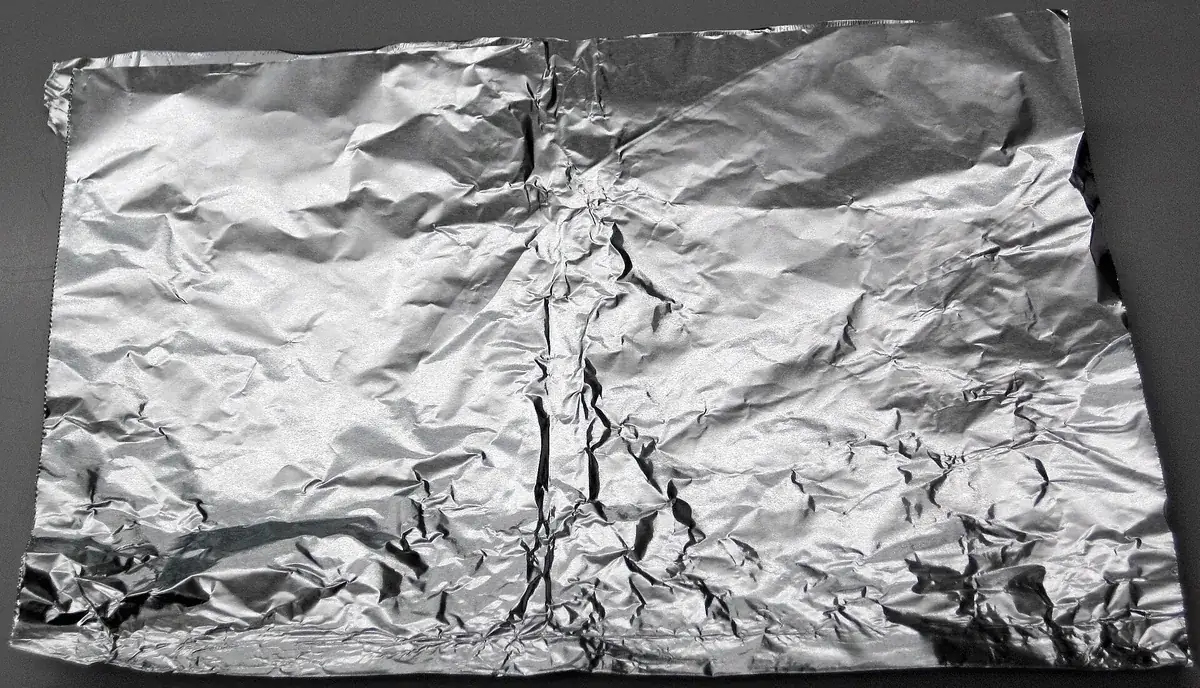
8011 is an 8xxx-series alloy in which iron (0.6 – 1.0 %) and silicon (0.5 – 0.9 %) are added on purpose rather than tolerated as impurities. They form a fine dispersion of Al-Fe-Si particles that strengthen the foil, keep the grain size small after annealing and give it better puncture and tear resistance than 1235 or 1100 foil of the same gauge.
The fine grain is the real advantage. In fully annealed (O) condition 8011 is still soft enough to fold and wrap, but it has more elongation at heavier gauges and draws into deep trays without tearing or orange-peel. In the partially annealed H22 and H24 tempers it keeps enough stiffness for a container to hold its shape when filled and lifted. In the hard H18 temper it is strong enough to act as a push-through lidding that tears cleanly when a tablet is pressed out.
The price of that strength is slightly lower conductivity and a practical lower gauge limit: 8011 can be rolled to about 6 – 7 µm, but the very thinnest laminating foils are more often made in 1235. Above about 9 µm, 8011 is the workhorse foil for food service, pharmaceutical and building products.
Registered Aluminum Association limits. In Europe the closely related EN AW-8011A (AlFeSi) is the usual designation, with slightly different limits; tell us which one your specification names.
| Element | Minimum | Maximum | What it does |
|---|---|---|---|
| Silicon (Si) | 0.50 | 0.90 | Forms Al-Fe-Si particles with iron |
| Iron (Fe) | 0.60 | 1.00 | Main strengthening and grain-refining addition |
| Copper (Cu) | — | 0.10 | |
| Manganese (Mn) | — | 0.20 | Small additional strengthening |
| Magnesium (Mg) | — | 0.05 | |
| Chromium (Cr) | — | 0.05 | |
| Zinc (Zn) | — | 0.10 | |
| Titanium (Ti) | — | 0.08 | Grain refiner |
| Others, each / total | — | 0.05 / 0.15 | |
| Aluminium (Al) | Remainder | About 97.3 – 98.9 % |
8011 meets the composition requirements of EN 602 for aluminium in contact with food. Food-contact declarations and migration test reports can be supplied on request.
As with all foil, strength and elongation vary with gauge, and the governing values are the temper and thickness bands in EN 546-2 or the customer specification. The ranges below are indicative to help you pick a temper; confirm the exact limits at order stage.
| Temper | Condition | Tensile strength (indicative) | Elongation (indicative) | Typical uses |
|---|---|---|---|---|
| O | Fully annealed | About 80 – 130 MPa | Low (1 – 4 %) at 10 – 20 µm; 10 % and more above about 40 µm | Household foil, containers, laminates, cable wrap |
| H22 | Strain-hardened, partially annealed (quarter hard) | About 100 – 140 MPa | Moderate | Smooth-wall and wrinkle-wall containers, lids |
| H24 | Strain-hardened, partially annealed (half hard) | About 120 – 160 MPa | Moderate | Containers needing more rigidity, fin stock |
| H14 / H16 | Strain-hardened (half / three-quarter hard) | About 120 – 170 MPa | Low | Closure stock, fin stock, technical foil |
| H18 | Full hard | About 150 – 200 MPa | 1 – 3 % | Blister (PTP) lidding, labels, stiff laminates |
H2x tempers are worth understanding. "H22" and "H24" foil is rolled harder than needed and then partially annealed back, rather than rolled directly to quarter or half hard (H12/H14). The partial anneal gives more elongation at the same strength, which is exactly what a container press needs: the walls form without splitting, and the finished tray still resists denting.
O, H22 or H24 foil around 30 – 120 µm, bare or lacquered, for smooth-wall and wrinkle-wall food containers and baking trays.
H18 foil around 20 – 25 µm, primer-printed on one side and heat-seal lacquered on the other, for sealing to PVC, PVDC or PP blister trays.
O-temper foil around 10 – 25 µm in jumbo rolls for rewinding into kitchen and catering rolls.
H22, H24 or H26 foil around 0.1 – 0.2 mm, bare or with hydrophilic coating, for air-conditioner and heat-exchanger fins.
Epoxy, polyester or vinyl lacquers, gold and colour coatings for lids, containers and decorative packaging.
Laminated to paper or film for labels, insulation facings and roofing membranes; embossed patterns add stiffness and grip.
Area per kilogram is about 369 ÷ thickness in µm for 8011. The table gives quick figures; the foil weight calculator works out full coil weights.
| Thickness (µm) | g per m² | m² per kg | Common use |
|---|---|---|---|
| 9 | 24.4 | 41 | Household foil, laminates |
| 11 | 29.8 | 34 | Household foil |
| 15 | 40.7 | 25 | Heavy household and catering foil |
| 20 | 54.2 | 18 | Blister lidding, catering foil |
| 25 | 67.8 | 15 | Blister lidding |
| 40 | 108 | 9.2 | Lids, light containers |
| 70 | 190 | 5.3 | Food containers |
| 100 | 271 | 3.7 | Containers, fin stock |
| 150 | 407 | 2.5 | Fin stock, heavy containers |
For container foil, the most common cause of rejects is temper drift: foil that is too hard splits at the corners of deep trays, and foil that is too soft produces flimsy containers. Agree the tensile and elongation window with your container press supplier, write it on the order, and check it on every lot. For blister lidding, peel and burst strength depend as much on the heat-seal lacquer as on the foil, so specify the lacquer system and the tray material together.
| Property | 8011 | 1235 | 8079 | 3003 |
|---|---|---|---|---|
| Main alloying | Fe 0.6 – 1.0, Si 0.5 – 0.9 | None (Al ≥ 99.35) | Fe 0.7 – 1.3, low Si | Mn 1.0 – 1.5 |
| Strength | Medium | Low | Medium | Medium–high |
| Elongation in O temper | Good | Fair | Very good | Good |
| Thin-gauge rolling | Good from about 9 µm | Excellent to 6 µm | Excellent to 6 µm | Heavier gauges |
| Typical uses | Containers, lidding, household, fins | Laminates, battery, cable | Flexible and cold-form pharma packaging | Rigid containers, fins |
In practice, 8011 and 3003 compete for container foil, with 3003 chosen for heavier, more rigid trays. For very thin laminating foil, 1235 or 8079 roll more easily. For cold-form blister foil, where the aluminium must stretch with the laminate, 8021 or 8079 with high elongation is the norm. See our 1235 foil page for the pure-aluminium alternative.
8011 contains deliberate iron and silicon additions that make it stronger, stiffer and more puncture resistant. 1235 is 99.35 % pure aluminium, softer and more conductive, and rolls more easily to 6 µm. Use 8011 for containers, lidding and household foil; 1235 for thin laminates, battery and cable foil.
Usually O, H22 or H24 depending on how deep the container is and how rigid it must be. Deep trays favour softer tempers; shallow, rigid trays favour H24. Your container press supplier will usually specify a tensile and elongation window.
Yes. Its composition complies with EN 602 for food contact, and it is widely used for containers, household foil and pharmaceutical packaging. We can supply food-contact declarations on request.
Push-through blister lidding is typically 20 – 25 µm in H18 temper, printed on one side and coated with heat-seal lacquer on the other.
Yes. It takes epoxy, polyester and vinyl lacquers, heat-seal coatings, colour coatings and hydrophilic coatings for fin stock, as well as printing, lamination and embossing.
Yes. Metline supplies 8011 foil worldwide from Mumbai with mill certificates and moisture-proof export packing, on EXW, FOB, CIF or DAP terms.
Send temper, gauge, width, coating and coil details with your volume. We will reply with availability, documentation and a delivered price.






