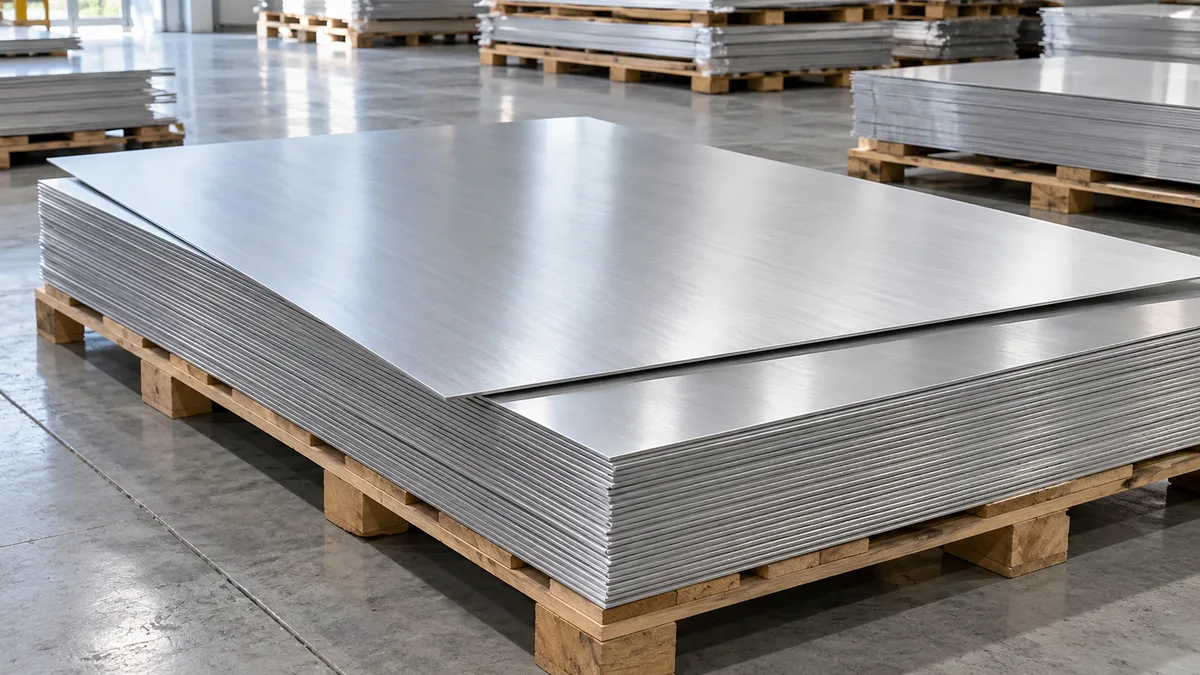
Corrugated Aluminium Metal: Profiles, Alloys and Specification
Corrugated aluminium (corrugated aluminum metal in the US) is flat sheet roll-formed into a repeating wave or rib so that a thin, light sheet can span between purlins and shed water. This guide explains the common profiles, which alloy and temper to choose for your climate, how thick the sheet should be, and the fixing details that decide whether a roof lasts decades or leaks in its first monsoon. Metline supplies the aluminium sheet and coil for corrugated and ribbed panels to roll-formers and project buyers worldwide.
Corrugating turns a flexible sheet into a stiff panel. Forming a 0.7 mm sheet into a 22 mm deep wave raises its bending stiffness across the corrugations many times over, so the sheet can span a metre or more between supports while weighing only around 2 – 3 kg per square metre.
The panel starts as aluminium coil, usually a 3xxx or 5xxx alloy in a strain-hardened temper. The coil is slit to width, optionally coated, and fed through a roll-forming line where successive pairs of rolls bend it progressively into the final profile before it is cut to length. Because the profile is created after the metal leaves the rolling mill, the sheet properties (alloy, temper, thickness and coating) and the profile geometry (pitch, depth and cover width) are two separate parts of the specification, and both matter.
Aluminium is chosen over galvanised or zinc-aluminium coated steel where corrosion would shorten the life of steel: coastal buildings, humid tropical climates, fertiliser stores, livestock sheds, paper mills and chemical plants. Aluminium forms its own protective oxide film, so a scratch or a cut edge does not start red rust. It also weighs roughly one third as much as steel of the same thickness, which reduces structural load and makes handling on the roof easier.
Profiles
Common corrugated and ribbed profiles
Profile names come mainly from the North American market, but the same geometries are rolled worldwide under local names. The pitch is the distance from one crest to the next; the depth is the crest-to-valley height. Deeper profiles span further and resist wind uplift better but use more metal per square metre of cover.
Profile
Geometry
Typical use
Notes
Classic corrugated
2.67 in (68 mm) pitch, 7/8 in (22 mm) depth, sinusoidal
Roofing, siding, fencing, agricultural buildings
The most widely recognised wave; overlaps by one or more corrugations at side laps
Shallow corrugated
2.67 in pitch, 1/2 in or 3/4 in depth
Siding, soffits, interior and decorative walls
Less stiff than 7/8 in; mainly for walls or short spans
Large corrugated
Wider pitch, e.g. 4.2 in (107 mm) or 76 mm
Industrial siding, pulp and paper plants, heavy-duty walls
Higher section stiffness for the same thickness
R-panel / PBR
Trapezoidal ribs on 12 in centres, about 1¼ in high, 36 in cover
Roofs and walls on commercial and agricultural buildings
PBR adds a purlin-bearing leg at the side lap for better support
Box rib
Rectangular ribs on 4, 6 or 8 in centres
Wall cladding, screening, fencing
Crisp architectural lines; typically walls rather than low-slope roofs
7.2 panel
Trapezoidal ribs on 7.2 in centres, about 1½ in high
Structural profiles designed to load tables; mostly steel, aluminium for corrosive sites
Cover width (net coverage) is the width each sheet actually covers after the side lap, and it is always narrower than the overall width of the sheet. A classic 7/8 in corrugated sheet may be rolled from coil of about 1000 – 1250 mm and cover roughly 760 – 1000 mm depending on the number of corrugations and the lap used on roofs or walls. Always calculate quantities from the cover width on the profile drawing, and specify whether the sheet is for roof (more lap) or wall use.
Perforated corrugated sheet is also made, for screens, ventilated façades and acoustic linings. Perforation is done on the flat coil before forming; see our perforated aluminium sheet guide.
Material selection
Which alloy and temper for corrugated aluminium?
All the usual corrugating alloys are non-heat-treatable: they gain strength by cold rolling, shown by the H temper. The first digit after H gives the processing route (H1x strain-hardened only, H2x strain-hardened and partly annealed, H3x strain-hardened and stabilised), and the second digit the hardness level (2 quarter-hard, 4 half-hard, 6 three-quarter hard, 8 full hard). H2x and H3x tempers keep slightly more ductility than H1x at the same strength, which helps the sheet survive roll-forming without cracking at the crests.
Alloy / temper
Typical tensile strength
Typical yield strength
Best for
1100-H14 / 1050-H14
125 MPa / 110 MPa
115 MPa / 105 MPa
Light cladding, ceilings, partitions, decorative work
3003-H14
150 MPa
145 MPa
General roofing and siding, trims and flashings
3105-H25
180 MPa
160 MPa
Painted roofing and rainwater goods
3004-H34 / H36
240 MPa / 260 MPa
200 MPa / 230 MPa
Long spans, higher wind and foot traffic, thinner gauges
5005-H34
160 MPa
140 MPa
Anodised architectural cladding with even colour
5052-H32 / H34
230 MPa / 260 MPa
195 MPa / 215 MPa
Coastal, marine and chemical environments
Typical values from Aluminum Association and ASM data for sheet; guaranteed minimums are lower and are set by ASTM B209 or EN 485-2 for each thickness band. The mill certificate shows the actual values for the lot.
3003 and 3004
Manganese gives 3003 about 20 % more strength than pure aluminium with the same easy forming and corrosion behaviour. 3004 adds about 1 % magnesium and is noticeably stronger, so a roof can often use a thinner 3004 sheet than 3003 for the same span. These are the volume alloys for corrugated roofing.
5052
With about 2.5 % magnesium, 5052 resists salt spray and industrial pollutants better than 3xxx alloys and is stronger again. It is the safe choice within sight of the sea, at ports and fish-processing sites, and on fertiliser or chemical stores.
5005
A low-magnesium alloy chosen because it anodises to a clear, uniform finish that matches 6063 extrusions. Use it when the corrugated sheet will be anodised rather than painted.
1xxx series
Commercially pure 1050, 1060 and 1100 are the most formable and highly corrosion-resistant, but soft. They suit decorative and low-load cladding; see the 1050, 1060 and 1100 corrugated sheet guide.
Temper choice
Harder tempers (H36, H34) resist denting and span further; softer tempers (H14, H24) form tighter curves and are easier for site bending of flashings. Curved (bull-nosed or barrel) corrugated roofs need a temper confirmed with the curving supplier.
6xxx alloys
6061 and 6063 are sometimes asked for, but they are rarely used for corrugated sheet because they are heat-treatable and less suited to continuous roll-forming. Stay with 3xxx or 5xxx unless a specific design requires otherwise.
Gauge and weight
How thick should corrugated aluminium be?
Thickness depends on purlin spacing, design wind load, snow load, foot traffic during maintenance and how much dent resistance the building needs. As a practical starting point, 0.5 – 0.6 mm suits walls, fencing and sheds; 0.7 – 0.9 mm suits most roofs on purlins at around 0.9 – 1.2 m; and 1.0 – 1.2 mm is used for long spans, high-wind regions and industrial siding exposed to impact. Final thickness should come from the roll-former's load-span tables for the specific profile and alloy.
Be careful with gauge numbers. Aluminium gauges do not correspond to the same thickness as steel gauges, and different charts are in circulation. A "26 gauge" aluminium sheet and a 26 gauge steel sheet are different thicknesses. Specify millimetres or decimal inches (for example 0.032 in, 0.040 in or 0.050 in, which are common North American aluminium corrugated thicknesses) on every order.
Thickness (mm)
Flat sheet (kg/m²)
Classic 7/8 in corrugated, per m² of sheet face (kg)
0.4
1.09
1.34
0.5
1.36
1.67
0.6
1.63
2.01
0.7
1.90
2.34
0.8
2.18
2.68
0.9
2.45
3.01
1
2.72
3.35
1.2
3.26
4.01
1.5
4.08
5.02
Weights use a density of 2.72 g/cm³ (3xxx alloys). Corrugated values include a take-up factor of about 1.23 for a 22 mm deep, 68 mm pitch wave; shallower profiles use less metal. Add the side-lap allowance when converting to weight per square metre of roof covered. Use the sheet weight calculator for other sizes.
Finishes & coatings
Mill finish, painted, PVDF and anodised options
Finish
What it is
Where it fits
Mill finish
Bare aluminium as rolled; weathers to a dull grey
Agricultural and industrial buildings where appearance is secondary
Stucco embossed
Textured surface rolled in before forming; hides scratches and glare
Factory-applied paint on a coil coating line, typically about 20 – 25 µm topcoat
General roofing and walls in normal environments
PVDF coil coating
Fluoropolymer paint with high resistance to UV fading and chalking
Coastal sites, strong sun and long design lives
Powder coating
Applied to cut sheets after forming
Small architectural runs and custom colours
Anodising
Electrochemical oxide layer; 5005 gives the most even colour
Architectural cladding with a metallic look, including black
Coil coatings for aluminium are specified under EN 1396 in Europe, and many projects call for AAMA 2603, 2604 or 2605 test performance (2605 being the highest level, typically met by 70 % PVDF systems). For colour consistency on a façade, order every panel for one elevation from the same coating lot and approve a physical colour sample, not a screen image. Metline can supply colour-coated aluminium coil and sheet or stucco embossed coil for roll-forming.
Installation
Fixing details that prevent leaks and corrosion
Most corrugated aluminium roofs are exposed-fastener systems, and most failures trace back to laps, fasteners or contact with other metals rather than to the sheet itself.
Lay laps away from the weatherStart at the end of the roof opposite the prevailing wind so side laps face away from driving rain. Use at least one and a half corrugations of side lap on roofs; end laps of 150 – 200 mm are common on moderate slopes, with sealant tape on low slopes.
Fix through the crest on roofsOn roofs, screw through the crest of the corrugation so water runs away from the hole; on walls, valley fixing is normal. Use fasteners with bonded EPDM sealing washers and tighten until the washer just compresses.
Allow for thermal movementAluminium expands about 23 µm per metre per °C, roughly twice as much as steel. A 6 m sheet that heats by 50 °C grows about 7 mm. On long sheets, oversize the holes at the fixings away from the fixed point, or use clips and slotted fixings so the sheet can move.
Isolate dissimilar metalsUse stainless steel (austenitic) or aluminium fasteners. Never let water run from copper, lead or bare steel onto aluminium, and separate aluminium from steel purlins with tape or a coated surface. Keep sheet off treated timber containing copper preservatives and away from wet concrete or mortar.
Detail edges and penetrationsUse profiled closures at eaves and ridges, matched flashings for verges and valleys, and flashing kits designed for aluminium at pipe and vent penetrations.
Handle with careLift sheets rather than dragging them, keep bundles dry and ventilated in storage to avoid water staining, and remove protective film soon after installation.
This is general guidance. Follow the profile manufacturer's fixing instructions and local building codes for fastener spacing, which depends on design wind load.
Comparison
Corrugated aluminium vs galvanised and Galvalume steel
Factor
Corrugated aluminium
Galvanised / zinc-aluminium coated steel
Density
2.7 g/cm³, about one third of steel
7.85 g/cm³
Corrosion at cut edges and scratches
Self-protecting oxide film; no red rust
Relies on zinc or zinc-aluminium coating; edges can rust in coastal air
Coastal performance
Very good, especially 5052 with PVDF
Coating consumed faster by salt; manufacturers often restrict warranties near the sea
Strength and dent resistance
Lower for equal thickness; use thicker sheet or harder temper
Higher for equal thickness
Thermal expansion
About 23 × 10⁻⁶ /°C
About 12 × 10⁻⁶ /°C
Solar reflectance (bare)
High; reflects much of the sun's heat
Moderate, falls as the zinc dulls
Material cost
Higher per square metre
Lower per square metre
End of life
High scrap value and endlessly recyclable
Recyclable, lower scrap value
Choose aluminium where the environment is aggressive, the building must last a long time with little maintenance, or weight matters (re-roofing over old structures, remote sites, transport of material). Choose coated steel when the site is inland and dry, budgets are tight and higher dent resistance at thin gauges is needed.
Ordering
How to specify and order material for corrugated panels
Define the applicationRoof or wall, location and exposure (inland, coastal, industrial), purlin spacing and design wind or snow load.
Choose the profileSend the profile drawing or name with pitch, depth, overall width and cover width.
Specify the sheetAlloy and temper (for example 3004-H36 or 5052-H32), thickness in mm or inches, governing standard (ASTM B209, EN 485 / EN 508-2) and coating system with colour.
Give the cut listCoil width and weight for roll-formers, or sheet lengths and quantities for cut-to-length supply.
Confirm documents and termsMill test certificate to EN 10204 3.1, coating test report where needed, export packing and delivery terms (EXW, FOB, CIF or DAP).
Related
Related products and guides
Alloy-specific corrugated guides, the sheet grades behind them, and related roofing and cladding pages:
Roofing and wall cladding on agricultural, industrial and residential buildings, fencing and screens, trailer and container panels, soffits, interior feature walls and the cores of sandwich panels. It is chosen where light weight and corrosion resistance matter more than lowest first cost.
What are the disadvantages of aluminium roofing?
It costs more per square metre than coated steel, dents more easily at the same thickness, expands about twice as much with temperature, and can corrode if it touches copper, bare steel or copper-treated timber. Correct thickness, temper, fasteners and movement detailing deal with each of these.
Which is better for coastal roofs, 3003 or 5052?
For buildings close to the sea, 5052 is the better choice because its magnesium content gives higher resistance to salt spray and it is stronger. 3003 and 3004 perform well inland and in mildly coastal areas, especially with a PVDF coating.
Is 26 gauge aluminium the same thickness as 26 gauge steel?
No. Aluminium and steel gauge charts differ, and several aluminium charts are in use. Always state the thickness in millimetres or decimal inches when ordering corrugated aluminum.
How long does a corrugated aluminium roof last?
With a suitable alloy, a good coil coating and correct fixing, aluminium roofs commonly give several decades of service; bare mill-finish sheet in clean inland air can last as long because the oxide film keeps renewing. Life is shortened mainly by galvanic contact, ponding water and poor fastener sealing.
Can corrugated aluminium be anodised in black or other colours?
Yes. Order 5005 in anodising quality for the most even result, keep all panels for one elevation from the same lot and approve an anodised sample before production. Slight shade variation between alloys and batches is normal.
Sourcing aluminium for corrugated panels?
Tell us the profile, alloy, temper, thickness, coating, quantity and destination. We will reply with availability, certification and a delivered price.