Round holes, 60° staggered
The most common pattern. The staggered layout gives the strongest sheet and the highest open area for a given hole size and pitch, and it looks uniform from every angle.



Perforated aluminium sheet is flat sheet or coil punched with a regular pattern of holes, used for facades, ceilings, acoustic panels, machine guards, ventilation grilles and filters. Its performance depends on four choices: the alloy and temper, the sheet thickness, the hole shape and pitch, and the finish. This guide explains each one, shows how to calculate open area and weight, and lists the information a perforator needs to quote.
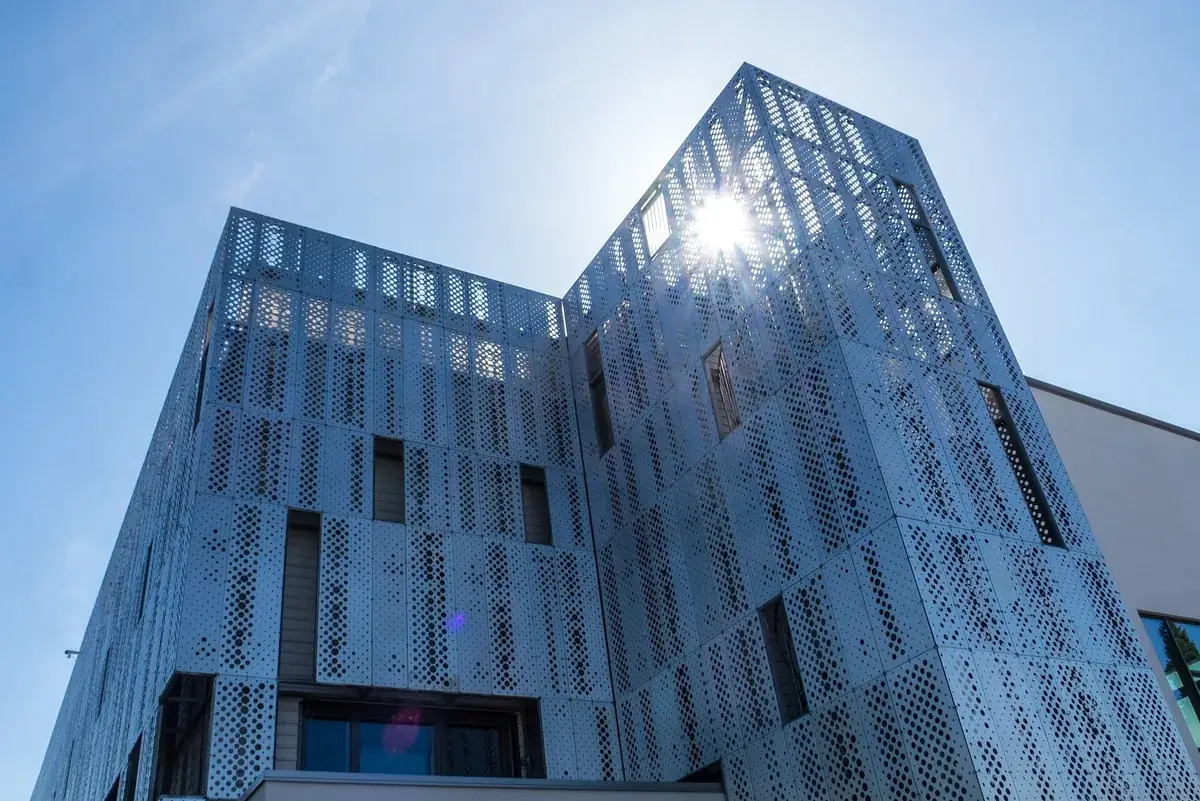
Perforated aluminium sheet, also called punched aluminium sheet or perforated aluminium panel, starts as ordinary rolled sheet or coil. A press punches thousands of identical holes in a repeating pattern, after which the sheet is levelled, trimmed and, if required, coated. The result keeps most of the stiffness of solid sheet while letting air, light, sound and liquid pass through it.
Aluminium is the default metal for perforated panels in buildings and transport because it is about one third of the weight of steel for the same thickness, does not rust, and accepts anodising, powder coating and PVDF paint. The holes can be round, square, slotted, hexagonal or decorative, and they can cover the whole sheet or leave plain margins for fixing.
Most perforated sheet is produced in two ways. High-volume standard patterns are made on wide multi-tool presses that punch a full row with each stroke, feeding from coil. Custom and decorative layouts are punched on CNC turret presses or, for thicker gauges and complex shapes, cut by laser. Punching is faster and cheaper per hole; laser cutting removes the need for a dedicated tool and suits one-off artwork patterns.
Punching works best in alloys with good ductility. A temper that is too hard tends to crack between holes, while a temper that is too soft leaves burrs and distorts. The grades below cover nearly all perforated work; the base sheet is supplied to ASTM B209 or EN 485 and the chemistry to EN 573-3.
| Alloy | Typical tempers | Character | Typical perforated uses |
|---|---|---|---|
| 1050 / 1100 | H14, H24 | Commercially pure, very ductile, lowest strength | Acoustic ceiling tiles, light grilles, filter screens |
| 3003 | H14, H24 | Mn-alloyed, a little stronger than 1100, punches cleanly | HVAC grilles, speaker grilles, general-purpose panels |
| 5005 | H14, H34 | Low Mg, matches anodised colour well | Anodised facade and ceiling panels |
| 5052 | H32, H34 | Higher strength, very good corrosion resistance | Marine grilles, vehicle panels, exterior cladding, step plates |
| 6061 | T6 | Heat-treatable, stiff and strong; less formable | Machine guards, platforms, structural screens |
| 6063 | T5, T6 (extruded) | Usually an extrusion alloy; perforated profiles and louvre blades | Sunshade blades, perforated profiles |
For facade cladding that will be anodised, 5005 is generally preferred because it gives a more even colour than 3003 or 5052. For panels that will be bent along the hole field, choose an H24 or H34 temper rather than H14 or H18: the partial annealing in the "2" and "3" tempers leaves more elongation for forming. 6061-T6 is chosen when strength matters, but it needs generous bend radii and is harder on tooling.
Values for each grade are given on the mill test certificate supplied with the base sheet. Perforating removes material but does not change the alloy or temper.
The most common pattern. The staggered layout gives the strongest sheet and the highest open area for a given hole size and pitch, and it looks uniform from every angle.
Holes in square rows. Lower open area than staggered for the same pitch, but simpler to set out where fixings or brackets must align with the hole grid.
Square holes in straight rows give a very high open area and a clean, technical look. Popular for screens and partitions.
Long slots, straight or staggered, with round or square ends. Used where directional airflow, drainage or a linear appearance is needed, and in grain-drying and sorting screens.
Hexagons nest closely, so very high open area is possible with narrow bars. Common in speaker grilles, radiator covers and lightweight guards.
Diamond, cross, fish-scale and custom shapes, or graded hole sizes that build an image across a facade. Usually CNC punched or laser cut.
Two dimensions define any round-hole pattern: the hole diameter (D) and the pitch, also called the centre distance (P), measured from the centre of one hole to the centre of the next. The solid strip left between holes is the bar or bridge. Pattern orientation also matters: on a long sheet, the stagger can run along the length or across it, and the two orientations look different and behave differently when the sheet is bent.
Open area is the percentage of the sheet surface taken up by holes. It controls airflow, light transmission, acoustic transparency, weight and strength, so it is the single most important number in a perforated sheet specification. Use these formulas:
| Pattern | Open area formula (%) |
|---|---|
| Round holes, 60° staggered | 90.69 × D² ÷ P² |
| Round holes, straight 90° rows | 78.54 × D² ÷ P² |
| Square holes, straight rows | 100 × W² ÷ P² (W = hole width) |
| Slots, straight rows | 100 × (W × L − 0.215 W²) ÷ (Pw × Pl) for round-end slots |
The table below applies the formulas to common round-hole patterns. Imperial patterns are widely used in North America; metric patterns elsewhere.
| Hole (in) | Stagger pitch (in) | Open area, 60° staggered |
|---|---|---|
| 1/16 | 3/32 | 40 % |
| 1/8 | 3/16 | 40 % |
| 3/16 | 1/4 | 51 % |
| 1/4 | 3/8 | 40 % |
| 3/8 | 9/16 | 40 % |
| 1/2 | 11/16 | 48 % |
| 3/4 | 1 | 51 % |
| 5/32 | 3/16 | 63 % |
| 1/16 | 1/8 | 23 % |
| Hole (mm) | Pitch (mm) | Open area, 60° staggered | Open area, straight rows |
|---|---|---|---|
| 1 | 2 | 22.7 % | 19.6 % |
| 2 | 3.5 | 29.6 % | 25.6 % |
| 3 | 5 | 32.6 % | 28.3 % |
| 5 | 8 | 35.4 % | 30.7 % |
| 8 | 12 | 40.3 % | 34.9 % |
| 10 | 15 | 40.3 % | 34.9 % |
There is a practical ceiling. The bar between holes has to be wide enough to punch reliably, which in aluminium normally means a bar no narrower than the sheet thickness. That limits round-hole patterns to about 60 – 65 % open area. Higher figures are possible with hexagonal or square holes, or with expanded metal instead of perforated sheet.
Open area figures are geometric. Measured airflow and acoustic performance also depend on sheet thickness, hole edge condition and any backing material.
Hole size is normally at least equal to the sheet thickness. Smaller holes in thicker sheet need special tooling or laser cutting.
Solid aluminium sheet weighs about 2.70 kg per square metre for every millimetre of thickness (2.68 kg for 5052). A perforated sheet weighs the solid weight multiplied by (1 − open area). For example, a 1220 × 2440 × 2 mm sheet in 3003 weighs about 16.1 kg solid; with 40 % open area it weighs about 9.6 kg. Use the plate and sheet weight calculator for the solid figure, then apply the open-area factor.
| Thickness (mm) | Solid kg/m² | kg/m² at 30 % open | kg/m² at 40 % open | kg/m² at 50 % open |
|---|---|---|---|---|
| 0.5 | 1.35 | 0.94 | 0.81 | 0.68 |
| 0.8 | 2.16 | 1.51 | 1.30 | 1.08 |
| 1 | 2.70 | 1.89 | 1.62 | 1.35 |
| 1.2 | 3.24 | 2.27 | 1.94 | 1.62 |
| 1.5 | 4.05 | 2.84 | 2.43 | 2.03 |
| 2 | 5.40 | 3.78 | 3.24 | 2.70 |
| 2.5 | 6.75 | 4.72 | 4.05 | 3.38 |
| 3 | 8.10 | 5.67 | 4.86 | 4.05 |
| 4 | 10.80 | 7.56 | 6.48 | 5.40 |
| 5 | 13.50 | 9.45 | 8.10 | 6.75 |
| 6 | 16.20 | 11.34 | 9.72 | 8.10 |
Perforated sheet can be finished before or after punching. Coating coil before perforating is economical but leaves raw aluminium on the hole edges; coating after punching covers the edges and is preferred for exterior work. Common options:
The as-rolled surface. Suitable for hidden acoustic layers, filters and industrial guards.
Clear, bronze, black and other colours. Hard, integral and lightfast; specify an anodising-quality alloy such as 5005 for an even appearance.
Any RAL colour in matt, satin or gloss; covers hole edges. Choose a facade-grade (e.g. Qualicoat class 2) powder for outdoor exposure.
Fluoropolymer paint for high-exposure facades, with very good colour and gloss retention. Metallic and mica effects are available.
Directional or reflective finishes for interiors, retail and signage.
Transfer-printed patterns that imitate timber or stone on ceilings and soffits.
Metline supplies the perforated aluminium sheet and coil; the ceilings, facade systems, grilles and furniture are made by fabricators and system companies using that material. For ceiling trays and cladding systems, see the related guides below.
There is no single alloy standard for perforated sheet. The base material is specified to the normal sheet standards, and the perforation pattern is defined by your drawing or by an industry reference.
| Aspect | Reference | Notes |
|---|---|---|
| Base sheet chemistry and properties | ASTM B209, EN 485-2, EN 573-3, JIS H4000 | Mill certificate for the parent coil or sheet |
| Base sheet dimensions | ANSI H35.2, EN 485-4 | Thickness, width, length and flatness before perforating |
| Perforated plate specification | ISO 10630 | Industrial perforated plates: specification and test methods |
| Hole designations and tolerances | Industrial Perforators Association (IPA) handbook | Widely used in North America for pattern names and tolerances |
| Coatings | Qualicoat, AAMA 2604 / 2605, EN 12206-1 | Powder and liquid coatings on architectural aluminium |
Inspection normally covers hole diameter and pitch, pattern position relative to the sheet edges, overall dimensions and squareness, flatness after levelling, burr height and coating thickness. Each delivery is supplied with an EN 10204 3.1 mill test certificate for the base metal.
Round holes on a 60° staggered pitch. A 1/8 in hole on 3/16 in centres, or a 3 mm hole on 5 mm centres, are typical general-purpose patterns, with about 40 % and 33 % open area respectively.
3003-H14 for general indoor use, 5005 for anodised architectural panels, 5052-H32 for outdoor and marine exposure, and 6061-T6 when strength and stiffness matter more than formability.
Multiply the solid weight (2.70 kg/m² per mm of thickness) by one minus the open area. A 2 mm sheet with 40 % open area weighs 5.4 × 0.6 = 3.24 kg/m².
As a rule, the hole diameter should be at least equal to the sheet thickness. Micro-perforation below 1 mm is possible in thin gauges; smaller holes in thicker sheet need laser cutting or special tooling.
Yes. Use an H24 or H34 temper, a bend radius of at least one to two times the thickness, and preferably a plain margin along the bend line. Bending through holes leaves an uneven edge.
Yes. Choose 5005 or 5052, and anodise or PVDF/powder coat after perforating so the hole edges are protected. Check panel stiffness and wind load with the facade engineer.
Send the alloy, thickness, hole pattern, size, finish and quantity. Our team will confirm the pattern and reply with a delivered price.





