Mill finish
Bare, bright aluminium that weathers to a soft grey. The lowest cost and fully recyclable.



Corrugated sheet in 1050, 1060 or 1100 pure aluminium is the lightest, most formable and most weather-resistant option for low-load roofing, wall cladding, interiors and vehicle linings. It weighs about a third as much as steel sheet of the same thickness and does not rust. The trade-off against 3003 or 3105 sheet is lower strength, which affects purlin spacing and foot traffic. This guide covers alloy choice, profiles, coatings and ordering.
Corrugated sheet is flat aluminium coil roll-formed into a repeating wave or trapezoidal rib. The profile multiplies the bending stiffness of thin sheet many times over, so a 0.5 – 0.9 mm sheet can span between purlins or rails and shed water.
The 1xxx grades used here are at least 99 % aluminium. They are softer than the 3xxx alloys more commonly used for structural roofing, which makes them very easy to roll-form, bend on site and crimp, and gives them the best natural corrosion resistance of any aluminium. They are a good fit for coastal and industrial atmospheres, for interiors where appearance matters and for applications such as reflective insulation cladding, vehicle bodies and agricultural buildings.
Their lower strength means you should use them with closer support spacing, or choose a deeper profile or thicker gauge, than you would for 3003 or 3105 sheet. For roofs that will carry foot traffic or high snow and wind loads, compare both options with the roof designer.
| Alloy | Purity / type | Typical H14 tensile | Strengths | Typical use |
|---|---|---|---|---|
| 1050 | 99.50 % Al | 105 – 145 MPa | Low cost, very formable, bright surface | General cladding, interiors, insulation jacketing |
| 1060 | 99.60 % Al | 97 – 131 MPa | Slightly purer, high reflectivity | Reflective roofing and linings |
| 1100 | 99.00 % Al + Cu | 110 – 145 MPa | A little stronger, still very formable | Roofing and wall sheet, vehicle linings |
| 3003 / 3105 | Al-Mn | 140 – 180 MPa | About 20 – 30 % stronger, good corrosion resistance | Structural roofing with wider purlin spacing |
Tensile ranges are typical specified ranges for H14 sheet from ASTM B209 and EN 485-2; check the certificate for your lot.
Comparing 1060 and 3003 directly: 1060 is brighter and silvery, softer and easier to form into tight profiles; 3003 contains about 1.2 % manganese, which makes it harder and stronger and slightly duller after finishing. Both resist weathering very well.
| Element (max %) | 1050 / 1050A | 1060 | 1070 | 1100 |
|---|---|---|---|---|
| Si | 0.25 | 0.25 | 0.20 | Si + Fe 0.95 |
| Fe | 0.40 | 0.35 | 0.25 | (see Si) |
| Cu | 0.05 | 0.05 | 0.04 | 0.05 – 0.20 |
| Mn | 0.05 | 0.03 | 0.03 | 0.05 |
| Mg | 0.05 | 0.03 | 0.03 | — |
| Zn | 0.05 (1050A: 0.07) | 0.05 | 0.04 | 0.10 |
| Ti | 0.03 (1050A: 0.05) | 0.03 | 0.03 | — |
| Others, each | 0.03 | 0.03 | 0.03 | 0.05 |
| Aluminium, min. | 99.50 | 99.60 | 99.70 | 99.00 |
Aluminum Association registered limits. 1100 is 99.00 % aluminium minimum, with copper intentionally added at 0.05 – 0.20 %.
Profile names and dimensions vary by region and roll-former. Give the supplier a drawing or the pitch and depth you need, and they can match it. The most common families are:
| Profile family | Typical pitch × depth | Character | Typical use |
|---|---|---|---|
| Classic sinusoidal corrugated | 2.67 in × 7/8 in (≈ 68 × 22 mm), 3 in × 1 in, 76 × 18 mm | Traditional wave, easy to curve | Roofs, walls, interiors, curved canopies |
| Mini-corrugated | 2.67 in × 1/2 in, around 32 × 6 mm | Fine wave, decorative | Interior walls, furniture, insulation cladding |
| Box rib / trapezoidal | 4, 6 or 8 in rib spacing; 25 – 35 mm deep | Stiffer, crisp lines | Industrial roofing and walls |
| R-panel / PBR style | 12 in ribs, ≈ 1¼ in deep | High stiffness, wide cover | Agricultural and commercial buildings |
| Deck profiles (B-deck) | 6 in rib, ≈ 1½ in deep | Structural profile | Floor and roof decks |
| Perforated corrugated | Any of the above with holes | Ventilation, acoustics, screening | Façades, sunscreens, acoustic linings |
Dimensions are typical trade values for guidance, not standard definitions. National product standards (for example EN 508-2 for self-supporting aluminium roofing sheet, or IS 1254 in India) govern where they apply.
Flat aluminium weighs 2.71 kg per m² per millimetre. Corrugating adds roughly 10 – 20 % more material per square metre of covered area, depending on profile depth.
| Thickness (mm) | Flat sheet (kg/m²) | Approx. covered area with sinusoidal profile (kg/m²) |
|---|---|---|
| 0.3 | 0.81 | 0.93 |
| 0.4 | 1.08 | 1.25 |
| 0.5 | 1.35 | 1.56 |
| 0.6 | 1.63 | 1.87 |
| 0.7 | 1.90 | 2.18 |
| 0.8 | 2.17 | 2.49 |
| 0.9 | 2.44 | 2.80 |
| 1.0 | 2.71 | 3.12 |
| 1.2 | 3.25 | 3.74 |
Bare, bright aluminium that weathers to a soft grey. The lowest cost and fully recyclable.
Coil-coated paint for interiors and moderate exteriors, in a wide colour range.
The longest-lasting colour and gloss retention for exposed roofs and façades, including coastal sites.
An orange-peel texture that hides marks and reduces glare; popular for insulation jacketing.
Builds a thicker oxide layer for extra corrosion resistance and a metallic look; normally applied to flat sheet before forming.
Matt or directional textures for interiors and design features.
Typical coil-coating colours include regal white, almond, charcoal grey, dark bronze and matt black, alongside mill finish. Standard colours are the quickest to supply; custom colours are matched to a RAL code or sample.
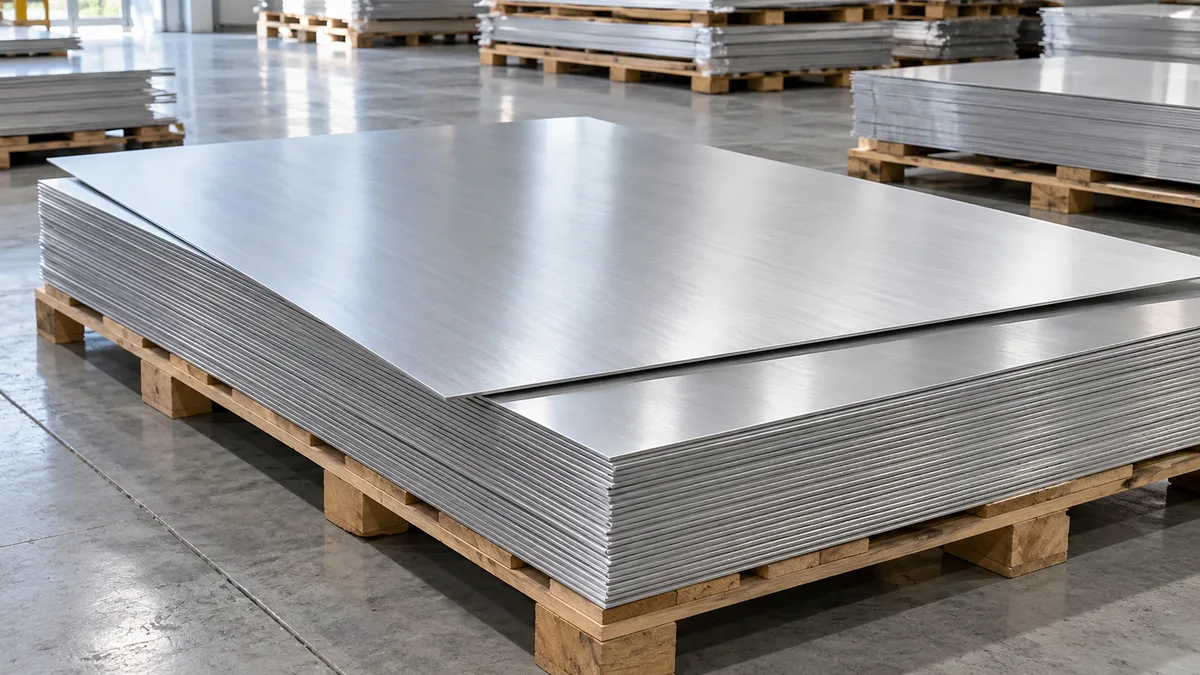
Sheets are supplied dry, stacked flat with nesting corrugations, and wrapped against moisture. Stacks are usually kept to about 500 mm high and around 2 tonnes gross so they can be handled safely by forklift without crushing the profile. Store under cover, raised off the ground and slightly sloped so any condensation drains; trapped water between nested sheets causes white staining.
3003 is about 20 – 30 % stronger, so it allows wider purlin spacing and resists foot traffic better. 1050 is cheaper, brighter and easier to form, and suits interiors, cladding and well-supported roofs.
Most roofs use 0.5 – 0.9 mm. Choose the gauge from the profile maker's load-span tables for your wind, snow and support spacing; thinner sheet suits walls and interiors.
No. Aluminium forms a protective oxide film instead of rust. Pure grades have the best natural corrosion resistance of all aluminium alloys, though they can stain if stored wet or touched by copper or bare steel.
Yes. Sinusoidal profiles in pure aluminium can be crimp-curved or bent to a radius, which is one reason they are popular for curved canopies and feature walls.
Mill finish plus coil-coated colours such as white, almond, grey, bronze and black in polyester or PVDF paint. Custom colours can be matched to a RAL code.
Send the alloy, profile, thickness, length, colour and quantity. We will confirm availability and a delivered price.





