H1x tempers
Strain-hardened only. H14 is half-hard, H16 three-quarter hard, H18 full hard. Higher numbers are stronger but tolerate tighter bends less well.



Aluminium roofing material is coated or mill-finish aluminium alloy sheet, coil and foil that roof-sheet manufacturers, panel makers and contractors form into roof coverings, insulated panels and radiant barriers. The usual alloys are 3003, 3004, 3105 and 5052 in half-hard tempers, 0.3 to 1.5 mm thick, finished with polyester (PE) or PVDF paint. This guide explains which alloy, temper, thickness and coating to specify for each roof type and climate, and what to check before you order.
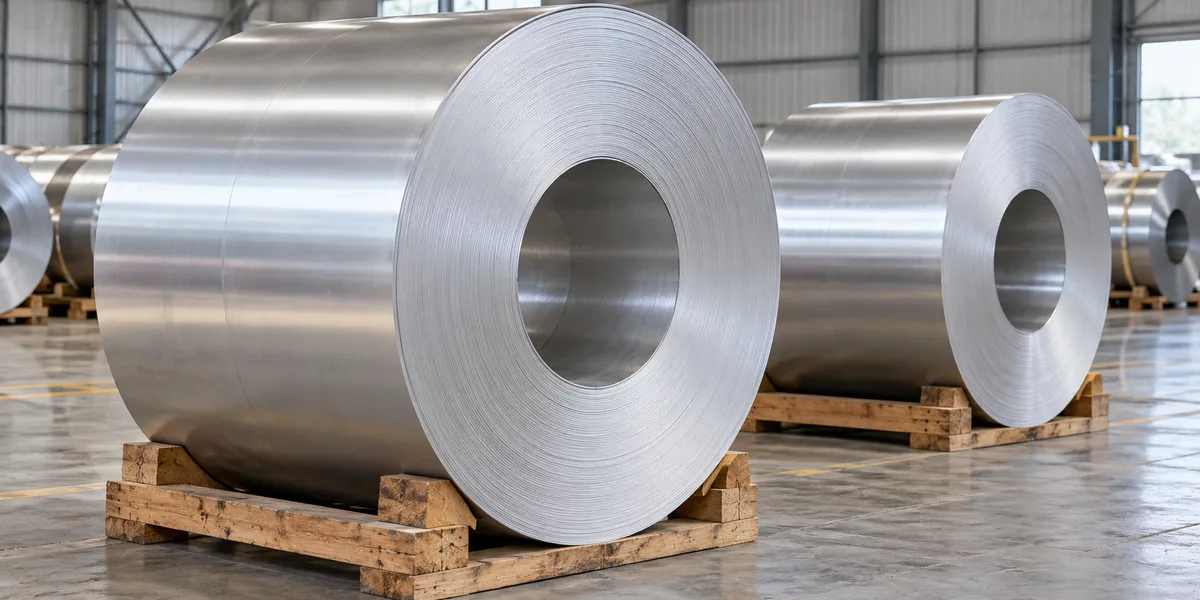
"Aluminium roofing material" covers every aluminium product that ends up in a roof build-up, from the visible weather skin to the reflective layer hidden under it. For a buyer the important point is that these are semi-finished materials: coil and sheet that a roll-forming line turns into corrugated, trapezoidal or standing-seam profiles, face sheets that a panel plant bonds to an insulating core, and foil that is laminated into insulation.
Aluminium is chosen for roofs for three practical reasons. It weighs about one third as much as steel for the same thickness (density 2.70 g/cm³ against roughly 7.85 g/cm³), which lowers dead load on purlins and makes long sheets easy to handle. It forms a thin, self-healing oxide film, so a cut edge or scratch does not rust and stain the roof the way bare steel does. And it is fully recyclable at end of life without losing its properties, which matters on projects assessed under green-building schemes.
The trade-offs are equally real. Aluminium has a lower elastic modulus than steel (about 69 GPa against 200 GPa), so profiles need deeper ribs or slightly greater thickness to span the same purlin spacing. It expands about twice as much as steel with temperature, so fixings must allow the sheet to move. And it must be kept away from copper, wet treated timber and certain other metals that cause galvanic or chemical attack. Each of these is manageable when the material is specified correctly, which is what the rest of this guide covers.
Most roofing projects use more than one aluminium form. The table maps each form to its role in the roof and to the specification points that matter when ordering it.
| Form | Where it is used | Typical alloys | Typical thickness | Key ordering points |
|---|---|---|---|---|
| Roll-forming coil | Feedstock for corrugated, trapezoidal and standing-seam lines | 3003, 3004, 3105, 5052 | 0.4 – 1.2 mm | Slit width to suit the forming line, coil ID (usually 508 or 610 mm), coating system, protective film |
| Flat and cut-to-length sheet | Flashings, ridge caps, gutters, soffits and small roofs | 1100, 3003, 3105, 5005 | 0.5 – 3.0 mm | Sheet size, temper for bending, colour match to the roof coil |
| Profiled roofing sheet | Finished weather skin on industrial and residential roofs | 3003, 3004, 3105 | 0.4 – 1.2 mm | Profile, cover width, length, rib height; see our roofing sheet guide |
| Face sheet for panels | Outer and inner skins of PU, PIR or mineral-wool sandwich panels | 3003, 3105, 5052 | 0.5 – 1.0 mm | Primer or paint compatible with the foam adhesive, flatness |
| Honeycomb panels | Lightweight flat roofs, canopies and soffits needing high stiffness | 3003, 5052 face; 3003/5052 core | Faces 0.6 – 1.5 mm | Panel thickness, core cell size, edge closure |
| Embossed sheet and coil | Glare-reducing roofs and liners, hides handling marks | 1050, 1100, 3003 | 0.3 – 1.0 mm | Pattern (stucco, orange peel), whether embossed before or after coating |
| Roofing foil | Radiant barrier and vapour control layer below the roof | 8011, 1235, 1100 | 0.006 – 0.04 mm | Laminate construction, perforation for vapour, fire rating of the composite |
Thickness ranges are typical for each application, not limits. The right thickness for a roof sheet depends on profile depth, purlin spacing and design wind and snow loads, and should be confirmed by the profile designer or structural engineer.
Roofing alloys come almost entirely from the 1xxx, 3xxx and 5xxx series. They are non-heat-treatable, so strength comes from cold rolling (the H temper), and they keep good corrosion resistance because they contain no copper. Higher manganese and magnesium content gives more strength, which lets a thinner sheet span further.
| Alloy and temper | Typical tensile strength | Typical yield strength | Character | Best roofing use |
|---|---|---|---|---|
| 1100-H14 | 125 MPa | 115 MPa | Commercially pure, very formable, lowest strength | Embossed liners, flashings, light corrugated sheet |
| 3003-H14 | 150 MPa | 145 MPa | Al-Mn; about 20 % stronger than 1100 with similar formability | Corrugated sheet, gutters, general roof sheet |
| 3105-H14 / H24 / H26 | about 170 – 200 MPa | about 150 – 170 MPa | Al-Mn-Mg; the standard painted building-sheet alloy | Coil-coated roof and wall sheet, rainwater goods |
| 3004-H34 | 240 MPa | 200 MPa | Al-Mn-Mg with more magnesium; stiffer roll-formed profiles | Long-span trapezoidal and standing-seam roofs |
| 5052-H32 | 228 MPa | 193 MPa | Al-Mg; best corrosion resistance of the group | Coastal and industrial roofs, panel face sheets |
Typical values from Aluminum Association and ASM data; they are not design minimums. Specified minimums depend on temper and thickness and are reported on the mill test certificate.
Strain-hardened only. H14 is half-hard, H16 three-quarter hard, H18 full hard. Higher numbers are stronger but tolerate tighter bends less well.
Strain-hardened then partially annealed. At the same strength level, H24 or H26 bends better than H14 or H16, which is why coil for standing seam and folded flashings is often ordered in H2x.
Strain-hardened and stabilised, used for magnesium alloys such as 5052-H32 and 3004-H34 so that properties do not drift with time at room temperature.
The curing oven of a coil-coating line acts like a light anneal. Coil painted from H14 base can come out near H24 properties, so specify the final temper you need after coating.
For roll-formed ribs and seams, ask for the minimum inside bend radius of the chosen temper and thickness. Cracking at the fold is the most common forming complaint on hard tempers.
Order flashings and trims from the same alloy family and coating as the main sheet so colour and weathering match over time.
The coating decides how long a roof keeps its colour and gloss. Aluminium itself does not need paint to resist the weather, but a mill-finish roof dulls and darkens unevenly over time, so most visible roofs are coil-coated. Coil coating is applied to flat strip on a continuous line before forming, which gives a uniform, well-cured film that can be roll-formed without cracking.
| Finish | Typical dry film | Colour and gloss retention | Where it fits |
|---|---|---|---|
| Mill finish | None | Weathers to a matt grey | Agricultural and industrial roofs where appearance is secondary; under-roof layers |
| Polyester (PE) | about 18 – 25 µm topcoat on primer | Good; gradual chalking and fading in strong UV | Residential and commercial roofs in moderate climates; most cost-effective painted option |
| Silicone-modified polyester (SMP) | about 20 – 25 µm | Better than PE in UV | Industrial and agricultural roofs needing longer colour life than PE |
| PVDF (fluorocarbon), 2-coat | about 25 – 30 µm | Very high; resists UV, chalking and chemical attack | Architectural roofs, coastal and high-UV sites |
| PVDF, 3-coat (with clear or metallic) | about 35 – 40 µm | Very high, with metallic effects | Signature buildings, metallic colours |
| Anodised | 10 – 25 µm oxide | Excellent, metallic look | Visible architectural roofing in sheet form; not usually roll-formed after anodising |
| Embossed (mill or painted) | As base finish | As base finish | Reduces glare and disguises minor dents and handling marks |
High-performance PVDF systems for architectural aluminium are commonly qualified against the AAMA 2605 specification (now published by FGIA), which sets weathering, salt-spray and humidity tests. EN 1396 covers coil-coated aluminium sheet and strip in Europe and defines how coating properties are tested. If a project specification names one of these, pass it to the supplier so the paint system is chosen and certified to match.
| Environment | Recommended base metal | Recommended finish | Watch out for |
|---|---|---|---|
| Inland, temperate | 3105 or 3003, H24 – H26 | PE or SMP | Ponding water on low-pitch roofs |
| Hot, high-UV (Gulf, South Asia, Africa, Australia) | 3105 or 3004 | PVDF in a light, high-reflectance colour | Thermal movement on long sheets; specify sliding clips or slotted holes |
| Coastal, within a few kilometres of the sea | 5052 or 3004 | PVDF, both faces protected | Salt deposits in sheltered areas that are not rain-washed; clean periodically |
| Industrial, chemical fumes | 5052 or 3004 | PVDF | Alkaline dust (cement, lime) and acidic condensate |
| Humid, tropical | 3105 or 5052 | PE/SMP or PVDF, with backer coat on the underside | Condensation under the sheet; add a vapour layer or ventilation |
| Snow and cold climates | 3004 or 5052, thicker gauge | PVDF | Snow load on long spans; snow guards and ice at eaves |
Aluminium is often specified for coastal roofs where coated steel would show red rust at cut edges and fixings. The base metal matters less than the detailing, though: a well-drained roof in 3105 with a PVDF coating will outlast a poorly detailed 5052 roof where salt and dirt collect in laps and gutters.
Bright aluminium foil has very low thermal emittance, typically around 0.03 to 0.05, which means it reflects most of the radiant heat that strikes it. Laid with an air gap below a hot roof sheet, it cuts the radiant heat that reaches the ceiling or the insulation below. That is the principle behind radiant barrier sheets and reflective insulation laminates.
Foil, usually 8011 or 1235 alloy, laminated to kraft paper, PE film or woven polypropylene for tear strength. Needs an air space facing the foil to work.
Micro-perforations allow water vapour to pass so moisture does not get trapped in the roof. Used where the layer must breathe.
Foil bonded to air-bubble film or closed-cell foam adds a small amount of resistive insulation to the radiant effect.
Composite laminates with fire-retardant adhesives or scrims, tested as a whole product to local reaction-to-fire rules.
Metline supplies the foil and laminating stock; the laminated insulation product and its fire classification belong to the converter. Alloy-specific details are in our 8011 roofing foil and 1100 roofing foil pages.
| Property | Aluminium (coated 3xxx/5xxx) | Galvanised or Al-Zn coated steel | Zinc (titanium-zinc) | Copper |
|---|---|---|---|---|
| Density | 2.70 g/cm³ | about 7.85 g/cm³ | about 7.2 g/cm³ | about 8.9 g/cm³ |
| Cut-edge corrosion | Does not rust | Can rust at cut edges and scratches | Forms patina | Forms patina |
| Coastal suitability | Very good | Fair to good, depends on coating | Good, avoid sheltered salt areas | Very good |
| Thermal expansion | High (about 23 µm/m·°C) | Low (about 12 µm/m·°C) | High | Medium (about 17 µm/m·°C) |
| Stiffness per thickness | Lower; needs deeper profiles | Higher | Low | Low |
| Relative material cost | Medium | Low | High | Very high |
One point causes frequent confusion: "aluzinc" or "Galvalume" roofing is steel sheet with a 55 % aluminium-zinc metallic coating (ASTM A792 or EN 10346), not aluminium sheet. It is cheaper and stiffer, but the steel core can still corrode where the coating is damaged. Solid aluminium is the better choice where long life near the sea, low weight or freedom from rust staining matters more than first cost.
3105 is the most common alloy for painted roof and wall sheet because it balances strength, formability and cost. 3004 is chosen for long-span and standing-seam profiles that need more stiffness, and 5052 for coastal or industrial sites where the best corrosion resistance is wanted. 3003 and 1100 suit corrugated sheet and flashings.
Most profiled aluminium roof sheet is 0.5 – 0.9 mm thick. Light corrugated sheet can be 0.4 mm, while long-span and standing-seam roofs in high wind or snow areas often use 0.9 – 1.2 mm. The correct gauge comes from the profile’s load-span table for your purlin spacing and loads.
For roofs in strong sunlight, near the sea or on buildings where colour matters, usually yes: PVDF resists UV chalking and fading far better than polyester. For sheds, warehouses and roofs in moderate climates, PE or SMP gives good value.
Direct contact in damp conditions can cause galvanic corrosion of the aluminium. Use galvanised or painted purlins with an isolating tape, and aluminium or stainless steel fasteners with sealing washers.
No. Aluzinc (Galvalume) is steel sheet with a 55 % aluminium-zinc coating. Aluminium roofing is solid aluminium alloy throughout, so it cannot rust at cut edges and weighs about a third as much.
No. Metline supplies the aluminium materials, such as roll-forming coil, flat and coated sheet, embossed coil and roofing foil, cut to size where needed, with mill certificates, to roof-sheet manufacturers, panel makers and contractors worldwide.
Tell us the alloy, temper, thickness, coating and quantity. We will confirm the material, certification and a delivered price to your port.





