Mill finish
Bare metal that weathers to a soft grey. Cheapest and fully recyclable; normal for agricultural and industrial buildings.



3003 corrugated sheet is aluminium-manganese sheet roll-formed into a wave or trapezoidal profile for roofs, walls, vehicle bodies and decorative cladding. It is about 20 % stronger than 1xxx sheet, keeps excellent corrosion resistance, and weighs about one third as much as steel sheet of the same thickness. Here is how to choose the profile, gauge, temper and finish.
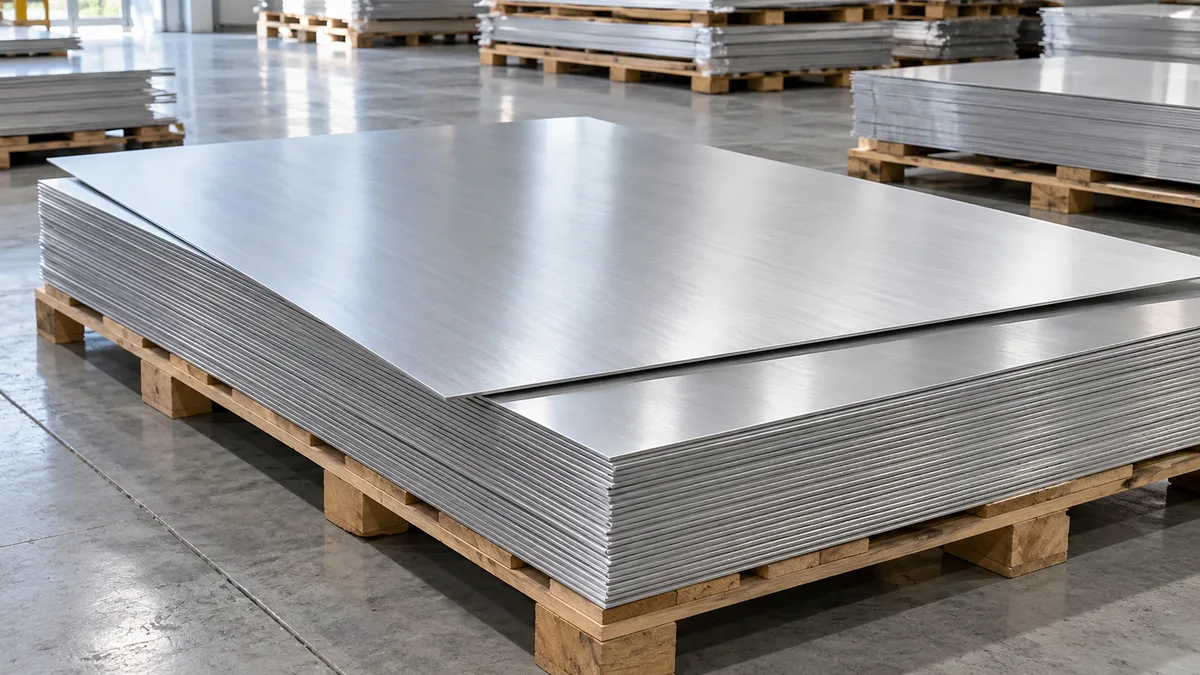
Flat aluminium sheet is flexible; corrugating it moves material away from the neutral axis and multiplies its bending stiffness, so a thin sheet can span between purlins and carry wind, snow and foot loads.
3003 adds about 1.2 % manganese to aluminium. That raises strength over 1050 or 1100 by roughly 20 % while keeping the same corrosion resistance and ductility, so the sheet roll-forms cleanly with tight radii and does not crack at the crests. For heavier structural decking or very exposed marine sites, 5052 or 3004 is sometimes preferred; for the lowest cost on light wall cladding, 1xxx or 3105 is used. For most roofing and cladding, 3003 is the balanced choice.
| Profile family | Typical pitch × depth | Typical use |
|---|---|---|
| Sinusoidal (classic corrugated) | 76 × 18 mm, or 2.67 × 7/8 in; also 2.67 × 1/2 in, 3 × 1 in | Roofs, walls, agricultural buildings, decorative cladding |
| Small-wave corrugated | about 32 × 6 mm to 42 × 9 mm | Interiors, soffits, furniture, feature walls |
| Box rib / trapezoidal | Rib spacing 100 – 200 mm, depth 20 – 40 mm | Industrial roofs and walls with longer purlin spacing |
| R-panel / PBR type | Major ribs about 300 mm apart | Metal buildings and sheds (North American style) |
| Deep deck | Depth above about 40 mm | Long spans; needs thicker gauge |
| Perforated corrugated | Any of the above with holes | Screens, acoustic linings, sunshades |
Deeper profiles carry more load per unit weight but use more sheet per square metre of cover. Ask for the profile drawing with effective cover width; it differs from the flat sheet width and is what you use to calculate quantities.
| Element | Limit (wt %) |
|---|---|
| Manganese (Mn) | 1.0 – 1.5 |
| Copper (Cu) | 0.05 – 0.20 |
| Iron (Fe) | ≤ 0.70 |
| Silicon (Si) | ≤ 0.60 |
| Zinc (Zn) | ≤ 0.10 |
| Others each / total | 0.05 / 0.15 |
| Aluminium | Remainder |
| Temper | Typical tensile strength | Typical yield strength | Notes |
|---|---|---|---|
| 3003-H14 | 150 MPa | 145 MPa | Most common for roofing; good roll-forming |
| 3003-H16 | 180 MPa | 170 MPa | Stiffer, better foot-traffic resistance, tighter forming limits |
| 3003-H24 / H26 | similar to H14 / H16 | slightly lower | Partially annealed; usual for pre-painted coil because the paint bake partially anneals the metal |
Typical values from Aluminum Association / ASM data. Minimums for each thickness band are given in ASTM B209 and EN 485-2. Density 2.73 g/cm³.
Flat-sheet weight is 2.73 kg/m² per millimetre of thickness; a corrugated sheet uses roughly 10 – 20 % more flat material per square metre of cover, depending on profile depth.
| Thickness | Flat weight (kg/m²) | Typical use |
|---|---|---|
| 0.40 – 0.50 mm | 1.1 – 1.4 | Interior linings, light wall cladding on close supports |
| 0.60 – 0.70 mm | 1.6 – 1.9 | Wall cladding, small roofs, sheds |
| 0.80 – 0.90 mm | 2.2 – 2.5 | General roofing, coastal buildings, vehicle bodies |
| 1.0 – 1.2 mm | 2.7 – 3.3 | Wider purlin spacing, foot traffic, industrial roofs |
| 1.5 mm | 4.1 | Deep deck, heavy-duty and container use |
Purlin spacing must come from the profile load tables for the chosen gauge and the local wind and snow loads. As a rule, aluminium needs either closer supports or a slightly thicker gauge than steel for the same span, because its elastic modulus is about one third of steel's.
Bare metal that weathers to a soft grey. Cheapest and fully recyclable; normal for agricultural and industrial buildings.
A textured pattern that hides handling marks and reduces glare.
Coil-coated before forming in a wide range of colours; suits most inland buildings.
Fluoropolymer paint with better colour and gloss retention for facades and coastal projects.
Used for decorative and interior corrugated panels; usually done after forming on cut sheets.
Decorative finishes for interiors, retail and furniture.
Coil coating is applied to flat coil before roll-forming so the paint flexes with the profile; standard colours include whites, greys, bronzes and black. Coated coil generally follows EN 1396 or the coater's specification for film thickness and durability.
| Factor | 3003 aluminium | Galvanised / colour-coated steel |
|---|---|---|
| Weight (same thickness) | About one third | Baseline |
| Corrosion if scratched or cut | Self-healing oxide; no red rust | Relies on zinc and paint; cut edges can rust |
| Coastal performance | Very good, especially PVDF coated | Needs heavier zinc or AZ coating and maintenance |
| Stiffness | Lower modulus; thicker gauge or closer supports | Higher modulus; longer spans for same gauge |
| Thermal expansion | About twice steel; use slotted holes on long sheets | Lower |
| Material cost | Higher per m² | Lower per m² |
| Scrap value / recycling | High | Lower |
Aluminium wins where weight, corrosion or long life without repainting matter: coastal homes, livestock buildings with ammonia, chemical plants, transport bodies and remote sites where freight is expensive. Steel remains cheaper up front for inland buildings with long spans.
Usually 0.7 – 1.0 mm for 3003 on typical purlin spacing; check the profile load table against your wind and snow loads.
Yes for most roofs: it is about 20 % stronger with the same corrosion resistance, so it resists dents and foot traffic better.
No. Aluminium forms a protective oxide instead of rust. It can stain white if stored wet, and it corrodes if in contact with steel or copper in damp conditions.
Usually H24 or H26, because the paint curing partially anneals the metal; the result behaves much like H14 or H16.
It is about a third of the weight and lasts longer in coastal or chemical environments, but costs more per square metre and needs a thicker gauge or closer supports.
Yes. Corrugated sheet is normally cut to the lengths on your cutting list, with export packing.
Send the profile, gauge, lengths, finish and quantity. We will confirm the specification and a delivered price.





