1100-O
Fully soft. Order it for deep drawing, spinning, flanging and severe bending. It is the only sensible choice for spun cookware and deep cups.



1100 is commercially pure aluminium (99.00 % minimum) with a small, deliberate copper addition that makes it slightly stronger than the higher-purity 1xxx grades while keeping excellent formability, weldability and corrosion resistance. Metline supplies 1100 sheet and plate in O, H14, H18 and other tempers, cut to size and certified to ASTM B209, to buyers worldwide.
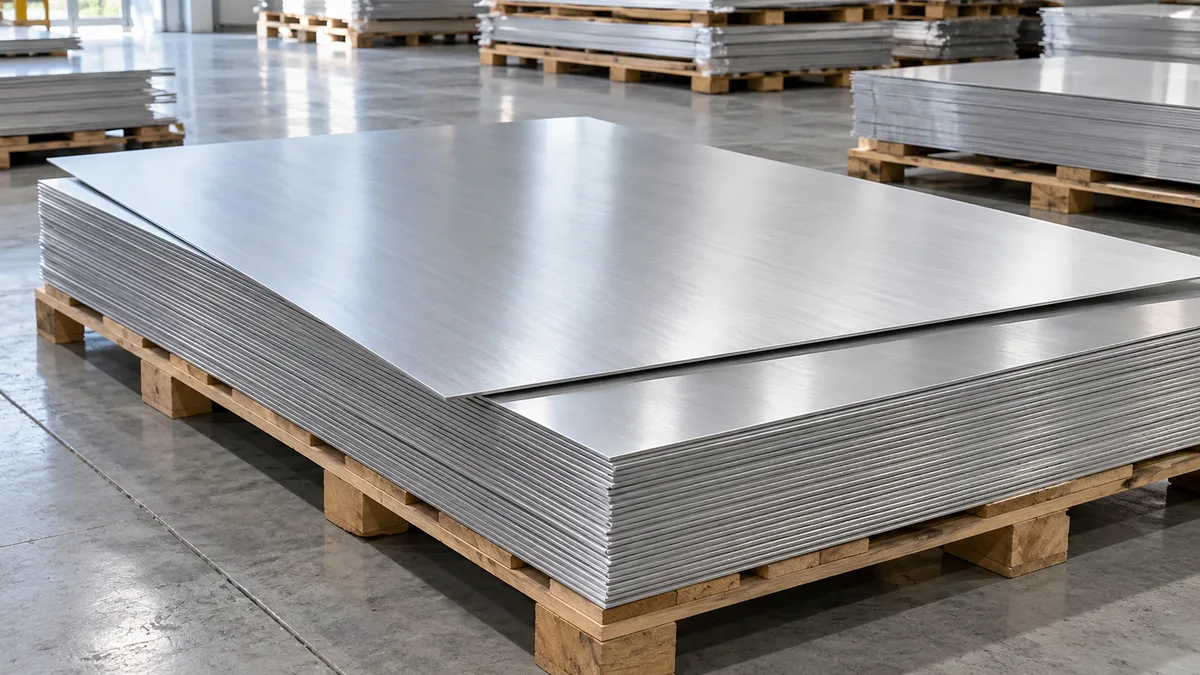
1100 is the workhorse of the commercially pure grades. Its 0.05 – 0.20 % copper gives a little extra strength and a finer response to cold work compared with 1050 or 1060, while silicon and iron together are capped at 0.95 %. It is non-heat-treatable, so strength is set by the degree of cold rolling.
In North America, 1100 is the default "pure aluminium" sheet. Fabricators use it for spun and deep-drawn parts, chemical and food-handling equipment, heat-exchanger fins, reflectors, nameplates and general sheet metal where corrosion resistance and an easy forming route matter more than load capacity. In annealed form it can be drawn into deep cups and spun into cookware and lamp shades without intermediate annealing.
The trade-off is low strength: even fully hard 1100-H18 reaches only about 165 MPa tensile, and the O temper about 90 MPa. If you need more stiffness with similar forming behaviour, 3003 (about 20 % stronger) is the usual next step; for real structural duty, move to 5052 or 6061.
Limits are the registered Aluminum Association values used by ASTM B209; EN AW-1100 in EN 573-3 is the same alloy. Every lot ships with a mill certificate reporting its actual analysis.
| Element | Minimum | Maximum | Comment |
|---|---|---|---|
| Silicon + Iron (Si + Fe) | — | 0.95 | Combined limit; the main impurities |
| Copper (Cu) | 0.05 | 0.20 | Deliberate addition for strength and work-hardening response |
| Manganese (Mn) | — | 0.05 | |
| Zinc (Zn) | — | 0.10 | |
| Others, each / total | — | 0.05 / 0.15 | |
| Aluminium (Al) | 99.00 | — | By difference |
Typical values below come from published Aluminum Association / ASM data and are for comparison. Design to the minimum limits in ASTM B209 for your thickness, which the mill certificate confirms.
| Temper | Tensile strength | Yield strength | Elongation (1.6 mm sheet) | Brinell hardness |
|---|---|---|---|---|
| 1100-O | 90 MPa / 13 ksi | 34 MPa / 5 ksi | 35 % | 23 HB |
| 1100-H12 | 110 MPa / 16 ksi | 103 MPa / 15 ksi | 12 % | 28 HB |
| 1100-H14 | 124 MPa / 18 ksi | 117 MPa / 17 ksi | 9 % | 32 HB |
| 1100-H16 | 145 MPa / 21 ksi | 138 MPa / 20 ksi | 6 % | 38 HB |
| 1100-H18 | 165 MPa / 24 ksi | 152 MPa / 22 ksi | 5 % | 44 HB |
H2x tempers (H22, H24, H26) are strain-hardened and partially annealed: same tensile range as the matching H1x temper with somewhat lower yield and better elongation.
Fully soft. Order it for deep drawing, spinning, flanging and severe bending. It is the only sensible choice for spun cookware and deep cups.
Quarter hard. A little stiffer for moderate forming; H22 gives more elongation for the same strength.
Half hard. The most common stock temper for general fabrication, flat panels, fins and parts with simple bends.
Three-quarter and full hard. Use for flat parts that must resist denting, such as nameplates and reflector backs. Bend only with generous radii.
As rolled, for thicker plate where light machining or welding is the main operation and a guaranteed hardness level is not needed.
Tell us the operations (drawing ratio, bend radius, welding) and we will recommend the temper that runs cleanly on your line.
| System | Designation | Sheet and plate standard |
|---|---|---|
| Aluminum Association / ASTM | 1100 | ASTM B209 (ASME SB-209) |
| Aerospace / federal | 1100 | AMS-QQ-A-250/1 |
| UNS | A91100 | — |
| European (EN) | EN AW-1100 / EN AW-Al99.0Cu | EN 485-1/-2, EN 573-3 |
| ISO | Al99.0Cu | ISO 6361, ISO 209 |
| Japan (JIS) | A1100P | JIS H4000 |
| China (GB) | 1100 | GB/T 3880, GB/T 3190 |
1100 is also accepted under ASME SB-209 for pressure equipment such as vessels and tanks in corrosive service, one reason it remains popular in chemical plant fabrication.
1100 weighs about 2.71 kg per m² per millimetre of thickness:
| Thickness (mm) | kg per m² | 1220 × 2440 mm (kg) | 1500 × 3000 mm (kg) |
|---|---|---|---|
| 0.5 | 1.35 | 4.0 | 6.1 |
| 0.8 | 2.17 | 6.5 | 9.8 |
| 1 | 2.71 | 8.1 | 12.2 |
| 1.2 | 3.25 | 9.7 | 14.6 |
| 1.5 | 4.06 | 12.1 | 18.3 |
| 2 | 5.42 | 16.1 | 24.4 |
| 3 | 8.13 | 24.2 | 36.6 |
| 4 | 10.8 | 32.3 | 48.8 |
| 5 | 13.6 | 40.3 | 61.0 |
| 6 | 16.3 | 48.4 | 73.2 |
| 8 | 21.7 | 64.5 | 97.6 |
| 10 | 27.1 | 80.7 | 122.0 |
| 12 | 32.5 | 96.8 | 146.3 |
| 16 | 43.4 | 129.1 | 195.1 |
| 20 | 54.2 | 161.3 | 243.9 |
| 25 | 67.8 | 201.7 | 304.9 |
O temper tolerates a 0 × t bend radius and very deep draws. Allow for springback in hard tempers and for orange-peel texture if coarse-grained O material is stretched heavily.
TIG and MIG weld easily with ER1100 filler for colour match and conductivity, or ER4043 for better fluidity and crack resistance. Gas and resistance welding also work.
Soft and gummy. Use sharp, high-rake tools, high speeds and lubricant; harder tempers give a better finish.
Anodises well for protection, though the copper content makes the film slightly less bright than on 1070 or 1085. Also accepts paint and lacquer.
1100 is 99.00 % minimum aluminium with 0.05 – 0.20 % copper; 1050 is 99.50 % minimum with almost no copper. 1100 is slightly stronger, while 1050 has slightly better conductivity and corrosion resistance. Both are very formable.
Commercially pure aluminium such as 1100 is widely used for cookware and food-processing equipment. Food-contact compliance depends on the regulation in your market (for example EN 602 in Europe), so state it on your enquiry.
Half-hard 1100 is the common stock temper for general sheet metal, fins, panels and parts with simple bends, where a little stiffness helps but forming is still required.
Yes. It anodises well for protection and decoration, though the film is slightly less bright than on higher-purity grades.
In the same temper 3003 is roughly 20 % stronger because of its manganese content, with similar formability. 1100 has better conductivity.
Yes. We supply cut circles and blanks in O and H-tempers to your diameter and thickness, packed for export.
Send the temper, size, quantity and destination. We will reply with availability, certification and a delivered price.





