Heat sinks and spreaders
Stamped fins, folded-fin assemblies and flat spreaders in power supplies, graphics cards, routers and set-top boxes. 1060 is the usual choice.



Computer, communication and consumer (3C) electronics use pure aluminium strip wherever heat must be moved and parts must be formed cheaply: heat sinks, shielding covers, LED bases, capacitor shells and simple housings. 1050, 1060 and 1070 contain 99.5 – 99.7 % aluminium, conduct heat at roughly 220 – 235 W/m·K and draw, stamp and bend easily in H14 and H24 tempers. This guide explains how to choose between them and what to specify.
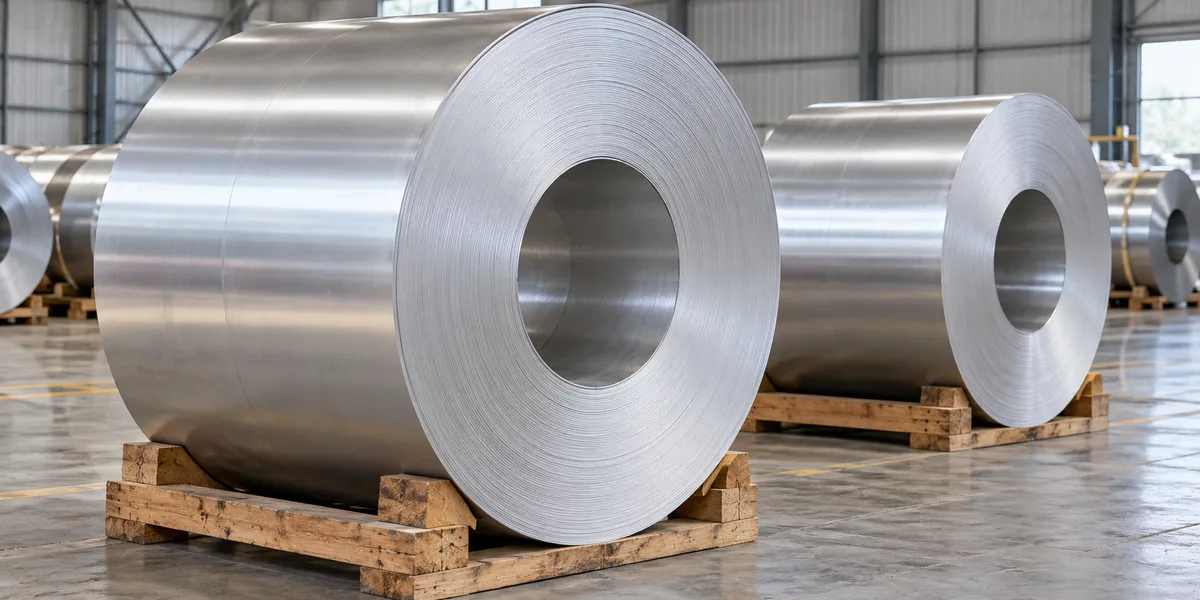
The defining job of aluminium inside most electronic products is thermal: carrying heat away from a chip, LED or power device into air. Pure aluminium does this better than any common aluminium alloy, because alloying elements in solution scatter the electrons and phonons that carry heat.
1060 conducts heat at about 234 W/m·K, compared with about 193 W/m·K for 3003, 138 W/m·K for 5052 and 167 W/m·K for 6061-T6. For a stamped heat spreader or fin, that 20 – 40 % advantage translates directly into lower component temperatures. Pure grades are also the easiest to stamp, deep draw and bend, take a bright, even anodised or chemical-conversion finish, and cost less than strong alloys.
The limit is strength. In H14 temper, 1050 to 1070 have a tensile strength of roughly 100 – 140 MPa, so they are used for parts that are supported by a frame, PCB or another structure, not for load-bearing phone frames or laptop chassis, which use 5xxx, 6xxx or 7xxx alloys.
| Property | 1050 | 1060 | 1070 |
|---|---|---|---|
| Minimum aluminium | 99.50 % | 99.60 % | 99.70 % |
| Thermal conductivity (O, approx.) | ≈ 229 W/m·K | ≈ 234 W/m·K | ≈ 226 – 237 W/m·K |
| Electrical conductivity (O) | ≈ 61 % IACS | ≈ 62 % IACS | ≈ 62 % IACS |
| Relative cost | Lowest | Low | Slightly higher |
| Typical choice for | Housings, covers, general stamping | Heat sinks, LED bases, battery and capacitor parts | Deep-drawn shells, high-purity contacts, reflectors |
Conductivity values are typical figures from Aluminum Association and ASM data; actual values depend on temper and exact chemistry.
In practice the three grades are interchangeable for many parts, and price and availability often decide. Choose 1060 as the default for thermal parts, 1050 when cost matters most and the part is mainly structural or cosmetic, and 1070 when the part is deep drawn or needs the most uniform anodised appearance. If the part also needs stiffness, consider 3003 or 5052 strip and accept the lower conductivity.
| Element (max %) | 1050 / 1050A | 1060 | 1070 | 1100 |
|---|---|---|---|---|
| Si | 0.25 | 0.25 | 0.20 | Si + Fe 0.95 |
| Fe | 0.40 | 0.35 | 0.25 | (see Si) |
| Cu | 0.05 | 0.05 | 0.04 | 0.05 – 0.20 |
| Mn | 0.05 | 0.03 | 0.03 | 0.05 |
| Mg | 0.05 | 0.03 | 0.03 | — |
| Zn | 0.05 (1050A: 0.07) | 0.05 | 0.04 | 0.10 |
| Ti | 0.03 (1050A: 0.05) | 0.03 | 0.03 | — |
| Others, each | 0.03 | 0.03 | 0.03 | 0.05 |
| Aluminium, min. | 99.50 | 99.60 | 99.70 | 99.00 |
Aluminum Association registered limits; EN 573-3 limits for EN AW-1050A, -1060 and -1070A are very similar.
H14 is half-hard by cold rolling alone. H24 reaches a similar strength by rolling harder and then partially annealing, which gives slightly better elongation and more consistent bending. For stamped and bent electronic parts, H24 is often the better choice; for flat parts that must stay stiff, H14 is fine.
| Grade and temper | Tensile strength | Yield strength (min.) | Elongation (typical range) |
|---|---|---|---|
| 1050A-H14 (EN 485-2) | 105 – 145 MPa | 85 MPa | 2 – 6 % (rises with thickness) |
| 1050A-H24 (EN 485-2) | 105 – 145 MPa | 75 MPa | 3 – 10 % |
| 1060-H14 (ASTM B209) | 97 – 131 MPa | 76 MPa | 1 – 10 % |
| 1070-H14 (typical) | ≈ 95 – 130 MPa | ≈ 70 MPa | 2 – 8 % |
| 1050 / 1060 / 1070-O | ≈ 60 – 95 MPa | ≈ 20 MPa | 20 – 40 % |
Values summarised from EN 485-2 and ASTM B209; guaranteed limits vary with thickness band and appear on the mill certificate.
Standard thickness tolerances under EN 485-4 and ANSI H35.2 suit most stamped parts. For precision fins, battery and capacitor components, ask for tighter thickness tolerance, burr-free slit edges, controlled camber and a flatness limit, and state whether the strip will be anodised, so the mill controls surface streaks and grain size.
Stamped fins, folded-fin assemblies and flat spreaders in power supplies, graphics cards, routers and set-top boxes. 1060 is the usual choice.
Strip formed into channels and bases for LED strips, conducting heat away from the diodes. Metal-core PCBs often use 1060 or 5052 substrate.
Stamped cans and gaskets that block electromagnetic interference around radio and processor modules.
Deep-drawn electrolytic capacitor cans, battery caps and tabs, where purity and drawability matter.
Simple enclosures for hard drives, adaptors and small appliances, usually anodised or painted.
Light internal brackets that support PCBs and connectors without carrying significant loads.
Computers, communication equipment and consumer electronics: laptops, routers, phones, set-top boxes, cameras, chargers and similar products.
For stamped or folded fins, 1060 or 1050 gives the highest thermal conductivity (about 230 W/m·K). Extruded heat sinks use 6063, which is less conductive but can be extruded into complex fin shapes.
Both are half-hard. H14 is reached by cold rolling only; H24 is rolled harder and partially annealed, which gives slightly lower yield strength and better elongation, so it bends more consistently.
Yes. Pure grades anodise to a clear, bright and uniform finish. 1070 and 1060 give the most even appearance; ask for an anodising-quality surface if the part is cosmetic.
Usually not. Load-bearing housings use 5052, 6061, 6063 or 7xxx alloys. Pure strip is used for internal thermal and shielding parts and for simple, supported covers.
Send the grade, temper, thickness, slit width and quantity. We will confirm availability, certification and a delivered price.





