Forming
O temper can be bent flat on itself, deep drawn and spun. Work hardening during forming raises strength; anneal between stages for very deep draws.



1050A is 99.5 % pure aluminium sheet, known in older British documents as 1B. In aircraft it is used for parts that must be deep drawn, spun, welded or kept free of corrosion while carrying little load: ducting, liners, fairing closures, shims, heat shields and interior panels. Metline supplies 1050A sheet and plate in O, H14 and H24 tempers, certified and cut to size, worldwide.
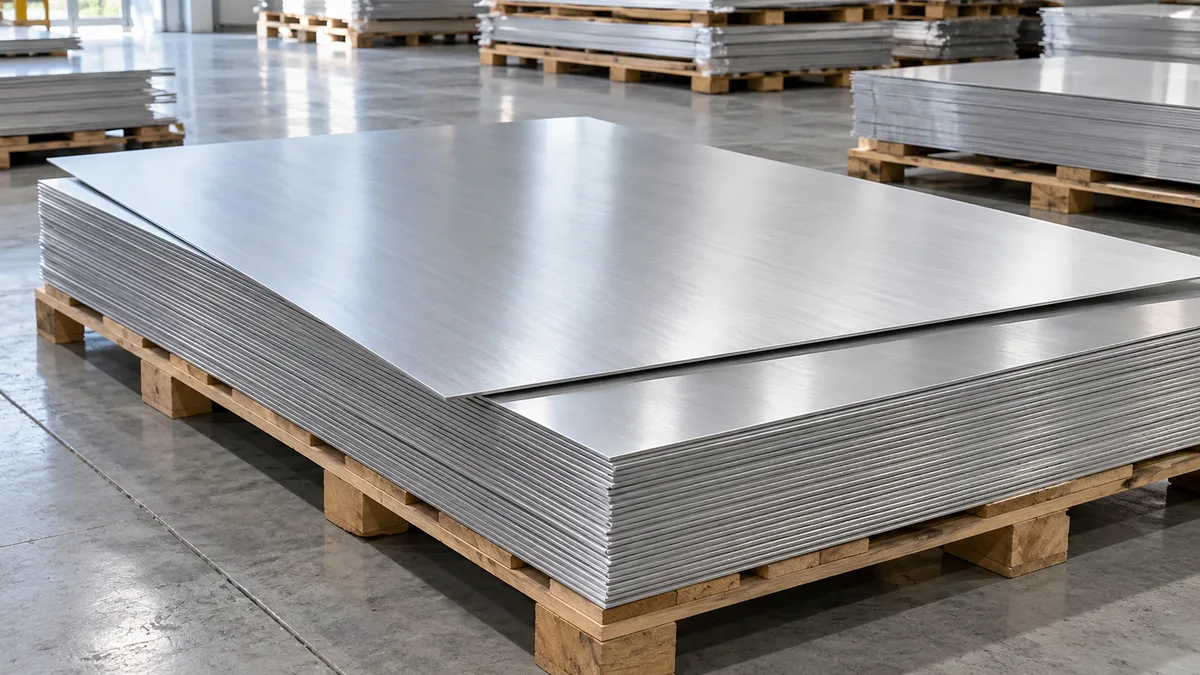
1050A is not a structural aerospace alloy, and nobody chooses it for strength. It is chosen because it forms further than almost any other aluminium sheet, welds without cracking and resists corrosion on its own, without cladding or heavy coatings.
Those qualities make it useful for the many secondary parts in an airframe and its systems: hot and cold air ducts that are spun or drawn, lightly loaded liners and covers, equipment closures, baffles, shims and packers, reflective heat shields and interior trim. On ground support equipment it is used for guards, panels and enclosures. Wherever a part carries real load, a 2xxx, 6xxx or 7xxx alloy, or at least a 3xxx or 5xxx grade, is the better choice.
The British designation 1B dates from BS 1470, which preceded the European EN 485 and EN 573 standards. Drawings from UK and Commonwealth programmes still use it, and 1B, 1050A and Al99.5 all describe the same material in practice.
| Element | Limit | Note |
|---|---|---|
| Silicon (Si) | 0.25 max | Impurity |
| Iron (Fe) | 0.40 max | Main impurity; affects grain size and anodised colour |
| Copper (Cu) | 0.05 max | Kept low for corrosion resistance |
| Manganese (Mn) | 0.05 max | |
| Magnesium (Mg) | 0.05 max | |
| Zinc (Zn) | 0.07 max | |
| Titanium (Ti) | 0.05 max | Grain refiner from casting |
| Others, each | 0.03 max | |
| Aluminium (Al) | 99.50 min |
Limits per EN 573-3 for EN AW-1050A. The AA grade 1050 differs only slightly (Zn 0.05, Ti 0.03, V 0.05 max).
Tensile limits below apply to the thinner thickness bands of EN 485-2; elongation minimums rise with thickness. The annealed figures, 65 – 95 MPa tensile and at least 20 MPa proof strength, show why the grade is used for forming, not for load.
| Temper | Rm (MPa) | Rp0.2 min (MPa) | Typical use |
|---|---|---|---|
| O / H111 | 65 – 95 | 20 | Deep drawing, spinning, severe bends |
| H12 | 85 – 125 | 65 | Moderate forming with some stiffness |
| H14 | 105 – 145 | 85 | Flat panels, shims, covers |
| H24 | 105 – 145 | 75 | Panels that are bent after delivery |
| H16 | 120 – 160 | 100 | Stiffer flat parts |
| H18 | 140 min | 120 | Hard flat stock, reflectors |
| System | Designation | Document |
|---|---|---|
| European | EN AW-1050A / EN AW-Al99.5 | EN 573-3 (chemistry), EN 485-2 (properties), EN 485-4 (tolerances) |
| British (withdrawn) | 1B | BS 1470 |
| German Werkstoff | 3.0255 | DIN EN 573-3 |
| ISO | Al99.5 | ISO 209, ISO 6361 |
| Aluminum Association | 1050 (closest registered grade) | US sheet specifications such as ASTM B209 usually list 1060 or 1100 instead |
| Aerospace dimensions | — | EN 2071 (sheet 0.25 – 6 mm dimensions) |
Older data sheets sometimes list AMS 4001 against 1050A. AMS 4001 is an 1100-O specification, so if the drawing calls for it, the material to order is 1100. We will point out mismatches like this at the quotation stage rather than ship the wrong grade.
1050A weighs 2.70 kg per m² per mm of thickness.
| Thickness (mm) | kg/m² | 1000 × 2000 mm (kg) | 1250 × 2500 mm (kg) |
|---|---|---|---|
| 0.5 | 1.35 | 2.7 | 4.2 |
| 0.8 | 2.16 | 4.3 | 6.8 |
| 1 | 2.70 | 5.4 | 8.4 |
| 1.2 | 3.24 | 6.5 | 10.1 |
| 1.5 | 4.05 | 8.1 | 12.7 |
| 2 | 5.40 | 10.8 | 16.9 |
| 3 | 8.10 | 16.2 | 25.3 |
| 4 | 10.80 | 21.6 | 33.8 |
| 5 | 13.50 | 27.0 | 42.2 |
| 6 | 16.20 | 32.4 | 50.6 |
| 8 | 21.60 | 43.2 | 67.5 |
| 10 | 27.00 | 54.0 | 84.4 |
| 12 | 32.40 | 64.8 | 101.2 |
| 16 | 43.20 | 86.4 | 135.0 |
| 20 | 54.00 | 108.0 | 168.8 |
| 25 | 67.50 | 135.0 | 210.9 |
O temper can be bent flat on itself, deep drawn and spun. Work hardening during forming raises strength; anneal between stages for very deep draws.
Excellent by TIG and MIG with 1100 or 4043 filler. The heat-affected zone returns to O-temper strength.
Soft and gummy. Use sharp, polished, high-rake tools, high speed and plenty of lubricant to avoid built-up edge and torn surfaces.
Gives a clear, bright film and is suitable for chemical brightening; useful for reflectors and heat shields.
Excellent in air and fresh water. Avoid direct contact with copper alloys and carbon fibre in damp conditions.
The surface marks easily; order PVC-filmed sheet for visible parts and handle with clean gloves.
Yes. 1B was the BS 1470 designation for 99.5 % aluminium sheet. It was replaced by EN AW-1050A when the EN standards took over, and the two are used interchangeably on drawings.
No. Its strength is too low. Use it for formed, lightly loaded parts such as ducts, liners, shims and covers.
O (or H111). It has the highest elongation and the lowest strength, so it flows into the tool without splitting.
Both have similar tensile ranges. H24 is hardened further and then partially annealed, which gives more elongation, so it bends better without cracking.
About 16.9 kg, using 2.70 kg per m² per mm of thickness.
Send thickness, size, temper and specification. We reply with availability, certification and a delivered price.





