Bending
Position the seam on the neutral axis (side of the bend) to reduce strain on the weld. O and H1x tempers in 3003 bend tightly.



Welded aluminium tube is made by roll-forming flat strip into a tube and joining the seam, usually by high-frequency (HF) welding. It gives very thin, uniform walls, long lengths and low cost in volume, and it can be made from clad strip for brazed heat exchangers. Metline supplies HF and laser welded round, oval and flat tube in 3003, clad brazing alloys, 5052 and 6063, to customers worldwide.
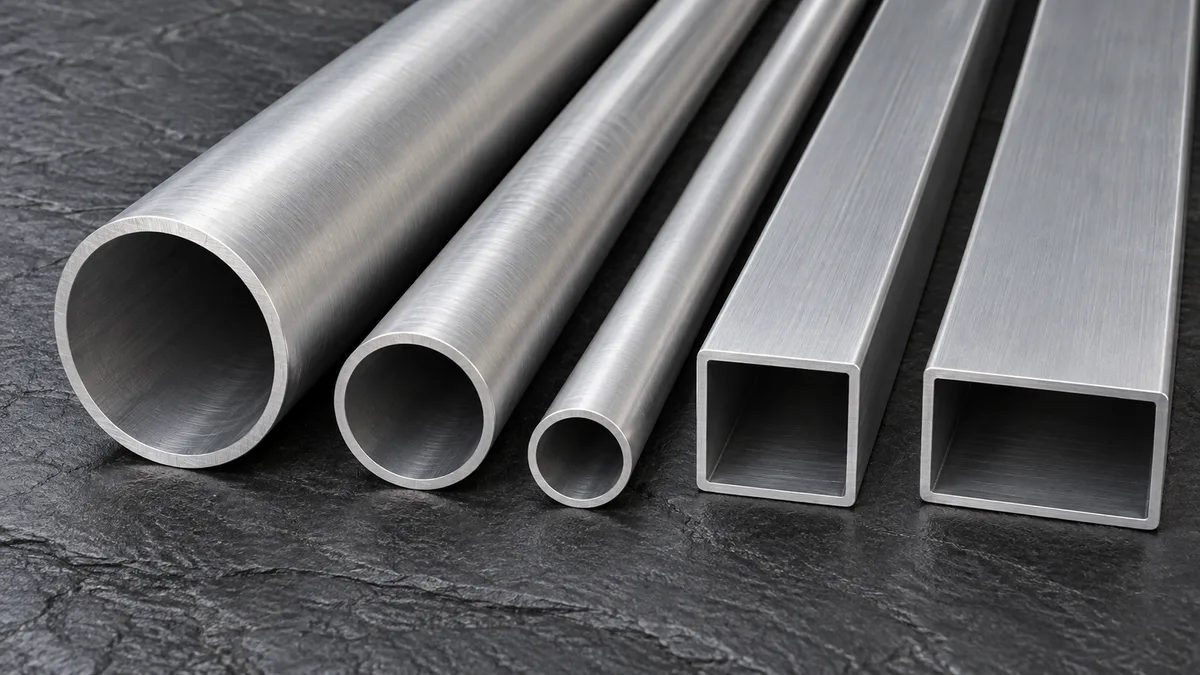
Welded tube starts as a coil of slit strip rather than an extrusion billet. The strip is progressively formed by rolls into a round, open tube; its edges are heated to welding temperature by high-frequency current and forged together by squeeze rolls, without filler metal. The outside weld bead is trimmed, the tube is sized to the final shape and cut to length or coiled.
Because the wall thickness comes straight from rolled strip, welded tube can have thinner and more uniform walls than extruded tube, often down to about 0.2 – 0.3 mm. That makes it the standard product for automotive radiators, condensers, heater cores and charge-air coolers, where flat or oval tubes made from clad strip are brazed to fins. It is also used for furniture, ladders, irrigation, antennas and other light structures where cost per metre matters.
The trade-off is the longitudinal seam. A well-made HF weld is a solid-state bond as strong as the parent strip in non-heat-treatable grades, but it is still a feature that the designer and inspector must account for, particularly in pressure service and tight bends.
Laser welding is also used for very thin or high-precision tube. Large-diameter welded aluminium pipe is made separately, by arc welding of formed plate or by spiral welding.
| Material | Character | Typical welded tube uses |
|---|---|---|
| 1050 / 1100 | Highly formable, conductive, low strength | Antennas, decorative tube, light-duty fluid lines |
| 3003 / 3102 | Good formability and corrosion resistance; brazeable core | Refrigerant lines, condenser and heater tube |
| 3003 + zinc arc-spray or Zn-clad | Sacrificial outer layer protects the core from pitting | Automotive condenser and radiator tube |
| Clad brazing strip (4343 or 4045 on 3xxx core) | Filler layer melts in the brazing furnace to join fins and headers | Radiators, charge-air coolers, oil coolers |
| 5052 | Higher strength, good marine resistance | Furniture, marine rails, ladders, structural light tube |
| 6063 / 6061 | Heat-treatable; strength reduced near seam unless re-heat-treated | Furniture, frames, sports goods |
Typical properties follow the parent strip: 3003-H14 is about 150 MPa tensile and 145 MPa yield; 5052-H32 about 228 MPa and 193 MPa. In brazed heat exchangers the tube is softened by the brazing cycle, so designers use post-braze (near O temper) properties, roughly 110 – 130 MPa tensile for 3003, or choose long-life core alloys with higher post-braze strength.
Weight in kg/m = 0.0084823 × (OD − wall) × wall, dimensions in mm, at 2.70 g/cm³.
| OD (mm) | Wall (mm) | kg per metre | metres per 100 kg |
|---|---|---|---|
| 8 | 0.5 | 0.032 | 3144 |
| 10 | 0.6 | 0.048 | 2090 |
| 12.7 | 0.7 | 0.071 | 1403 |
| 16 | 0.8 | 0.103 | 970 |
| 19.05 | 0.89 | 0.137 | 729 |
| 22 | 1 | 0.178 | 561 |
| 25.4 | 1.2 | 0.246 | 406 |
| 32 | 1.2 | 0.314 | 319 |
| 38 | 1.5 | 0.464 | 215 |
| 50 | 1.5 | 0.617 | 162 |
| 63.5 | 2 | 1.043 | 96 |
| 76.2 | 2 | 1.259 | 79 |
| 100 | 2.5 | 2.068 | 48 |
| Standard | Scope |
|---|---|
| ASTM B313 / B313M | Aluminum and aluminum-alloy round welded tubes |
| ASTM B547 / B547M | Formed and arc-welded round tube (larger diameters) |
| EN 1592-1 to -4 | HF seam-welded tubes: delivery conditions, properties and tolerances for round and other shapes |
| EN 573-3 | Chemical composition of the strip alloy |
| Customer drawings | Flat and oval heat-exchanger tube is normally made to OEM drawings with tight height and width tolerances |
Position the seam on the neutral axis (side of the bend) to reduce strain on the weld. O and H1x tempers in 3003 bend tightly.
Clad tube is brazed with fins and headers in controlled-atmosphere (flux) or vacuum furnaces; keep surfaces clean and free of heavy oils.
Flaring, beading, reducing and expanding are routine; flaring tests confirm the seam can take it.
3003 and 5052 welded tube can be TIG welded into assemblies; avoid welding directly across the seam where possible.
Zinc-diffused or clad outer layers sacrificially protect thin walls in road-salt environments.
Powder coating and anodising suit furniture and consumer tube in 5052 and 6063.
In non-heat-treatable alloys such as 3003 and 5052, a sound HF weld is close to parent-metal strength and passes flattening and flaring tests. For high-pressure or safety-critical service, seamless or drawn tube is still the safer specification.
High-frequency welding uses high-frequency current to heat the strip edges to welding temperature in a fraction of a second; rolls then forge them together without filler metal. It is fast, clean and suited to thin aluminium walls.
It can be made with very thin, uniform walls from clad strip whose outer layer melts in the brazing furnace to bond the fins, giving light, efficient heat exchangers at low cost per metre.
Yes. The internal bead can be removed or controlled to a specified maximum height. State the requirement if the bore must be smooth for fluid flow or inserts.
Usually by continuous in-line eddy current testing, plus flattening, flaring and pressure or leak tests on samples, as agreed in the order.
Yes. Small-diameter welded tube for refrigerant and heat-exchanger use can be supplied level-wound in coils as well as in cut lengths.
Send material, shape, dimensions, testing and quantity. We will reply with options, certification and a delivered price.





