


Precision Drawn Aluminium Tube
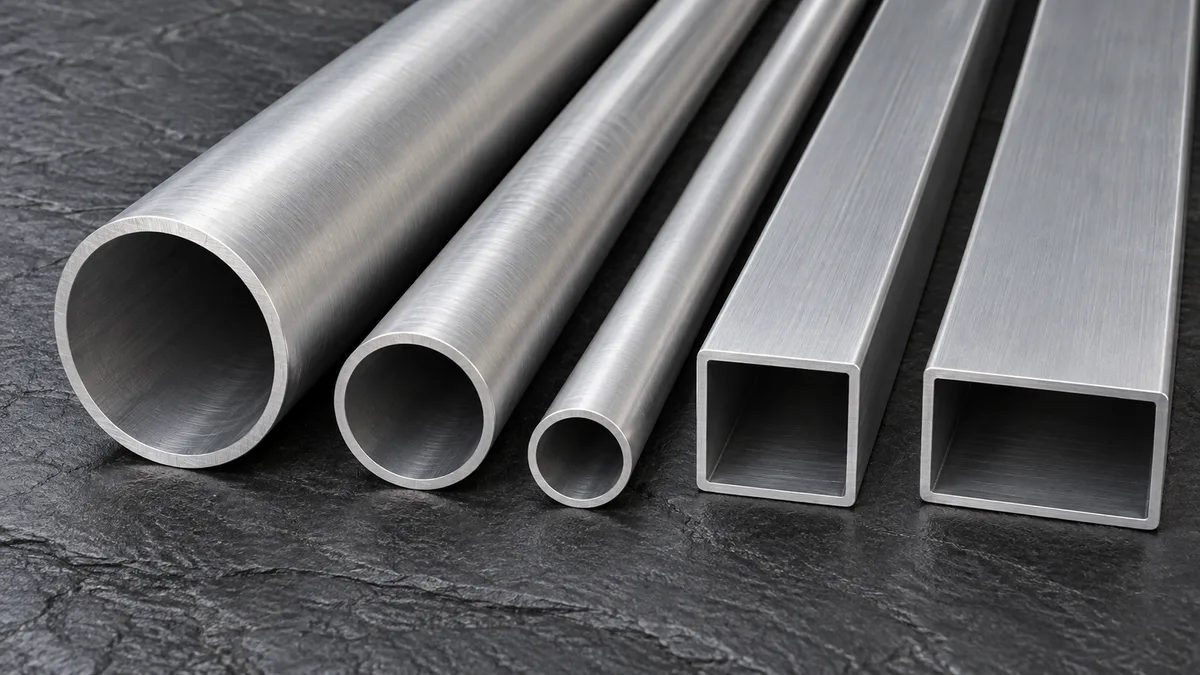
Precision drawn aluminium tube is extruded tube that has been cold drawn through a die over a mandrel or plug, often in several passes. Drawing tightens diameter and wall tolerances, smooths the surface and allows thin walls and small sizes that extrusion alone cannot reach. Metline supplies seamless drawn tube in 1xxx, 3xxx, 5xxx, 6xxx, 2xxx and 7xxx alloys, cut and certified, worldwide.
- Route
- Extruded, then cold drawn
- Grades
- 3003, 5052, 6061, 6063, 7075
- Tempers
- O, H14, H32, T4, T6
- Standards
- ASTM B210 · B483 · EN 754
What is precision drawn aluminium tube?
Drawn tube starts as an extruded "tube shell". It is pointed at one end, pushed through a die and pulled while a mandrel, floating plug or bar supports the bore. Each pass reduces the diameter and wall and work-hardens the metal; annealing between passes restores ductility. The final pass sets the size, tolerance, surface and temper.
Compared with extruded tube, drawn tube offers tighter control of outside diameter, inside diameter, wall thickness and concentricity, a brighter and smoother surface inside and out, and access to thin walls and small diameters. In non-heat-treatable alloys such as 3003 and 5052, drawing also raises strength through strain hardening (H tempers). Heat-treatable alloys such as 6061 and 7075 are usually drawn, then solution heat-treated and aged to T4 or T6.
Seamless drawn tube, made from a seamless extruded shell, is the choice for pressure, hydraulic and critical applications. Drawn tube made from porthole-extruded shells carries the die seam welds through the drawing and is covered by separate standards (EN 754-8); it is economical for general engineering and decorative use. Always state which you need.
Alloys, tempers and mechanical properties
Typical values are shown; minimum values for each size and wall are set by ASTM B210 or EN 754-2 and reported on the mill certificate.
| Alloy / temper | Typical tensile strength | Typical yield strength | Character and use |
|---|---|---|---|
| 1100-O / H14 | 90 / 125 MPa | 35 / 115 MPa | Very formable; chemical, food and electrical tubing |
| 3003-O | 110 MPa | 40 MPa | Heat exchanger and refrigeration tube, flaring and bending |
| 3003-H14 | 150 MPa | 145 MPa | General tube with moderate strength |
| 5052-O | 195 MPa | 90 MPa | Fuel and hydraulic lines that are bent and flared |
| 5052-H32 | 230 MPa | 195 MPa | Stronger lines and marine fittings |
| 6061-T6 | 310 MPa | 276 MPa | Hydraulic tubing, structures, bicycle and sports tube |
| 6063-T6 | 241 MPa | 214 MPa | Smooth-surface tube for anodising, rollers and drums |
| 2024-T3 | 483 MPa | 345 MPa | High-strength aerospace and fastener-sleeve tube |
| 7075-T6 | 572 MPa | 503 MPa | Tent and trekking poles, arrows, high-strength sports tube |
Typical values from Aluminum Association and ASM data. Density 2.70 – 2.81 g/cm³ depending on alloy.
Standards for drawn aluminium tube
| Standard | Scope |
|---|---|
| ASTM B210 / ASME SB-210 | Drawn seamless aluminium and aluminium-alloy tubes |
| ASTM B483 | Drawn tube and pipe for general-purpose applications |
| ASTM B234 | Drawn seamless tubes for condensers and heat exchangers |
| SAE AMS 4083 and related AMS specs | Drawn seamless hydraulic tubing for aerospace (e.g. 6061) |
| EN 754-1 / 754-2 | Cold-drawn rod/bar and tube: delivery conditions and mechanical properties |
| EN 754-7 | Seamless drawn tubes: tolerances on dimensions and form |
| EN 754-8 | Porthole drawn tubes: tolerances on dimensions and form |
| ANSI H35.2 | Dimensional tolerances for ASTM orders |
| ASTM E215 | Electromagnetic (eddy-current) examination of seamless aluminium-alloy tube |
Tolerances: what "precision" means in practice
Standard drawn-tube tolerances in ANSI H35.2 and EN 754-7 are already much tighter than those for extruded tube. Precision orders go further, with OD, ID or wall held to tolerances on the customer's drawing, often to a few hundredths of a millimetre on diameter for small tubes. The right approach is to specify only the dimensions that matter functionally.
| Dimension | How to specify | Notes |
|---|---|---|
| Outside diameter | Nominal and tolerance, mean or at any point | Specify "at any point" if ovality matters for a fit |
| Inside diameter | Nominal and tolerance, when the bore is functional | Drawn over a fixed mandrel for best ID control |
| Wall thickness | Nominal and tolerance, or minimum wall | Pressure designs often specify minimum wall |
| Concentricity / eccentricity | Maximum wall variation around the circumference | Important for rotating parts and thin walls |
| Straightness | Deviation per metre or over the full length | Roller straightening improves this |
| Surface roughness | Ra on OD and/or ID | For seals, honed bores and photoconductor drums |
| Length | Fixed length and tolerance, or random lengths | Saw or precision cut, deburred ends |
Supply range and weight
Supply range
- Outside diameter
- From about 3 mm to about 150 mm, depending on alloy
- Wall thickness
- From about 0.3 mm thin-wall up to heavier walls on larger tubes
- Shapes
- Round as standard; drawn square, rectangular, oval and streamline on request
- Lengths
- Random lengths, fixed lengths, or coils for soft small-diameter tube
- Tempers
- O, H12 – H18, H32 – H38, T4, T6, T3, T8 depending on alloy
- Finish
- Bright drawn, anodised, or cleaned and capped for fluid systems
Weight in kg/m = π × (OD − t) × t × density / 1000, with OD and wall t in mm and density in g/cm³ (2.70 for 6061 and 6063, 2.73 for 3003, 2.68 for 5052, 2.81 for 7075). A 25 × 1.5 mm 6061 tube weighs about 0.30 kg/m.
Inspection and testing
- Dimensional: OD, ID, wall, ovality and straightness by gauges, micrometers or laser
- Eddy-current testing to ASTM E215 to detect wall defects in seamless tube
- Pressure testing: hydrostatic or pneumatic tests on hydraulic and fluid tube when specified
- Mechanical tests: tensile, flattening and flare or expansion tests on samples from each lot
- Cleanliness: internal cleaning, drying and end caps for refrigeration, hydraulic and instrument lines
- Certification: mill test certificate to EN 10204 3.1 with chemistry and mechanical results
Where precision drawn tube is used
- Fluid power: hydraulic, pneumatic, fuel and lubrication lines; pneumatic cylinder barrels
- Heat exchangers: mechanically expanded round tubes for condensers, evaporators and oil coolers
- Office and printing equipment: photoconductor drums, rollers and shafts
- Sports and outdoor: tent and trekking poles, arrows, bicycle parts, ski poles
- Aerospace and defence: hydraulic tubing, antenna masts and structural tube
- Medical and scientific: instrument tubes, mobility aids and laboratory equipment
- Telescopic systems: nesting tubes where consistent OD and ID give smooth sliding
Drawn tube compared with extruded and welded tube
| Factor | Seamless drawn | Extruded | Welded |
|---|---|---|---|
| Dimensional tolerance | Tightest | Moderate | Moderate |
| Surface finish | Bright, smooth | Extrusion finish, die lines possible | Good OD, weld bead inside unless removed |
| Thin walls / small OD | Yes | Limited | Thin walls yes, small OD limited |
| Pressure service | Excellent | Good (seamless) | Depends on weld quality and code |
| Cost | Highest | Low | Lowest for thin-wall, high volume |
If your design does not need drawn tolerances, extruded round tube or welded tube may cost less.
How to order precision drawn tube
- SpecifyAlloy and temper, OD and wall (or ID) with tolerances, seamless or porthole, length, straightness, surface and cleanliness requirements, tests, quantity and standard (ASTM B210, B483, EN 754).
- QuoteWe confirm alloy, temper, tolerances, certification, packing and delivery terms (EXW, FOB, CIF or DAP) for your destination.
- ProcessTubes are cut, deburred and inspected for dimensions and surface, with eddy-current or pressure testing where specified.
- DocumentEach delivery carries a mill test certificate to EN 10204 3.1 with the cast analysis and mechanical results; third-party inspection can be arranged on request.
- ShipBundled, interleaved or crated for export and shipped by sea or air on EXW, FOB, CIF or DAP terms.
References and standards
- ASTM B210/B210M – Aluminum and Aluminum-Alloy Drawn Seamless Tubes
- ASTM B483/B483M – Aluminum and Aluminum-Alloy Drawn Tube and Pipe for General Purpose Applications
- EN 754-7 – Cold drawn rod/bar and tube: seamless tubes, tolerances on dimensions and form
- ASTM E215 – Standardizing Equipment for Electromagnetic Examination of Seamless Aluminum-Alloy Tube
- The Aluminum Association – International Alloy Designations and Chemical Composition Limits for Wrought Aluminum (Teal Sheets)
Precision drawn aluminium (aluminum) tube: FAQ
What is the difference between drawn and extruded aluminium tube?
Extruded tube is pushed through a die once while hot. Drawn tube is extruded and then cold drawn through dies over a mandrel, giving tighter tolerances, thinner walls, smaller sizes and a smoother surface, at higher cost.
Is drawn aluminium tube seamless?
It is when the starting shell is a seamless extrusion (ASTM B210, EN 754-7). Drawn tube made from porthole extrusions keeps the seam welds and is covered by EN 754-8. Specify seamless for pressure and hydraulic service.
Which alloy is best for hydraulic tubing?
6061-T6 for most rigid hydraulic lines, and 5052-O or 3003-O where tubes must be bent and flared in the field. Aerospace hydraulic tubing is ordered to the relevant AMS specification.
How thin can the wall of drawn aluminium tube be?
Walls of about 0.3 mm are practical on small diameters, depending on alloy and OD. Very thin walls increase cost and sensitivity to handling damage, so specify only what the design needs.
How do I calculate drawn tube weight?
Weight in kg/m = π × (OD − wall) × wall × density / 1000, with dimensions in mm. A 25 × 1.5 mm 6061 tube weighs about 0.30 kg/m.
Can you supply drawn tube cut to precise lengths?
Yes. Metline supplies precision drawn tube cut and deburred to length, cleaned and capped where required, with certificates, to customers worldwide.
Need precision drawn tube?
Send the alloy, temper, dimensions, tolerances and quantity. We will reply with feasibility, testing and a delivered price.





