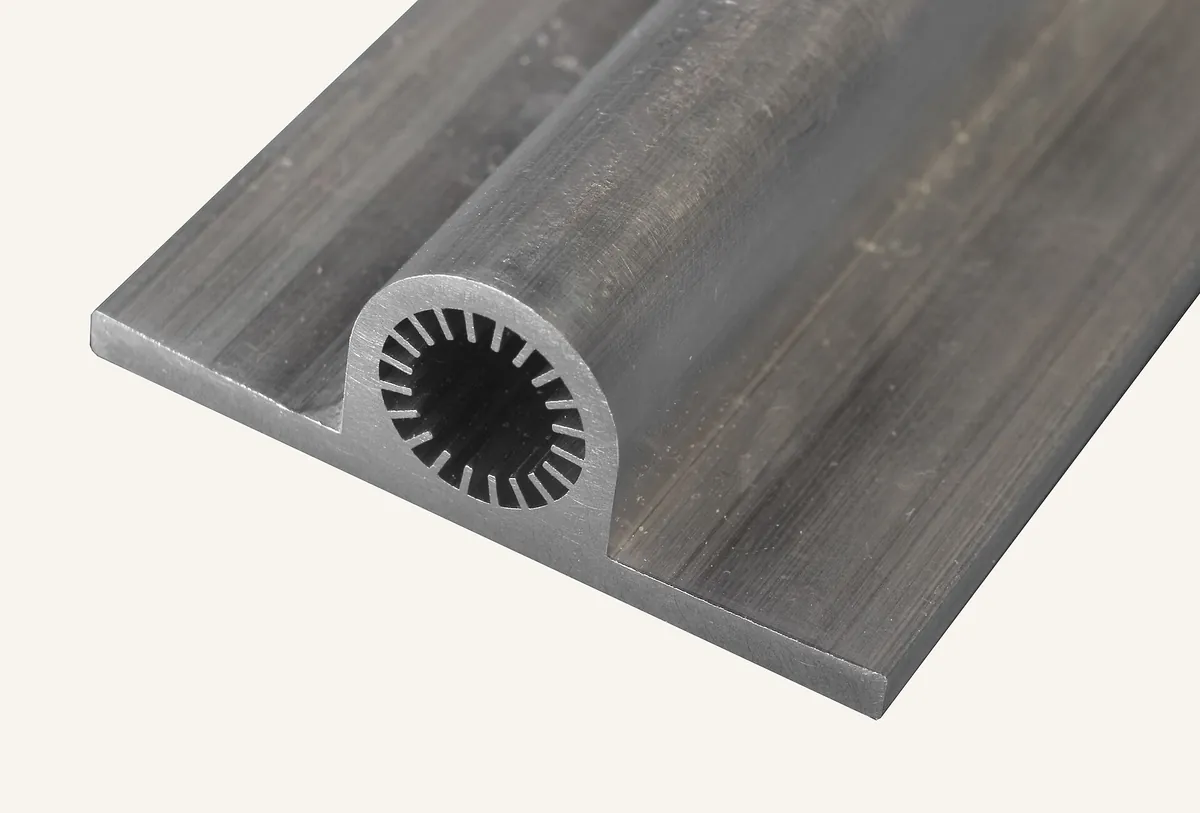
Micro-channel aluminium tube, also called multi-port extruded (MPE) or flat multi-port tube, is a thin, flat extrusion with a row of small parallel channels for refrigerant or coolant. Brazed to louvred fins and headers, it forms compact all-aluminium condensers, evaporators, heat pumps and battery cooling plates. Metline supplies micro-channel tube to drawing, bare, zinc-coated or flux-coated, in coils or cut lengths, worldwide.
A micro-channel tube looks like a thin flat strip, but inside it carries a row of small ports separated by thin webs. The ports give a large internal surface for the fluid, the webs hold the tube together under pressure, and the flat outer faces give a broad, flat contact for brazed fins. Hydraulic diameters are typically around one millimetre or less, which is where the name comes from.
Micro-channel heat exchangers (MCHX) were first adopted for automotive air-conditioning condensers and are now common in residential and commercial HVAC, heat pumps, chillers, refrigerated transport and electric-vehicle thermal systems. Compared with round-tube plate-fin coils, they hold much less refrigerant, weigh less, take less depth and are made from a single metal, which simplifies recycling and removes galvanic corrosion between tube and fin.
Most micro-channel tube is extruded from rod or billet, then coated and coiled in one continuous line. A folded alternative is made from clad sheet; it uses a different route and is compared in our folded vs extruded micro-channel article. This page covers extruded multi-port tube.
Tube geometry
Geometry parameters to specify
Micro-channel tube is always made to a drawing, because every heat exchanger design has its own port layout. The outer envelope sets fin and header fit; the port geometry sets heat transfer, pressure drop and burst strength. Treat them as two separate sets of requirements.
Parameter
Typical range
Design effect
Tube width
About 12 – 32 mm for most HVAC and automotive tubes; wider tubes for special designs
Matches fin depth and header slot
Tube height (thickness)
About 1.3 – 2.5 mm
Sets fin contact; usually the most critical tolerance
Number of ports
Roughly 8 – 30 or more, depending on width
More ports raise area and strength, and pressure drop
Port shape
Rectangular, round, D-shaped or with internal micro-fins
Affects heat transfer and burst resistance
Outer wall and web thickness
Typically a few tenths of a millimetre
Set by burst pressure and corrosion allowance
Cut length
To coil design; tubes are often cut to length in-line
Length tolerance affects header assembly
Ranges are indicative of common designs, not supply limits. Wider, ultra-wide and high-pressure tubes (for CO2 / R744 systems) are made to specific designs and need die and burst validation.
Alloys & coatings
Alloys and surface coatings
The tube alloy must extrude into very thin webs at high speed, survive brazing at about 600 °C and resist corrosion in service. Lean manganese 3102 and commercially pure 1100 or 1050 extrude most easily; long-life alloys add controlled amounts of manganese, copper or zinc to make the tube more noble than the fins and slow pitting.
Element (wt %)
3102
1100
3003
Silicon (Si)
≤ 0.40
Si + Fe ≤ 0.95
≤ 0.60
Iron (Fe)
≤ 0.70
(see Si)
≤ 0.70
Copper (Cu)
≤ 0.10
0.05 – 0.20
0.05 – 0.20
Manganese (Mn)
0.05 – 0.40
≤ 0.05
1.0 – 1.5
Zinc (Zn)
≤ 0.30
≤ 0.10
≤ 0.10
Aluminium
Remainder
≥ 99.00
Remainder
Zinc arc spray
A thin layer of zinc is sprayed onto the flat faces in-line, commonly a few g/m² up to about 10 g/m². During brazing it diffuses into the surface, making the outer skin sacrificial, so corrosion spreads sideways rather than through the wall.
Flux pre-coat
A non-corrosive potassium fluoroaluminate flux, sometimes mixed with silicon or filler powder, is applied to the tube. It removes the need to flux the core before brazing and can supply filler metal for tube-to-fin joints.
Bare tube
Uncoated tube for designs where fins and headers carry the filler and the coil is fluxed after assembly, or where the environment is benign.
Heat exchanger assembly
How micro-channel tube is used in a brazed coil
Cut and stackTubes are cut to length and stacked with louvred fins made from clad fin stock (an Al-Si filler skin on a 3xxx core).
Insert into headersTube ends enter slots in clad header tubes; side plates and fittings complete the core.
FluxThe core is fluxed, unless pre-coated tube or fins already carry flux.
BrazeControlled atmosphere brazing in nitrogen at about 590 – 610 °C melts the Al-Si cladding, which flows by capillary action to form every tube-fin and tube-header joint.
TestFinished coils are leak tested (helium or pressure decay) and sampled for burst pressure.
Because brazing anneals the tube, design strength is the post-braze (O-temper equivalent) strength, not the as-extruded value. Burst pressure, fatigue under pressure cycling and resistance to port collapse should all be checked on brazed samples.
Inspection
Tolerances, testing and acceptance
Typical inspection plan
Outer dimensions
Width, height, flatness, camber and twist, measured continuously or by frequent sampling
Port geometry
Sectioning and optical measurement of ports, webs and walls
Coating weight
Zinc or flux load in g/m², measured by stripping or gravimetric method
Burst and pressure tests
Burst pressure on samples, before and after a simulated braze cycle
Corrosion tests
Acidified salt spray (SWAAT, ASTM G85 Annex A3) or customer-specific tests on brazed samples
Cleanliness
Internal residue and particle limits, with tubes capped or coiled to keep ports clean
Agree which dimensions are production acceptance limits and which are design targets still being developed, especially for a new die.
When a substitute tube is offered, approve samples on your real brazing line before accepting it. Two tubes with the same envelope can behave very differently in brazing, burst and corrosion if the port layout, alloy or coating differ.
Applications
Where micro-channel tube is used
Automotive air-conditioning: condensers, evaporators and gas coolers for R1234yf and R744 systems
Residential and commercial HVAC: outdoor condenser coils and heat pump coils
Electric vehicles: battery cooling plates, chiller and heat pump modules
Refrigeration: display cabinets, transport refrigeration and chillers
Data centres and electronics: liquid-to-air coolers and rear-door heat exchangers
Industrial: oil coolers, charge-air coolers and compact process heat exchangers
Comparison
Micro-channel vs round-tube plate-fin coils
Factor
Micro-channel (MCHX)
Round-tube plate-fin (RTPF)
Refrigerant charge
Substantially lower
Higher
Weight and depth
Lower
Higher
Materials
All aluminium
Copper or aluminium tubes with aluminium fins
Air-side pressure drop
Low with louvred fins
Moderate
Manufacturing
Brazing furnace; high capital cost
Mechanical expansion; established lines
Field repair
Difficult
Easier
Evaporator condensate drainage
Needs careful design
Good
Manufacturers keeping their fin-and-tube lines often move to inner-grooved aluminium tube first; those designing a new compact coil generally choose micro-channel.
SpecifyTube drawing with width, height, port layout and wall/web thickness; alloy; coating type and load; coil or cut-length format; burst, corrosion and cleanliness requirements; annual and call-off volumes.
QuoteWe confirm alloy, temper, tolerances, certification, packing and delivery terms (EXW, FOB, CIF or DAP) for your destination.
ProcessSamples from the die are measured and tested on your brazing cycle; after approval, tube is extruded, coated, coiled or cut and inspected.
DocumentEach delivery carries a mill test certificate to EN 10204 3.1 with the cast analysis and mechanical results; third-party inspection can be arranged on request.
ShipCoils or cut tubes are packed to keep ports clean and faces undamaged, then shipped by sea or air on EXW, FOB, CIF or DAP terms.
Most commonly 3102, 1100 or 1050, which extrude easily into thin webs, plus long-life 3xxx alloys designed to resist pitting. The alloy is chosen together with the fin and header alloys so that the tube stays more noble than the fins.
Why is micro-channel tube zinc-coated?
Zinc sprayed on the flat faces diffuses into the surface during brazing and makes it sacrificial. Corrosion then spreads sideways along the surface instead of pitting through the thin wall, which extends coil life in coastal and polluted air.
What is the difference between extruded and folded micro-channel tube?
Extruded tube is pushed through a die from a single alloy, with ports formed by the die. Folded tube is formed and brazed from clad sheet. Extruded tube dominates HVAC; folded tube is used in some automotive and high-performance designs.
How is micro-channel tube joined?
By controlled atmosphere brazing in nitrogen at about 590 – 610 °C with a non-corrosive flux. The Al-Si cladding on fins and headers melts and forms all joints in a single furnace pass.
Can micro-channel tube handle CO2 (R744) pressures?
Yes, with designs made for it: smaller, rounder ports, thicker webs and validated burst performance. Standard HVAC tube is not automatically suitable; ask for a design and burst test on brazed samples.
Do you supply micro-channel tube in coils?
Yes. Metline supplies micro-channel tube in coils for in-line cutting or as cut lengths, bare or coated, with test records, to customers worldwide.
Need micro-channel tube?
Send your tube drawing, coating and volumes. We will reply with feasibility, test plan, packing and a delivered price.