Cryogenic plants
5083-O pipe for air-separation units, LNG and gas-processing plants, where aluminium stays tough at very low temperatures.



Spiral welded aluminium pipe is made by winding a strip or narrow plate of 5xxx alloy into a helix and welding the seam, which produces large diameters (about 219 to 1580 mm) from material much narrower than the pipe circumference. Because the weld runs at an angle, it carries less of the hoop stress than a straight seam. This guide covers how the pipe is made, alloys, sizes and weights, testing and where it is used.
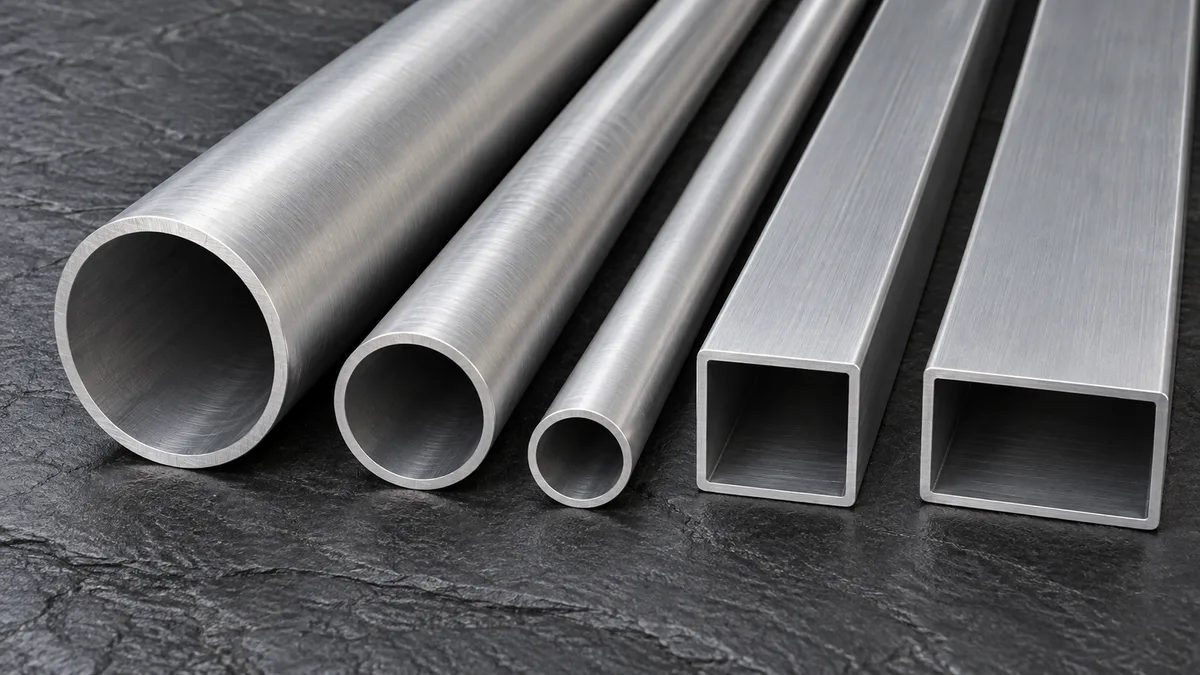
Seamless aluminium pipe is extruded, and extrusion presses limit how large it can be. Above roughly 500 – 700 mm diameter, almost all aluminium pipe is fabricated from plate or strip and welded. There are two ways to do it: bend a full-width plate into a cylinder and weld one straight (longitudinal) seam, or wind a narrower strip around at an angle and weld a continuous helical seam. The second method is spiral welding.
Spiral welding is familiar from large steel line pipe, but aluminium is harder to do well: the metal conducts heat rapidly, has a tenacious oxide film and distorts easily, so forming and seam alignment must be tightly controlled. Mills that make aluminium spiral pipe use either inert-gas arc welding (MIG/TIG) or friction stir welding, a solid-state process that joins the metal below its melting point and leaves a fine-grained weld with low distortion.
The products are almost always non-heat-treatable Al-Mg alloys such as 5052, 5754 and 5083 in the O or H112 condition. These alloys weld without losing strength relative to the annealed base metal, resist corrosion in water, seawater and industrial atmospheres, and stay tough at cryogenic temperatures.
Bends, tees, reducers and end caps for spiral pipe systems are fabricated separately from the same alloys, usually as segmented mitre bends or pressed fittings.
In a thin-walled pipe under internal pressure, the hoop (circumferential) stress is twice the axial stress. A longitudinal seam lies along the pipe axis, so it is loaded by the full hoop stress. A helical seam lies at an angle φ to the axis, and the stress acting across it is σn = σhoop × (1 − ½ sin²φ).
The helix angle follows from the strip width B and pipe diameter D: cos φ = B / (πD). The table shows the result for a few combinations.
| Pipe D (mm) | Strip width B (mm) | Seam angle to axis φ | Stress across seam (% of hoop stress) |
|---|---|---|---|
| 1000 | 800 | 75° | 53 % |
| 1000 | 1000 | 71° | 55 % |
| 1000 | 1500 | 61° | 61 % |
| 1000 | 2000 | 50° | 70 % |
| 500 | 800 | 59° | 63 % |
| 1500 | 2000 | 65° | 59 % |
In practice the seam of a spiral pipe sees roughly 50 – 75 % of the hoop stress, compared with 100 % for a straight seam. That margin is useful, but design codes still apply the weld joint efficiency set by the inspection level, so the pipe wall is not automatically thinner. The real gain is a more forgiving joint and fewer site welds.
Values below are EN 485-2 minimums for O/H111 sheet and plate, which govern the strip used to make the pipe. H112 material is supplied as rolled and carries similar or slightly higher values; actual results appear on the certificate.
| Alloy | Tensile strength Rm (MPa) | 0.2 % proof Rp0.2 (MPa, min) | Main traits |
|---|---|---|---|
| 5052 (EN AW-5052) | 170 – 215 | 65 | Good corrosion resistance, easy forming, lowest cost of the group |
| 5754 (EN AW-5754) | 190 – 240 | 80 | Widely stocked in Europe; can be used where service temperatures exceed 65 °C |
| 5083 (EN AW-5083) | 275 – 350 | 125 | Strongest weldable non-heat-treatable alloy; standard for cryogenic and marine service |
Because O-temper material is already fully annealed, the heat of welding does not lower its strength, so the welded pipe keeps close to base-metal properties. Alloys with more than about 3 % magnesium, such as 5083, should not be used for long periods above about 65 °C, where they can become sensitive to intergranular corrosion; 5754 or 5454 is chosen for warm service. Filler metal is normally ER5356 or ER5183 for 5083.
Weight per metre = π × (OD − wall) × wall × 0.0027 kg (dimensions in mm, density 2.70 g/cm³).
| OD (mm) | Wall (mm) | kg per metre | kg per 12 m pipe |
|---|---|---|---|
| 219 | 4 | 7.3 | 88 |
| 273 | 5 | 11.4 | 136 |
| 325 | 5 | 13.6 | 163 |
| 406 | 6 | 20.4 | 244 |
| 508 | 6 | 25.5 | 307 |
| 610 | 8 | 40.9 | 490 |
| 711 | 8 | 47.7 | 572 |
| 813 | 10 | 68.1 | 817 |
| 914 | 10 | 76.7 | 920 |
| 1016 | 12 | 102.2 | 1226 |
| 1219 | 12 | 122.9 | 1474 |
| 1422 | 14 | 167.2 | 2006 |
| 1580 | 14 | 186.0 | 2232 |
| Aspect | Spiral welded | Longitudinal (straight) seam |
|---|---|---|
| Stress across seam | About 50 – 75 % of hoop stress | 100 % of hoop stress |
| Raw material | Narrow strip or plate; one width covers many diameters | Plate width must match the circumference; very wide plate costs more |
| Length | Continuous; cut to long lengths | Limited by plate length; sections joined by girth welds |
| Total weld length | Longer per metre of pipe | Shorter per metre of pipe |
| Roundness and straightness | Good when forming is well controlled | Seam peaking and ovality harder to control on thin walls |
| Equipment | Specialised forming and welding line | Simple roll bending and welding |
| Best for | Long runs of large-diameter pipe | Short runs, special sizes, thick walls |
5083-O pipe for air-separation units, LNG and gas-processing plants, where aluminium stays tough at very low temperatures.
Large aluminium enclosure tubes for gas-insulated transmission lines and busbar ducts.
Seawater intake and discharge, ventilation trunks and structural tubes on vessels and platforms.
Large ducts for corrosive gases, fume extraction and ventilation where steel would corrode.
Lightweight large-bore pipe for cooling water and outfalls, easy to handle on site.
Cylindrical shells for storage vessels and silos, built to the applicable pressure-vessel code.
Spiral welding can produce aluminium pipe up to about 1580 mm OD. Larger shells are possible as rolled-and-welded fabrications from plate.
Not in the O-temper 5xxx alloys normally used: welding does not reduce their annealed strength, and the helical seam sees less hoop stress. Design pressure still depends on the code and the weld inspection level.
5083-O is the standard choice. It keeps its toughness at liquid-nitrogen and LNG temperatures and welds well with ER5183 filler.
For sustained service above about 65 °C, choose 5754 or 5454 rather than 5083, because high-magnesium alloys can become sensitised to intergranular corrosion.
Typically 6 – 12 m, cut from continuous production. Longer lengths are possible if transport and handling allow.
Yes. Elbows, tees, reducers and heads in the same alloy can be supplied with the pipe, along with mill certificates.
Send diameter, wall, alloy, length, design conditions and the governing code. We will reply with a technical offer and delivered price.





