Drawn seamless
Extruded hollow, then cold drawn over a mandrel for tight tolerances, thin walls and a smooth bore. The usual form for condenser and evaporator tube. See 3003 seamless tube.



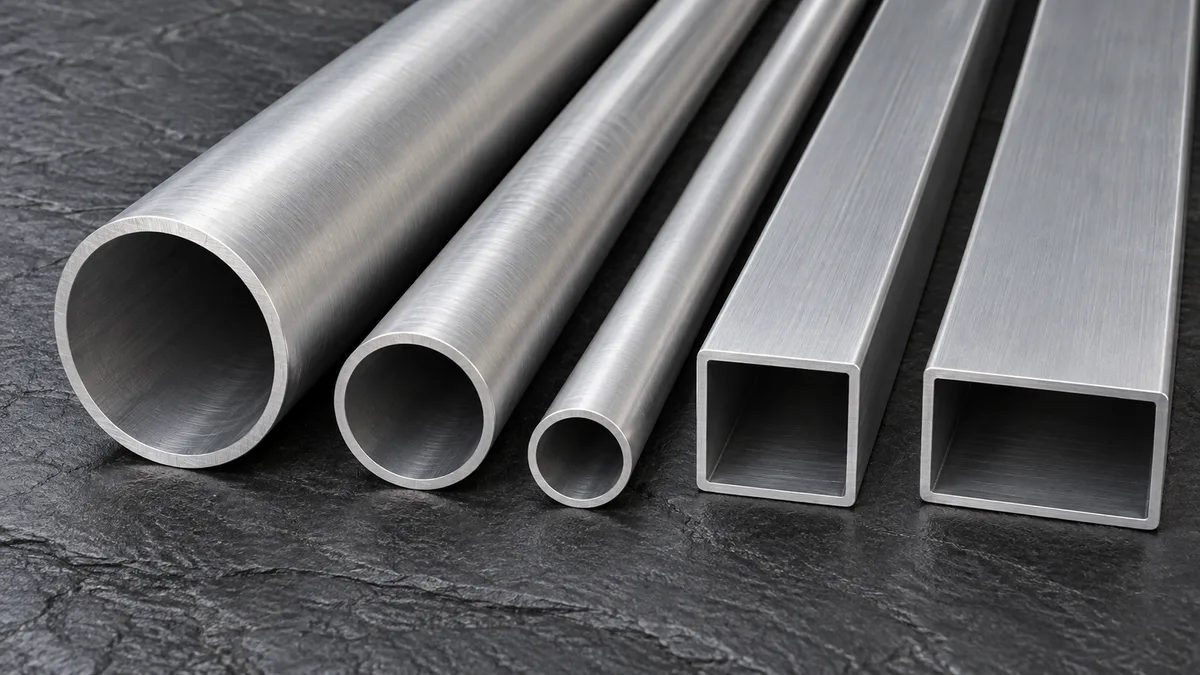
3003 aluminium tube is a manganese-alloyed, non-heat-treatable tube that is about 20 % stronger than pure 1100 while keeping its easy forming, brazing and corrosion resistance. That balance makes it the standard tube for heat exchangers, air-conditioning and refrigeration coils, radiators, fuel and oil lines and general fabrication. Metline supplies 3003 tube drawn, extruded or welded, straight or coiled, worldwide.
3003 is aluminium with about 1.2 % manganese and a little copper. The manganese forms fine particles that strengthen the metal without heat treatment, and the copper raises strength slightly while keeping corrosion resistance close to that of pure aluminium.
In tube form, 3003 is the workhorse of heat transfer. It is soft enough in the O temper to be bent into hairpins, expanded into fin packs and flared for fittings, and its melting range sits well above the temperature of aluminium-silicon brazing filler, so it can be furnace or flame brazed into complete heat-exchanger cores. It also resists the moist, sometimes condensing conditions inside air-conditioning and refrigeration systems.
Beyond HVAC, 3003 tube is used for fuel and oil lines, instrument tubing, irrigation and chemical lines, ladder rails, furniture and decorative trim. When higher pressure or structural strength is needed, buyers move up to 5052 or 6061 tube; when maximum conductivity or ductility is needed, they move down to 1100 or 1060.
Registered Aluminum Association limits, equivalent to EN AW-3003 (AlMn1Cu) under EN 573-3.
| Element | Minimum | Maximum | Role in the alloy |
|---|---|---|---|
| Silicon (Si) | — | 0.6 | Impurity |
| Iron (Fe) | — | 0.7 | Impurity |
| Copper (Cu) | 0.05 | 0.20 | Small addition; raises strength and shifts corrosion potential |
| Manganese (Mn) | 1.0 | 1.5 | Main alloying element: about 20 % more strength than 1100 |
| Zinc (Zn) | — | 0.10 | Impurity |
| Others, each / total | — | 0.05 / 0.15 | |
| Aluminium (Al) | Remainder | About 96.8 – 99 % |
Typical values from Aluminum Association and ASM data. Specified minimums depend on product route and wall: ASTM B210 and B234 for drawn tube, B221 and B241 for extruded tube. For example, drawn 3003-O tube must reach about 97 MPa (14 ksi) tensile and H14 about 138 MPa (20 ksi) tensile minimum.
| Temper | Condition | Tensile strength | Yield strength | Elongation | Hardness |
|---|---|---|---|---|---|
| O | Annealed | 110 MPa / 16 ksi | 42 MPa / 6 ksi | 30 – 40 % | 28 HB |
| H12 | Quarter hard | 131 MPa / 19 ksi | 124 MPa / 18 ksi | 10 – 20 % | 35 HB |
| H14 | Half hard | 152 MPa / 22 ksi | 145 MPa / 21 ksi | 8 – 16 % | 40 HB |
| H16 | Three-quarter hard | 179 MPa / 26 ksi | 172 MPa / 25 ksi | 5 – 14 % | 47 HB |
| H18 | Full hard | 200 MPa / 29 ksi | 186 MPa / 27 ksi | 4 – 10 % | 55 HB |
| H112 | As extruded | Close to O; minimums per ASTM B221 | — | — | — |
Extruded hollow, then cold drawn over a mandrel for tight tolerances, thin walls and a smooth bore. The usual form for condenser and evaporator tube. See 3003 seamless tube.
Pressed through a die and mandrel from a hollow billet; for larger diameters and heavier walls in H112.
Extruded through a bridge die, which leaves longitudinal weld lines. Economical for shapes and non-pressure uses.
Roll-formed from strip and high-frequency welded. Used for radiator and condenser tube, often from brazing-clad 3003 strip.
Annealed tube supplied in level-wound or pancake coils for refrigeration lines and long continuous runs.
Oval, flat and D-shaped tube for compact heat exchangers.
| System | Designation | Tube standard |
|---|---|---|
| ASTM / ASME | 3003 | B210 (drawn seamless, general), B234 (drawn seamless for condensers and heat exchangers), B221 (extruded), B241 (seamless pipe), B313 (welded round tube), B483 (drawn tube) |
| UNS | A93003 | — |
| European (EN) | EN AW-3003 (AlMn1Cu) | EN 754-2, EN 755-2, EN 573-3 |
| ISO | AlMn1Cu | ISO 6363, ISO 6362 |
| German Werkstoff | 3.0517 | — |
| Japan (JIS) | A3003 | JIS H4080 (A3003TD, A3003TE) |
Heat-exchanger tube is usually ordered in inch-based ODs (1/4, 3/8, 1/2, 5/8, 3/4 in) or metric equivalents with thin walls. Mass per metre below uses 2.73 g/cm³.
| OD (mm) | Wall (mm) | ID (mm) | Mass (kg/m) |
|---|---|---|---|
| 6.35 | 0.71 | 4.93 | 0.034 |
| 7 | 0.6 | 5.8 | 0.033 |
| 8 | 0.8 | 6.4 | 0.049 |
| 9.52 | 0.81 | 7.9 | 0.061 |
| 10 | 1 | 8 | 0.077 |
| 12 | 1 | 10 | 0.094 |
| 12.7 | 0.89 | 10.92 | 0.090 |
| 15.88 | 1 | 13.88 | 0.128 |
| 16 | 1.2 | 13.6 | 0.152 |
| 19.05 | 1.24 | 16.57 | 0.189 |
| 20 | 1.5 | 17 | 0.238 |
| 22 | 1.5 | 19 | 0.264 |
| 25.4 | 1.65 | 22.1 | 0.336 |
| 30 | 2 | 26 | 0.480 |
| 38.1 | 2 | 34.1 | 0.619 |
| 50 | 3 | 44 | 1.209 |
O-temper tube makes tight hairpin bends; use a mandrel for thin walls. H14 holds shape better in straight runs.
Ductile enough for mechanical or hydraulic expansion into fins for tube-and-fin coils.
Furnace, flame or induction brazes with Al-Si filler such as 4047; works with clad fin stock. Brazing anneals the tube to near O.
TIG and MIG weld readily with ER4043 or ER1100 filler.
Good in most refrigerants, fresh water and atmospheres. For aggressive coastal air, zinc-diffused or coated tube can be specified.
Tube for refrigeration can be supplied with cleaned, dry and capped bores.
| Property | 1100-O | 3003-O | 5052-O | 6063-T6 |
|---|---|---|---|---|
| Typical tensile strength | 90 MPa | 110 MPa | 193 MPa | 241 MPa |
| Brazeability | Excellent | Excellent | Poor (Mg) | Fair |
| Formability | Excellent | Excellent | Good | Fair |
| Thermal conductivity | About 222 W/m·K | About 193 W/m·K | About 138 W/m·K | About 200 W/m·K |
| Typical use | General, chemical | Heat exchangers, HVAC | Fuel and hydraulic lines | Structures, architecture |
Mainly heat exchangers: air-conditioning and refrigeration coils, radiators and oil coolers. It is also used for fuel and oil lines, instrument tubing, ladders, furniture and trim.
Yes. Its melting range (about 643 – 654 °C) sits comfortably above Al-Si brazing filler, so it brazes reliably by furnace, flame or induction. Brazing anneals the tube to near the O temper.
Yes, by about 20 % in each temper, thanks to the manganese addition, while keeping similar formability and corrosion resistance.
No. 3003 is non-heat-treatable; strength comes from cold work. Choose H14 or H18 for more strength, or 6061 tube if heat-treated strength is required.
O (annealed) for tight bends, hairpins and expansion; H14 for straight lengths that need to stay rigid.
Yes. Annealed small-bore 3003 tube can be supplied in coils, alongside straight lengths and cut pieces.
Send size, temper, form and test requirements with quantity and destination for a delivered quote.





