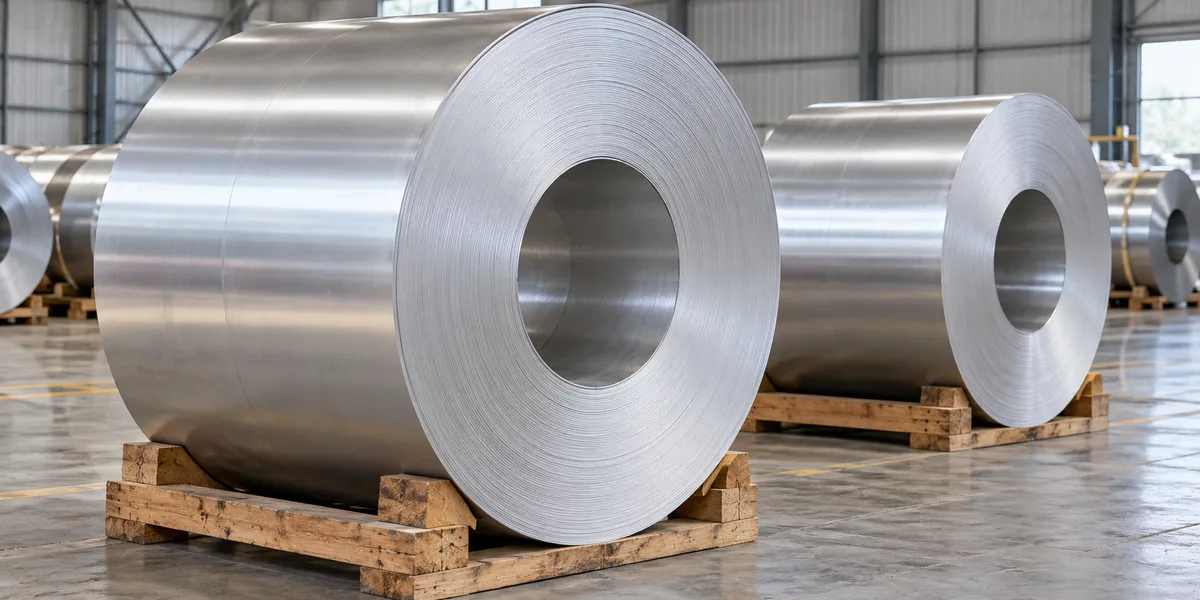
Aluminium brazing sheet is a roll-bonded composite: a core alloy, usually 3003 or another Al-Mn alloy, clad on one or both sides with a thin layer of low-melting Al-Si filler alloy such as 4343 or 4045. In the brazing furnace the cladding melts and flows into every joint, so a whole radiator or cold plate is joined in one pass. Metline supplies brazing sheet, strip and fin coil with the layer stack, clad ratio and temper you specify, to customers worldwide.
Brazing joins metals with a filler that melts below the parent metal. Aluminium alloys melt only a little above the usual aluminium-silicon fillers, so the filler must be placed exactly where it is needed and heated precisely. Brazing sheet solves this by carrying the filler as a cladding layer bonded to the sheet during hot rolling.
The core alloy (for example 3003, solidus about 640 °C) stays solid while the Al-Si cladding (4343 or 4045, which start to melt at about 577 °C) becomes liquid at the brazing temperature of roughly 590 – 610 °C. Capillary action draws the molten filler into the gaps between tubes, fins, plates and headers, forming fillets at every contact point. On cooling, the assembly is a single metallurgically bonded unit.
Brazing sheet is the basis of almost every modern aluminium heat exchanger: car radiators, condensers, evaporators and heater cores, charge-air coolers, HVAC coils, oil coolers, plate-fin exchangers for industrial gases, and the liquid cold plates that cool electric-vehicle batteries.
Alloy system
Core, cladding and liner alloys
Layer
Alloy
Approx. Si / key element
Role
Core
3003
Mn 1.0 – 1.5 %
Standard core: good strength after brazing and corrosion resistance
Core
3005 / long-life 3xxx
Mn plus Mg, Cu or Ti additions
Higher post-braze strength and better internal corrosion life
Core
6951
Al-Mg-Si
Heat-treatable core for higher strength after brazing (e.g. evaporator plates)
Filler clad
4343
Si 6.8 – 8.2 %
Common CAB cladding with moderate fluidity
Filler clad
4045
Si 9.0 – 11.0 %
More fluid filler; widely used for CAB sheet and fin stock
Filler clad
4047
Si 11.0 – 13.0 %
Near-eutectic; lowest melting, most fluid
Filler clad
4004 / 4104
Al-Si with Mg (4104 also Bi)
Vacuum brazing: magnesium disrupts the oxide film without flux
Liner
7072
Zn about 1 %
Sacrificial waterside layer that corrodes in preference to the core
Composition ranges follow the Aluminum Association / EN 573-3 registrations. AWS A5.8 classifies the same filler alloys for brazing, for example BAlSi-2 (4343), BAlSi-4 (4047) and BAlSi-5 (4045).
Process
CAB and vacuum brazing
Controlled-atmosphere brazing (CAB)
Parts are coated with a non-corrosive potassium fluoroaluminate flux (commonly known by the trade name Nocolok) and brazed in a nitrogen atmosphere. Uses 4343 or 4045 cladding. The dominant process for automotive and HVAC exchangers.
Vacuum brazing
No flux: magnesium in 4004 or 4104 cladding evaporates and breaks up the oxide film in a high-vacuum furnace. Preferred for complex plate-fin exchangers and parts that must be free of flux residue.
Flame and induction brazing
Used for repairs and joining tubes to fittings with separate filler rod, wire or rings rather than brazing sheet.
Typical brazing cycles reach about 590 – 610 °C and hold for a few minutes. The window between filler melting and core melting is narrow, so furnace uniformity matters. Too hot or too long, and silicon diffuses from the cladding into the core ("erosion"), weakening thin fins and tubes; too cool, and joints are incomplete.
Supply range
Supply range, clad ratio and tempers
Typical supply range
Thickness
Fin stock from about 0.05 mm; tube and plate stock about 0.2 – 2 mm; thicker header and side plate
Width
Slit coil to the customer width, from narrow fin strip to wide sheet
Clad ratio
Usually 5 – 15 % of total thickness per side; specified per face
Tempers
O for deep-drawn plates and headers; H14 or H24 for fins and tubes
Configurations
One-side clad, two-side clad, clad plus waterside liner, bare fin with clad tube
Inspection
Total thickness, clad thickness by metallographic section, mechanical properties, flatness, surface cleanliness
Final layer stack and clad ratio are confirmed against your process and drawing.
Post-braze properties are what count. The brazing cycle anneals the sheet, so a strain-hardened H14 temper loses most of its extra strength and finishes close to the O-temper values of the core alloy. Long-life cores are designed to keep more strength and resist the internal corrosion caused by coolant, which is why they have largely replaced plain 3003 in automotive radiators.
Applications
Applications of aluminium brazing sheet
Automotive: radiators, condensers, evaporators, heater cores, charge-air and oil coolers
Electric vehicles: battery cold plates, chillers and power-electronics coolers
HVAC and refrigeration: microchannel and round-tube coils, plate heat exchangers
Industrial: brazed plate-fin exchangers for air separation and cryogenic gas processing
Power and electronics: liquid-cooled heat sinks and cooling plates for inverters and transformers
For tube and fin designs, a common arrangement is clad tube stock with bare fins, or clad fin stock with bare extruded tubes. Fins are often made from slightly zinc-rich alloys so that they are sacrificial to the tube, protecting the refrigerant or coolant passage from pitting.
What is the difference between 4343 and 4045 cladding?
4045 contains more silicon (9 – 11 %) than 4343 (6.8 – 8.2 %), so it melts more completely at the brazing temperature and flows more freely. 4343 gives less erosion of thin cores; 4045 fills larger gaps.
What clad ratio should I use?
Typically 5 – 15 % of the total thickness per side. Thin fins and tubes use lower ratios to limit core erosion; plates and headers that must fill larger joints use higher ratios.
Why does brazing sheet lose strength after brazing?
The brazing cycle at about 600 °C anneals the sheet. Strain-hardened tempers revert to near O-temper strength, so designs should use post-braze properties.
Can brazing sheet be used for vacuum brazing?
Yes, with magnesium-containing cladding such as 4004 or 4104. Standard 4343 and 4045 clad sheet is intended for flux brazing (CAB).
What is a waterside liner?
A thin layer, usually 7072 (Al-1 % Zn), on the coolant side of the tube. It is anodic to the core and corrodes sideways instead of letting pits penetrate the tube wall.
Do you supply fin stock as well?
Yes. We supply bare and clad fin stock in narrow slit coils, as well as tube stock and header plate.
Need brazing sheet or clad coil?
Send the layer stack, clad ratio, thickness, width and quantity. Our team will confirm availability and quote.