Bending
Place the seam on the neutral axis (at the side of the bend, not the inside or outside) to keep it out of the zones of highest strain. Use mandrels on thin walls.



Welded aluminium tube is made by forming flat strip or sheet into a round or shaped section and joining the edges with a continuous longitudinal or helical seam. It is the economical choice for heat exchangers, HVAC lines, furniture, frames and large ducts, where a seamless extruded or drawn tube would cost more than the job needs. This guide explains how each welding route works, which alloys suit it, what the standards say and when you should insist on seamless instead.
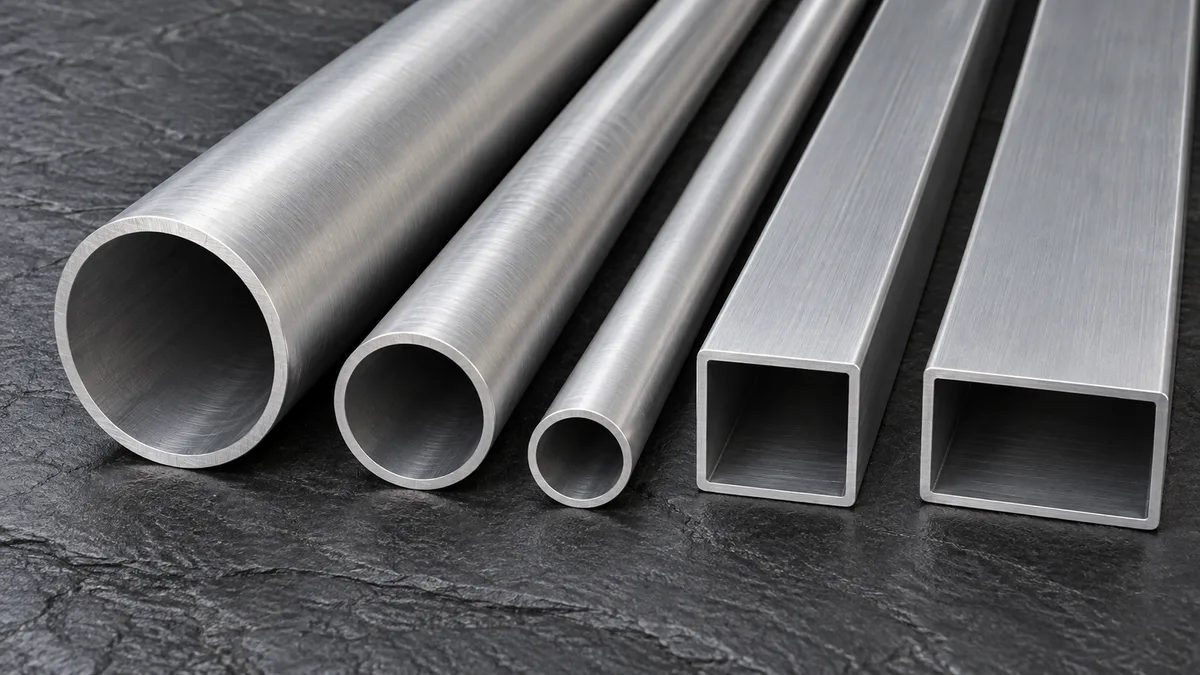
Every aluminium tube is made in one of two ways. Seamless tube is pushed or drawn from a solid billet, so the wall is one continuous piece of metal. Welded tube starts life as coil or sheet that has already been rolled to the final wall thickness; rolls bend it into a tube and the edges are fused together. The finished tube has a seam, but its wall thickness is as uniform as the strip it came from.
That difference drives the economics. A tube mill can run continuously at high speed from a coil, scrap is low and wall thickness can be thinner than an extrusion press can reliably produce. Pre-finished strip can even be painted, lacquered or clad with a brazing alloy before it is formed. Against that, the seam and the zone around it are metallurgically different from the parent metal, and that matters for pressure, fatigue and some heat-treatable alloys.
In practice, welded tube dominates in automotive radiators and condensers, air-conditioning tubing, solar and HVAC equipment, furniture, ladders, display systems and very large diameter ducts, while seamless tube remains standard for hydraulic lines, high-pressure gas, aerospace and critical structural members.
Suppliers use the terms loosely, so it helps to know what each route really is. High-frequency (HF) welding is a form of electric resistance welding (ERW): a high-frequency current, introduced by an induction coil or by sliding contacts, flows along the converging strip edges and heats them almost instantly; squeeze rolls then forge them together without filler metal. Older low-frequency ERW is rarely used for aluminium today, so in most quotations "ERW" and "HFW" describe the same kind of tube.
| Route | How the seam is made | Typical size window | Best suited to |
|---|---|---|---|
| HF induction / contact (HFW, ERW) | Edges heated by HF current and forged by squeeze rolls; no filler; outside and often inside bead scarfed | Small to medium diameters, thin to medium walls | Heat-exchanger tube, HVAC, furniture, frames, pre-painted tube |
| Laser or TIG seam welding on a mill | Edges melted by laser or arc as the tube passes; narrow fused seam | Small diameters, thin walls | Precision and decorative tube, alloys sensitive to HF welding |
| Formed and arc-welded (TIG / MIG) | Sheet or plate rolled to a cylinder, seam butt-welded with filler | Large diameters, heavier walls | Process pipe, tanks, large ducts and columns |
| Spiral (helical) forming | Strip wound helically; seam welded or mechanically lock-seamed | Very large diameters, long lengths | Ventilation ducts, exhaust and chimney liners |
The seam geometry on an HF mill decides weld quality. Strip edges should meet parallel through the wall (an "I" approach) or with a very slight V so that oxide is squeezed out; a wide or inverted V heats the inner and outer surfaces unevenly and can trap oxide in the bond line. Good mills control edge preparation, squeeze pressure and weld power together and monitor them continuously.
Spiral lock-seam duct is not welded at all. If your application needs a gas-tight or pressure-bearing joint, specify a welded seam explicitly.
Alloys that gain their strength from cold work or solid solution behave best, because the heat of welding does not destroy a precipitation-hardened structure. The typical values below are for the strip temper before welding (Aluminum Association / ASM typical data); the tube near the seam will be closer to the annealed value.
| Alloy | Typical strip temper | Typical tensile strength | Character | Typical welded-tube uses |
|---|---|---|---|---|
| 1100 / 1050 | H14 | 125 MPa (1100-H14) | Very high corrosion resistance and conductivity, low strength | Decorative tube, sleeves, light ducts |
| 3003 | H14 | 150 MPa | Excellent formability and brazability | Radiator and condenser tube, HVAC lines, furniture |
| Clad 4343/3003 or 4045/3003 | H14 – H24 core | Core similar to 3003 | Brazing-alloy layer melts in the furnace to form joints | Brazed heat exchangers, battery-cooling tubes |
| 3004 / 3105 | H34 / H14 | 240 MPa (3004-H34) | Stronger than 3003, still easy to form | Light structures, pre-painted tube |
| 5050 / 5052 | H32 – H34 | 230 MPa (5052-H32) | Good strength, good marine corrosion resistance | Marine and outdoor frames, fuel and coolant lines |
| 5454 | H32 / H34 | 275 MPa (5454-H32) | Mg kept below 3 %, suitable for service above 65 °C | Hot fluid lines, tanker and chemical equipment |
| 5083 / 5086 | O, H111, H32 | 290 MPa (5083-O) | Highest non-heat-treatable strength, excellent in seawater | Marine pipe, offshore and structural tube (usually arc-welded) |
| 6061 / 6063 | O or T4, aged after welding | 310 MPa (6061-T6), 241 MPa (6063-T6) | Heat-treatable; seam softens unless re-treated | Frames, furniture, bicycle and sports tube |
Two cautions apply. First, avoid 5xxx alloys with more than about 3 % magnesium for permanent service above 65 °C, because they can become sensitised to intergranular and stress corrosion; 5454 exists for that reason. Second, 2xxx and 7xxx aerospace alloys are almost never supplied as welded tube: they crack during fusion welding or lose most of their strength in the heat-affected zone.
Many enquiries still quote ASTM B313 and B547, but both have been withdrawn by ASTM (B313 in 2018 and B547 in 2019) without a direct replacement. They are still useful as technical references and can be agreed as a contract basis, but buyers should state the edition they mean. In Europe, the EN 1592 series remains the dedicated product standard for HF seam-welded tube.
| Standard | Scope | Status / remarks |
|---|---|---|
| EN 1592-1 | HF seam-welded tubes: technical conditions for inspection and delivery (bare and pre-coated strip) | Current European product standard |
| EN 1592-2 | Mechanical properties | Used with EN 573-3 chemistry and EN 515 tempers |
| EN 1592-3 / -4 | Tolerances for circular tubes / square, rectangular and shaped tubes | Define OD, wall, straightness and squareness limits |
| ASTM B313 / B313M | Round welded tube from formed sheet, continuous seam welding | Withdrawn 2018; quote edition if used |
| ASTM B547 / B547M | Formed and arc-welded round tube, roughly 230 – 1520 mm diameter | Withdrawn 2019; quote edition if used |
| ASTM B209 / EN 485 | Sheet and strip from which tube is formed | Governs the parent material |
| ASME B31.3 | Process piping design, including weld joint factors | Applies where welded tube is used as pressure pipe |
For pressure piping, the design code matters more than the product standard. ASME B31.3, for example, applies a longitudinal weld joint quality factor to welded pipe, typically 0.85 for ERW pipe, which reduces the allowable pressure compared with seamless pipe of the same size unless additional testing is specified.
These are industry-typical ranges, not guaranteed limits. Confirm the exact size, wall and tolerance at enquiry.
Weight per metre of a round tube is π × (OD − t) × t × 2.70 / 1000 kg, with OD and wall t in millimetres. Values below are calculated for alloys of density 2.70 g/cm³; 5xxx alloys are about 1 – 2 % lighter.
| OD (mm) | Wall (mm) | Weight (kg/m) |
|---|---|---|
| 12.7 | 0.8 | 0.081 |
| 19.05 | 1 | 0.153 |
| 25.4 | 1.2 | 0.246 |
| 31.75 | 1.5 | 0.385 |
| 38.1 | 1.5 | 0.466 |
| 50.8 | 2 | 0.828 |
| 63.5 | 2 | 1.043 |
| 76.2 | 2.5 | 1.563 |
| 101.6 | 3 | 2.509 |
| 152.4 | 3 | 3.802 |
| 203.2 | 4 | 6.759 |
| 304.8 | 5 | 12.715 |
The seam is where welded tube can fail, so inspection concentrates there. Typical defects are cold welds (edges touched but did not bond), oxide entrapment, porosity in arc-welded seams, and excessive inside bead that restricts flow or traps contamination. The tests below are chosen according to duty; ask for them in the order rather than assuming they are standard.
| Test | What it reveals | When to specify |
|---|---|---|
| Eddy-current testing in line | Lack of fusion, cracks and pinholes along the seam | Heat-exchanger, refrigerant and fluid tube |
| Flattening and flaring / expansion tests | Ductility of the seam; a weak bond opens | All pressure and expanded-joint applications |
| Leak test (air under water or helium) | Through-wall defects | Refrigerant, coolant and gas lines |
| Hydrostatic or burst test | Pressure capacity of the finished tube | Pressure piping and vessels |
| Radiography or ultrasonic of arc welds | Porosity, lack of penetration | Large formed-and-welded pipe |
| Macro / micro section | Bond line, bead shape, HAZ width | Qualification and first-article approval |
Metline supplies welded tube with a mill test certificate to EN 10204 3.1 showing chemistry and mechanical results, plus dimensional reports and any additional test records agreed in the order. Third-party inspection can be arranged on request.
| Factor | Welded tube | Seamless (extruded / drawn) tube |
|---|---|---|
| Starting material | Rolled strip, sheet or plate | Cast and homogenised billet |
| Wall uniformity | Very uniform (from strip) | Some eccentricity, reduced by drawing |
| Thin walls | Practical down to a few tenths of a millimetre | Limited by press and die, improved by drawing |
| Very large diameters | Easy by rolling and welding or spiral forming | Limited by press size |
| Pressure and fatigue | Seam and HAZ limit design values | Uniform properties around the circumference |
| Heat-treatable alloys | Possible, with post-weld treatment | Standard (6061-T6, 7075-T6, 2024-T3) |
| Pre-coating or cladding | Strip can be painted or clad before forming | Coating applied afterwards |
| Relative cost | Lower in high volumes | Higher, especially in thin walls |
Choose seamless for hydraulic and high-pressure gas lines, aircraft and other fatigue-critical tube, and any part that will be heavily bent, flared or expanded at a location you cannot keep away from the seam. Choose welded tube where volumes are high, walls are thin, the strip benefits from pre-finishing or the diameter is beyond extrusion limits. Our seamless tube guide covers the other side of the decision.
Place the seam on the neutral axis (at the side of the bend, not the inside or outside) to keep it out of the zones of highest strain. Use mandrels on thin walls.
Tube for expanded joints in heat exchangers needs inside bead removal and a ductile seam. Flare and expansion tests confirm it.
Clad 4343/3003 tube brazes in controlled-atmosphere furnaces with non-corrosive flux. Unclad tube can be joined with Al-Si filler rings or wire.
TIG and MIG with 4043 or 5356 filler, chosen by base alloy. For 5xxx tube use 5356 or 5183; for 6xxx, 4043 resists hot cracking.
6061 or 6063 tube welded from O or T4 strip is aged or fully heat-treated after forming to reach T6 values; ask what temper the seam actually is.
Anodise after forming for uniform colour; the seam can appear as a faint line. Pre-painted strip gives a finished surface straight from the mill.
Metline supplies the tube itself and the strip, sheet and plate it is made from, cut to length or prepared to drawing on request. It does not supply finished assemblies such as heat exchangers or furniture.
Away from the seam the wall has the strength of the strip it was made from. The seam and heat-affected zone are usually softer, especially in cold-worked or heat-treated alloys, so pressure and fatigue designs use reduced values unless the tube is heat-treated and tested after welding.
High-frequency welding is a type of electric resistance welding. In current aluminium tube production the two terms usually describe the same process: HF current heats the strip edges and rolls forge them together without filler.
ASTM withdrew B313 in 2018 and B547 in 2019. They can still be named in a contract as a reference, but you should state the edition. EN 1592 remains current for HF seam-welded tube in Europe.
3003 for general use, or 3003 clad with 4343 or 4045 when the tube will be furnace-brazed. Long-life automotive designs sometimes use modified 3xxx cores with improved corrosion resistance.
Yes. Anodising after forming gives a uniform finish, although the seam may show as a faint line, particularly on bright or coloured finishes. Specify an anodising-quality strip if appearance matters.
Yes. Metline supplies welded and seamless aluminium tube, along with the strip and sheet used to make it, to customers worldwide with mill test certificates and export packing.
Send the alloy, size, wall, length, quantity and any test requirements. We will reply with availability, documentation and a delivered price.





