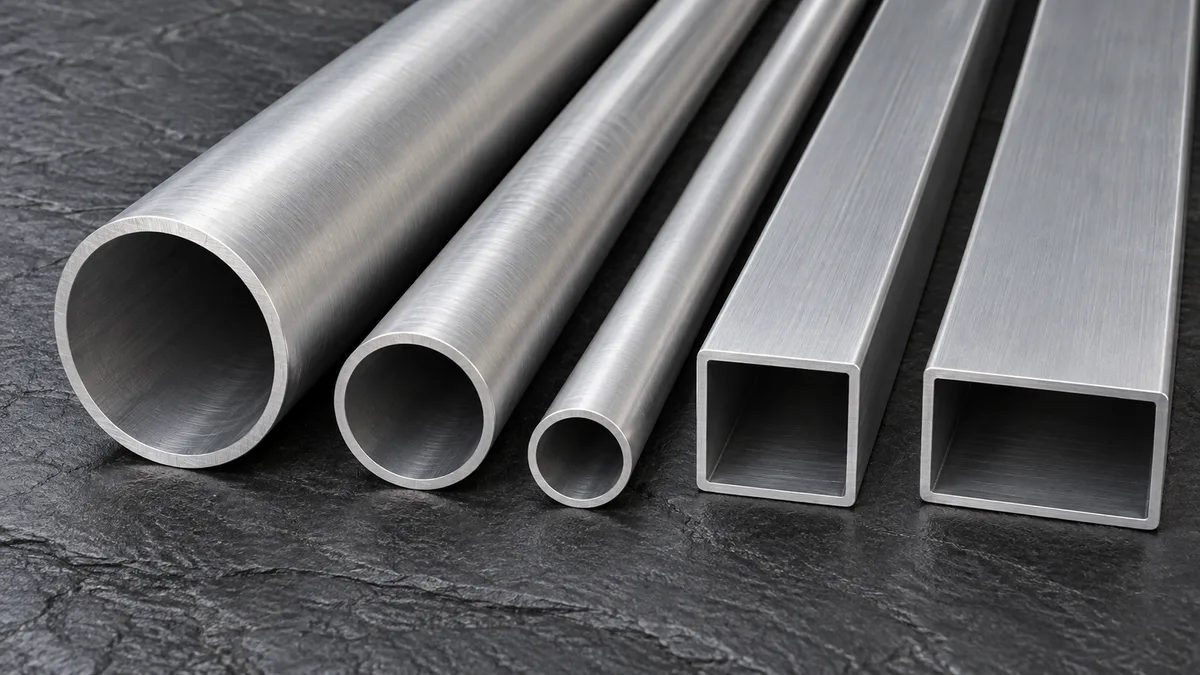
Flat-oval radiator tube is the thin, welded aluminium tube that carries coolant through a brazed radiator core. It is roll-formed from brazing-clad strip, high-frequency welded and sized to a precise width, height and wall, so it joins to fins and headers in a single brazing cycle. This guide explains profiles, clad constructions, sizes, quality checks and how to specify tube for a new core or a replacement supply.
A modern aluminium radiator is a brazed sandwich of three parts: rows of flat tubes that carry coolant, corrugated louvred fins between them that shed heat to the air, and headers (tube plates) that receive the tube ends and connect to the tanks. The tube is the pressure-retaining part, so its profile, wall and weld decide how much heat the core can move and how long it survives.
A flat-oval section has two long parallel faces joined by rounded ends. The flat faces give a large contact area with the fins and a thin coolant channel, which raises the heat-transfer coefficient on the liquid side; the low height keeps the air-side pressure drop down so more air passes through the core. Compared with the round tubes used in older copper-brass radiators, a flat tube of the same cross-sectional area puts far more of its surface against the fins.
Most radiator tube is made by roll-forming brazing-clad aluminium strip into a closed shape and joining the seam by high-frequency (HF) induction welding. The outside clad layer melts during furnace brazing and becomes the filler metal that bonds tube to fin and tube to header. Other tube families, such as folded B-type tube and extruded multi-port microchannel tube, compete for the same job and are compared later in this guide.
Dimensions
Flat-oval tube size range and common sections
Tube is described as width × height × wall (W × H × T) in millimetres. Width matches the core depth or one row of a multi-row core; height is the minor dimension that sets coolant channel size; wall is the strip gauge. The ranges below cover passenger-car, commercial-vehicle and off-highway radiators.
Typical supply range
Width (W)
12 – 40 mm
Height (H)
1.45 – 2.00 mm
Wall thickness (T)
0.20 – 0.40 mm
Construction
HF-welded from brazing-clad strip, sized and cut to length
Length
Cut to core length; tolerance agreed per drawing
Inner features
Plain bore; dimpled or insert-type tube on request for turbulence
Common section (W × H, mm)
Typical wall range (mm)
Typical use
12 × 1.7
0.20 – 0.26
Compact cores, heater-type cores
14 × 1.6
0.20 – 0.26
Small passenger-car radiators
14.55 × 1.45 / 1.5
0.20 – 0.25
Thin-core car radiators
16 × 1.5
0.20 – 0.28
Passenger-car radiators
16 × 1.8 / 16 × 2.0
0.20 – 0.40
Car and light-truck radiators
18 × 2.0
0.26 – 0.35
Light commercial vehicles
20 × 1.5 / 20 × 2.0
0.25 – 0.30
Single-row deeper cores
22 × 1.8 / 22 × 2.0
0.24 – 0.40
SUV, pick-up and van radiators
23.5 × 2.0 / 26 × 2.0
0.25 – 0.40
Heavier-duty single-row cores
32 × 2.0 / 34 × 1.8
0.30 – 0.32
Truck and bus radiators
36 × 1.6 / 40 × 2.0
0.30 – 0.40
Off-highway and industrial radiators
Sections are examples of profiles commonly specified by radiator makers. Any section inside the range can be developed from a drawing or a sample tube.
Material construction
Brazing-clad constructions: what each layer does
Radiator tube strip is a roll-bonded composite. Each layer is a different alloy with a specific job, and the combination is chosen to suit the brazing process and the coolant and road environment the radiator will see.
Braze clad: 4343 or 4045
Aluminium-silicon alloys that melt below the core. 4343 contains about 6.8 – 8.2 % Si and 4045 about 9.0 – 11.0 % Si; the higher silicon of 4045 gives more fluid filler and larger fillets. The clad is on the outside, where it bonds to fins and header.
Core: 3003 or 3005
The structural layer. 3003 (Al-Mn-Cu) is the standard core. 3005 adds a little magnesium for more strength after brazing, but magnesium must be kept low for flux brazing because it reacts with the fluoride flux.
Water-side liner: 7072
An Al-Zn alloy (about 0.8 – 1.3 % Zn) on the inside of the tube. It is electrochemically more active than the core, so it corrodes preferentially and spreads attack sideways instead of letting a pit run through the wall.
Construction (outside / core / inside)
Layer arrangement
Where it is used
4343 / 3003 / 7072
Braze clad, 3003 core, sacrificial liner
Standard automotive radiator tube
4343 / 3005 / 7072
Braze clad, stronger 3005 core, sacrificial liner
Thinner walls or higher pressure duty
4045 / 3005 / 7072
High-Si braze clad, 3005 core, sacrificial liner
Cores that need generous fillets plus internal protection
4343 / 3003 / 4343
Braze clad on both sides
Tubes with internal inserts or turbulators that must be brazed inside
4343 / 3005 / 4343
Double-sided braze clad, 3005 core
Heavy-duty and off-highway tube profiles
4045 / 3003, 4045 / 3005
Single-sided braze clad, no liner
Cores where internal corrosion is controlled by coolant chemistry
Clad thickness is usually expressed as a percentage of total strip thickness per side, commonly in the range of about 5 – 15 %. Too little braze clad leaves weak fillets; too much causes erosion of the thin core during brazing. Your brazing furnace profile and fin design should be considered together with the clad ratio. Metline also supplies the strip itself: see brazing clad strip and coil.
Manufacturing
How HF-welded radiator tube is made
Slit clad stripBrazing-clad coil is slit to the exact developed width of the tube section. Width tolerance and edge quality at this stage control weld quality later.
Roll-formA train of forming stands progressively bends the strip into an open oval with the edges meeting at the top.
High-frequency weldAn induction coil heats the strip edges to welding temperature and squeeze rolls forge them together. The outside bead is trimmed or flattened.
Size and straightenSizing rolls bring the tube to final width and height. Straightness matters because core builders stack tubes automatically.
Eddy-current test and cutThe tube passes an eddy-current coil that flags weld defects online, then a flying cut-off produces lengths to the core drawing.
Inspect and packDimensions, burst pressure and weld structure are checked on samples; tubes are bundled and packed to protect the thin clad surfaces.
Quality control
Tests that prove a radiator tube
Check
Method
What it shows
Section dimensions
Profile projector, micrometers
Width, height and wall within the drawing tolerance
Weld integrity
Online eddy-current testing
Pinholes, lack of fusion and cold welds along the full length
Burst pressure
Hydraulic burst test on samples
Pressure margin over the radiator design pressure
Weld structure
Metallographic cross-section
Weld line shape, clad continuity and absence of oxide inclusions
Clad ratio
Metallography of the strip
Braze clad and liner thickness as specified
Straightness and length
Gauge and length check
Suitability for automated core stacking
Brazeability
Trial brazing of mini-cores (on request)
Fillet formation and erosion under your furnace profile
A useful habit is to agree lot traceability from strip coil to finished bundle. If a core fails in the field, the coil number lets both parties check the clad ratio and chemistry of that exact batch. Every Metline delivery carries a mill test certificate to EN 10204 3.1 for the strip material.
Comparison
Flat-oval tube compared with B-type and microchannel tube
Feature
HF-welded flat-oval
Folded B-type
Extruded microchannel
How it is made
Roll-formed and welded from clad strip
Folded from clad strip with a central web, no weld
Extruded multi-port section, clad by zinc spray or separate filler
For water-glycol radiators running at modest pressures, welded flat-oval tube is usually the most economical choice. Where the design pushes wall thickness down to save weight, a folded B-type tube with its internal web keeps pressure strength. For refrigerant circuits, extruded microchannel tube is standard. See the B-type tube guide and the microchannel tube guide for detail.
Applications
Where flat-oval aluminium radiator tube is used
Passenger cars
Single-row radiators with 16 – 26 mm tubes, thin walls and 4343/3003/7072 construction. Weight and core depth are tightly constrained.
Trucks and buses
Wider 32 – 40 mm sections and heavier walls resist pressure cycling, vibration and longer service intervals.
Construction and agricultural machinery
Cores face dust, debris and high ambient temperatures. Thicker walls and double-sided clad sections are common.
Heater cores
Narrow 12 – 16 mm tubes in compact cabin heaters, often with the same clad system as the main radiator.
Generator sets and industrial coolers
Stationary radiators for engines, compressors and hydraulic systems, built to custom sizes.
Aftermarket replacement cores
Replacement radiator makers match OE tube sections from samples so cores fit existing tanks and headers.
Specifying
How to specify radiator tube for a quote
Section: width, height and wall, with tolerances, or a drawing of the profile
Material: clad construction (e.g. 4343/3003/7072) and clad ratio per side if fixed by your process
Temper and condition: as-welded condition and any requirement for straightness or end preparation
Length: cut length and tolerance, or coil-to-length supply if you cut in-house
Testing: burst pressure, eddy-current acceptance level, and metallography frequency
Brazing route: controlled atmosphere (flux) brazing or vacuum brazing, which affects alloy choice
Commercials: annual volume, call-off pattern, packing and destination port, Incoterm (EXW, FOB, CIF or DAP)
If you are switching supply for an existing radiator, send two or three sample tubes. Cross-sections reveal the clad layers and their thickness, which removes most of the guesswork in matching the original.
Why do radiator tubes use a 4343/3003/7072 construction?
Each layer has a job. The 4343 outer clad melts during brazing and bonds the tube to the fins and header; the 3003 core carries the pressure; the 7072 inner liner corrodes sacrificially so coolant-side pits spread sideways rather than perforating the thin wall.
Can you match an existing flat-oval tube from a sample?
Yes. A sample tube is cross-sectioned to measure width, height, wall and clad layers, and a matching section is developed. A drawing with tolerances speeds this up.
What wall thickness should I choose?
Most passenger-car tubes run 0.20 – 0.28 mm. Trucks, buses and off-highway radiators usually use 0.30 – 0.40 mm for higher pressure-cycle and erosion margin. The right figure depends on design pressure, coolant flow velocity and expected service life.
What is the difference between 4343 and 4045 braze clad?
4045 has more silicon (about 9 – 11 % against 6.8 – 8.2 %), so it melts at a slightly lower temperature range and flows more freely, giving larger fillets. 4343 gives less erosion of thin cores. The choice depends on fin design and furnace profile.
Is flat-oval tube suitable for vacuum brazing?
Vacuum brazing normally uses magnesium-bearing filler alloys such as 4004 or 4104 rather than 4343. Tell us which brazing route you use so the clad system matches it.
How is aluminum radiator tube packed for export?
Tubes are bundled by count, protected against crushing and moisture, and packed in wooden cases or crates for sea or air freight, with the mill test certificate and packing list.
Need radiator tube for a new or existing core?
Send the section, clad construction, volumes and destination, or a sample tube. We will confirm material, testing and delivery terms.