Bending
Mandrel bending gives the tightest radii without wrinkling. Annealed (O) or T4 tube bends much tighter than T6; bend in T4 and age afterwards for strong formed parts.



Aluminium round tube is a hollow circular section described by outside diameter (OD) and wall thickness, made by extrusion, by cold drawing or by seam welding of strip. The route matters as much as the grade: structural porthole tube, seamless tube and welded tube suit different pressures, tolerances and budgets. Metline supplies round tube in all common grades and routes, cut to length and certified, to customers worldwide.
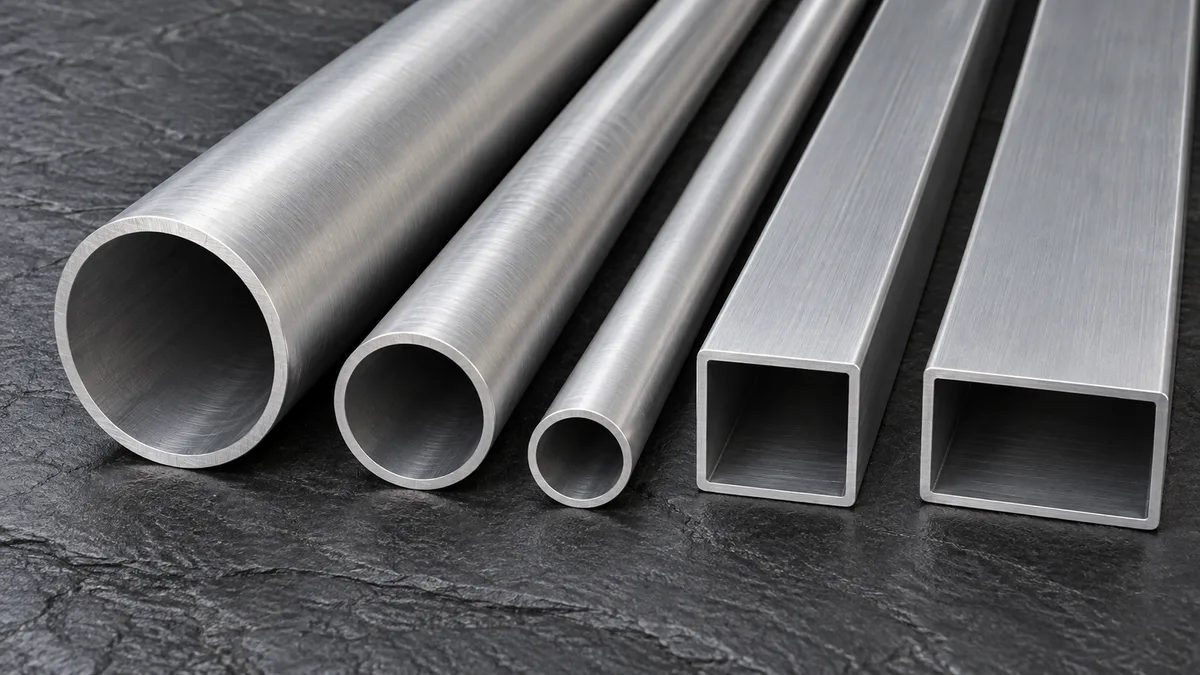
Round tube is the most efficient aluminium section for torsion, internal pressure and bending in any direction, which is why it appears in everything from bicycle frames and handrails to heat exchangers, hydraulic lines and aircraft structures. It is specified by OD and wall thickness (or OD and ID for thick tube), unlike pipe, which is sized by nominal pipe size and schedule.
Aluminium tube is lighter than steel tube of the same size by about two thirds, does not rust, and can be anodised or powder coated. The trade-off is a lower modulus (about 69 GPa against 200 GPa for steel), so for the same stiffness an aluminium tube is usually made larger in diameter rather than thicker in wall.
If you are sizing pipe for fluid service by schedule (SCH 40, SCH 80), see the aluminium pipe page. This page covers tube sized by actual OD and wall.
| Route | How it is made | Strengths | Watch-outs | Main standards |
|---|---|---|---|---|
| Porthole (structural) extruded | Billet splits around a bridge die and re-welds inside the die | Low cost, wide size range, short lead times | Contains longitudinal extrusion welds; not for high-pressure or critical service | ASTM B221, EN 755-8 |
| Seamless extruded | Hollow or pierced billet extruded over a mandrel | No seam welds; suits pressure and critical parts | Higher cost; heavier minimum wall | ASTM B241, EN 755-7 |
| Seamless cold drawn | Extruded tube drawn over a mandrel or plug | Tight OD and wall tolerances, thin walls, smooth bore | Smaller sizes; extra cost per kg | ASTM B210, B483, EN 754-7 |
| Welded (HF or laser) | Strip roll-formed and welded along the seam | Very thin walls, long lengths, lowest cost in high volume | Lower-strength grades mostly; weld bead on ID | ASTM B313, EN 1592 |
A useful rule: if the tube carries internal pressure, will be bent hard, or is called up by an aerospace or pressure code, ask for seamless. For frames, furniture, handrails, scaffolding-type structures and general fabrication, porthole tube is normally fine and noticeably cheaper.
| Grade and temper | Typical tensile | Typical yield | Character | Typical uses |
|---|---|---|---|---|
| 3003-H14 | 150 MPa | 145 MPa | Formable, corrosion resistant | Heat exchangers, fuel and refrigerant lines |
| 5052-H32 | 228 MPa | 193 MPa | Good marine resistance, bendable | Marine rails, fuel lines, instrument tube |
| 6063-T5 | 186 MPa | 145 MPa | Best surface, anodises well | Architectural, furniture, curtain rails |
| 6063-T6 | 241 MPa | 214 MPa | Smooth finish, moderate strength | Handrails, frames, irrigation |
| 6061-T6 | 310 MPa | 276 MPa | Strong, weldable, machinable | Structures, bicycle and vehicle frames, hydraulic tube |
| 6082-T6 | about 310 MPa (min. 290 – 310) | about 260 MPa (min. 250 – 260) | European structural standard | Structures, trailers, scaffolding |
| 2024-T3 | 483 MPa | 345 MPa | High strength and fatigue | Aerospace tube, high-load parts |
| 7075-T6 | 572 MPa | 503 MPa | Highest strength | Sports goods, aerospace, tent poles |
Typical values from Aluminum Association and ASM data; 6082 values are EN 755-2 minimums, which depend on wall thickness. Governing values are the specified minimums on the mill certificate.
Weight in kg/m = 0.0084823 × (OD − wall) × wall, with dimensions in mm and density 2.70 g/cm³. Use the tube weight calculator for other sizes.
| OD (mm) | Wall (mm) | ID (mm) | kg per metre | kg per 6 m |
|---|---|---|---|---|
| 12 | 1 | 10 | 0.093 | 0.56 |
| 16 | 1.5 | 13 | 0.184 | 1.11 |
| 20 | 2 | 16 | 0.305 | 1.83 |
| 25 | 2 | 21 | 0.390 | 2.34 |
| 25.4 | 1.65 | 22.1 | 0.332 | 1.99 |
| 32 | 2 | 28 | 0.509 | 3.05 |
| 38.1 | 3.18 | 31.74 | 0.942 | 5.65 |
| 40 | 3 | 34 | 0.942 | 5.65 |
| 50 | 3 | 44 | 1.196 | 7.18 |
| 50.8 | 3.18 | 44.44 | 1.284 | 7.71 |
| 60 | 4 | 52 | 1.900 | 11.40 |
| 76.2 | 6.35 | 63.5 | 3.762 | 22.57 |
| 80 | 5 | 70 | 3.181 | 19.09 |
| 100 | 5 | 90 | 4.029 | 24.17 |
| 120 | 10 | 100 | 9.331 | 55.98 |
| 150 | 10 | 130 | 11.875 | 71.25 |
| 200 | 15 | 170 | 23.538 | 141.23 |
Round tube tolerances cover mean OD, OD at any point (which controls ovality), wall thickness, straightness and length. Extruded tube follows EN 755-7/-8 or ASTM B221/B241 tables; drawn tube to EN 754-7 or ASTM B210/B483 is several times tighter, which matters for hydraulic cylinders, telescopic assemblies and push-fit joints.
Mandrel bending gives the tightest radii without wrinkling. Annealed (O) or T4 tube bends much tighter than T6; bend in T4 and age afterwards for strong formed parts.
6061, 6063, 6082, 3003 and 5052 weld well by TIG or MIG. The heat-affected zone of 6xxx tube loses part of its T6 strength.
Swaging, flaring, crimping and push-in connectors suit drawn tube with tight OD tolerance.
3003 tube is widely brazed in heat exchangers with 4xxx filler and flux or vacuum processes.
6063 gives the best decorative anodised finish; 6061 and 6082 anodise well for protective coatings.
Thin-wall tube needs soft jaws or expanding mandrels to avoid ovality during turning.
Tube is specified by its actual outside diameter and wall thickness and is used mainly for structures and mechanical parts. Pipe is specified by nominal pipe size and schedule (for example 2 in SCH 40) and is used mainly for fluid systems.
Not always. Most structural tube is made on porthole dies, which leave longitudinal extrusion welds. Seamless tube is extruded over a mandrel from a hollow or pierced billet, or drawn from such tube. Specify seamless when the tube carries pressure or is safety-critical.
3003, 5052 and 6063 bend most easily. For a strong bent part, bend 6061 in O or T4 temper and then age it to T6, or use mandrel bending with generous radii in T6.
Weight (kg/m) = 0.0084823 × (OD − wall) × wall, with dimensions in millimetres. A 50 × 3 mm tube weighs about 1.20 kg per metre.
Yes. 6063 gives the brightest, most uniform decorative finish; 6061 and 6082 are widely anodised for protection and hard coating. Tell us the finish when ordering so we can select the right grade and surface quality.
Yes. Round tube is supplied in mill or cut lengths with mill certificates and export packing, by sea or air.
Send grade, OD, wall, route, length and quantity. We will reply with availability, certification and a delivered price.





