Extruded tube
Pushed through a die from a hot billet. Economical for 6063 and 6061 tube from about 6 mm OD upwards, with walls down to about 0.8 – 1 mm. Tolerances follow extrusion tables, so it suits structural and decorative uses.



Small aluminium tubing usually means round tube from about 1 mm up to 20 mm outside diameter, with walls from 0.2 to 2 mm. It is made by extrusion followed by cold drawing, or by welding thin strip, and it is supplied in straight lengths or in coils. This guide shows which manufacturing route, alloy and temper suit each use, with sizes, weights, tolerances and the details to put on an order.
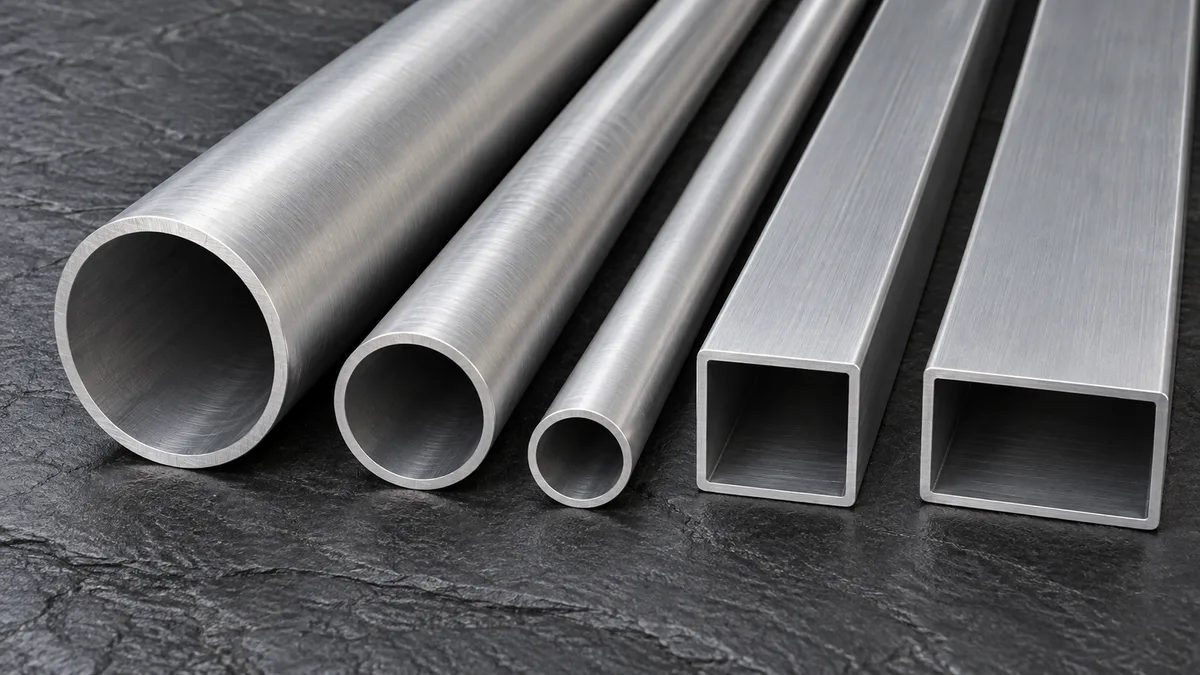
There is no single standard definition, but in the trade "small tubing" covers round tube small enough to be drawn through a die in several passes: roughly 1/16 in to 3/4 in (1.6 – 19 mm) in imperial markets and 1 – 20 mm in metric ones. Below about 3 mm it is usually called capillary tube. At these sizes the wall is a large fraction of the diameter, so tolerances, surface quality and cleanliness matter as much as alloy strength.
Small tubes carry refrigerant in air-conditioners and heat-pump coils, coolant and fuel in vehicles, oxygen and gases in medical equipment, and signals in instrument lines. They also work as light structural members: antenna elements, tent and kite frames, model and drone parts, pointers, telescopic rods and spacers. In each case aluminium is chosen for its low weight (about one-third the weight of copper or steel tube of the same size), its corrosion resistance and how easily it bends, flares and brazes.
The challenge with small tube is consistency. A refrigerant capillary must have a precise bore to meter flow; a medical gas line must be clean inside; a sliding telescopic set needs a controlled OD and ovality so sections fit without play. Those requirements decide the production route more than the alloy does.
Pushed through a die from a hot billet. Economical for 6063 and 6061 tube from about 6 mm OD upwards, with walls down to about 0.8 – 1 mm. Tolerances follow extrusion tables, so it suits structural and decorative uses.
Extruded hollows cold-drawn over a mandrel through successive dies. Gives tight diameter and wall tolerances, a bright smooth surface and strengths raised by cold work. Standard for precision and pressure tube.
Drawn to very small sizes, from about 1 mm OD and 0.3 mm bore, mainly in 1050, 1060, 1100 and 3003. Used for flow metering, sensor lines and thermostatic bulbs.
Long lengths of soft (O temper) tube in level-wound or pancake coils, typically 3003 or 1100. Lets HVAC and appliance plants feed tube straight into bending and cutting machines.
Roll-formed from strip and seam-welded at high frequency. Very thin walls and long lengths at low cost; common for heat-exchanger and furniture tube.
Flat extruded tube with several tiny channels, used in microchannel condensers and battery cooling plates rather than round-tube coils.
The table gives typical properties from published Aluminum Association and ASM data. Specified minimums depend on the standard and size and are reported on the mill certificate.
| Alloy & temper | Tensile (MPa) | Yield (MPa) | Character | Typical small-tube use |
|---|---|---|---|---|
| 1100-O / H14 | 90 / 124 | 34 / 117 | Very ductile, high conductivity | Capillaries, instrument and sensor tube |
| 3003-O / H14 | 110 / 150 | 42 / 145 | Formable, brazeable, good corrosion resistance | Refrigerant coils, HVAC, heat exchangers |
| 5052-O / H32 | 193 / 228 | 90 / 193 | Stronger non-heat-treatable, marine-resistant | Fuel and hydraulic lines, marine instruments |
| 6063-T5 / T6 | 186 / 241 | 145 / 214 | Excellent anodised finish | Decorative, furniture and light structural tube |
| 6061-T6 | 310 | 276 | Strong, machinable, weldable | Precision structural tube, drone and sports parts |
| 7075-T6 | 572 | 503 | Highest strength, not for welding | Arrow shafts, high-load sports and aero tube |
Non-heat-treatable 1xxx, 3xxx and 5xxx alloys are the only practical choice for coil tube, because they can be supplied soft and long. Heat-treatable 6061, 6063 and 7075 are normally supplied in straight lengths. For brazed assemblies use 3003 or 1100; 6061 can be brazed only with care because its solidus is close to brazing temperatures.
Weight per metre is calculated from geometry and a density of 2.70 g/cm³: kg/m = π × (OD − wall) × wall × 0.0027. Alloys differ by only a few per cent, so the table works for all of them.
| OD (mm) | Wall (mm) | ID (mm) | Weight (kg/m) | Metres per kg |
|---|---|---|---|---|
| 3 | 0.5 | 2.00 | 0.0106 | 94 |
| 4 | 0.5 | 3.00 | 0.0148 | 67 |
| 4.8 | 0.5 | 3.80 | 0.0182 | 55 |
| 6 | 0.75 | 4.50 | 0.0334 | 30 |
| 6.35 | 0.71 | 4.93 | 0.0340 | 29 |
| 8 | 1 | 6.00 | 0.0594 | 17 |
| 9.53 | 0.89 | 7.75 | 0.0652 | 15 |
| 10 | 1 | 8.00 | 0.0763 | 13 |
| 12 | 1 | 10.00 | 0.0933 | 11 |
| 12.7 | 1.24 | 10.22 | 0.1205 | 8 |
| 15 | 1 | 13.00 | 0.1188 | 8 |
| 16 | 1.5 | 13.00 | 0.1845 | 5 |
| 19.05 | 1.24 | 16.57 | 0.1873 | 5 |
| 20 | 2 | 16.00 | 0.3054 | 3 |
Drawn tube is held to much tighter limits than extruded tube. Under the standard tables a drawn tube a few millimetres in diameter is controlled to a few hundredths of a millimetre on mean diameter, while an extruded tube of the same size may vary by about a tenth. Specify which standard applies and add any tighter limits explicitly.
| Requirement | Typical reference | Notes |
|---|---|---|
| Drawn seamless tube | ASTM B210 / B210M; EN 754-7 | General and pressure use; diameter, wall and ovality limits by size |
| Drawn general-purpose and HVAC tube | ASTM B483 / B483M | Includes coiled tube; coils limited to non-heat-treatable alloys and thin walls |
| Condenser and heat-exchanger tube | ASTM B234 | Drawn seamless tube for heat exchangers |
| Extruded tube | ASTM B221 or B241; EN 755-7 | Wider tolerances; suits structural and decorative uses |
| Dimensional tolerance tables | ANSI H35.2 | Referenced by the ASTM product standards |
For refrigerant, medical-gas and instrument service, also agree an internal cleanliness level (residual oil or particles per unit area), end caps, and whether the tube must be dry-nitrogen sealed. Straightness for straight lengths and the coil wind pattern for coil tube should be written on the order.
Soft 1100-O and 3003-O tube bends to tight radii, often by hand or on simple benders. T6 tubes need larger radii and mandrel support to avoid flattening or cracking on the outside of the bend.
Flaring, beading, swaging, expanding and reducing are routine in O and H1x tempers. Check that flared ends meet the fitting standard (for example SAE 45° flare) before mass production.
3003 and 1xxx tubes are furnace or torch brazed with Al-Si filler. Keep tube and fitting clean, and control heat closely because tube walls are thin.
TIG welding of small tube is possible but needs low currents and good fit-up. 7075 should not be fusion welded; join it mechanically or with adhesives.
Use burr-free cutting (rotary or orbital) for refrigerant tube, followed by deburring and blowing out chips.
6063 and 6061 anodise to clear or coloured finishes; bright-dip and mirror polishing suit visible parts.
| Sector | Typical part | Usual tube |
|---|---|---|
| HVAC and refrigeration | Coil hairpins, capillaries, connecting lines | 3003-O or 1100-O drawn or coil tube, 6 – 12 mm |
| Automotive and EV | Coolant, fuel, brake-booster and A/C lines | 3003, 5052 or 6061 drawn tube, 6 – 12 mm |
| Medical and laboratory | Oxygen concentrator lines, instrument tubing | 3003 or 6061 drawn, cleaned and capped |
| Electronics | Heat-pipe envelopes, antenna elements, spacers | 1xxx, 6063 or 6061, often anodised |
| Sports and outdoor | Tent poles, arrow shafts, kite and drone frames | 6061-T6 or 7075-T6 drawn tube |
| Instruments and hobby | Telescopic sections, pointers, model parts | 6061 or 6063 in telescoping sizes |
Capillary tube can be drawn down to about 1 mm OD with a bore of a few tenths of a millimetre, usually in 1xxx or 3003 alloy. Below about 3 mm, sizes and tolerances are normally agreed per order.
3003 in O temper is the usual choice: it bends and flares easily, brazes well and resists corrosion. 1100 is used where maximum ductility matters.
For precision it is. Drawing gives tighter diameter and wall tolerances, better roundness and a smoother bore. Extruded tube costs less and is fine for structural or decorative parts.
Generally no. Coiled tube is made in soft non-heat-treatable alloys such as 1100, 3003 and 5052. 6061-T6 small tube comes in straight lengths.
About 0.076 kg per metre, so roughly 13 metres per kilogram.
Yes. Tube can be cut to length, deburred and supplied with bends or formed ends to your drawing, with dimensional reports on request.
Send OD, wall, alloy, temper, length or coil weight and quantity. We will reply with tolerances, certification and a delivered price.





