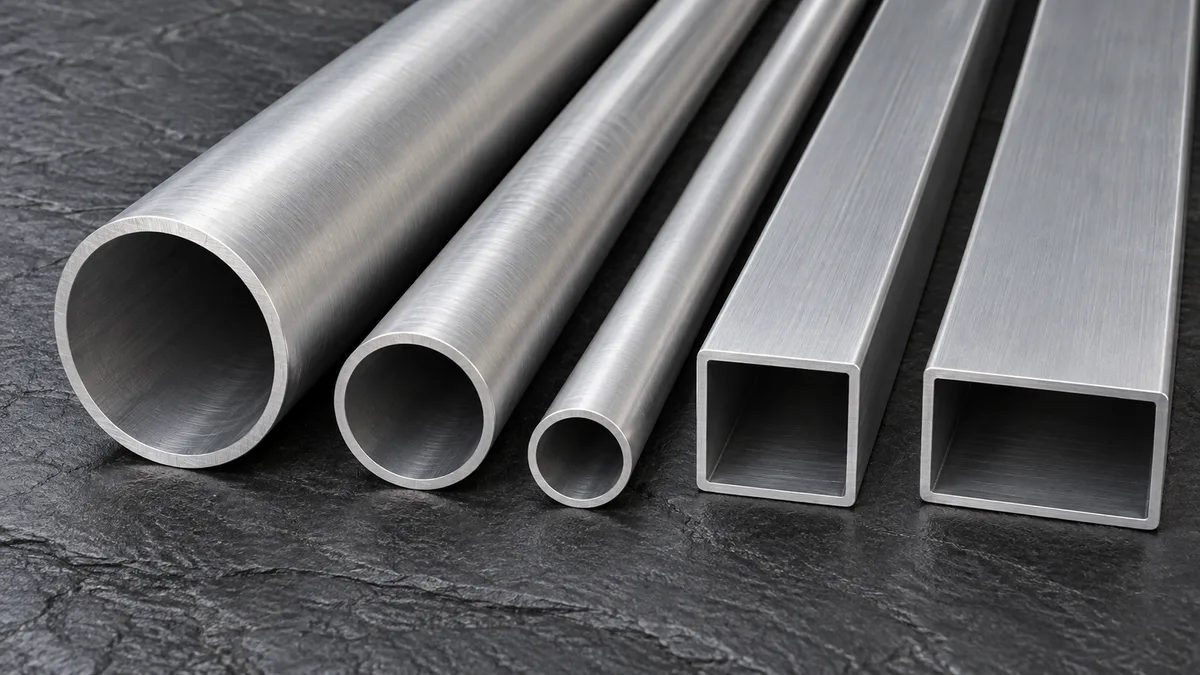
Aluminium capillary tube is cold-drawn seamless tubing with an outside diameter of roughly 0.5 to 10 mm and a bore that can be well under 1 mm. It is made mainly from 1050, 1060, 1070 and 3003 for fluid and refrigerant lines and from 6063 where a little more strength is needed. This guide covers alloys, sizes, standards, manufacturing, applications and how aluminium compares with copper.
A capillary tube is a tube whose bore is small enough that its length and diameter, rather than a valve, control how much fluid passes and how much pressure is lost. The term is also used more loosely for any very fine, thin-walled tube. In aluminium, capillary tubes are usually produced by extruding a hollow shell and then cold drawing it through dies, with annealing between passes, until the tube reaches its final size.
Aluminium brings low weight, good thermal conductivity, resistance to corrosion in clean environments and easy bending and flaring. Its main limitations against copper are lower strength at the same wall thickness, more difficult brazing and soldering, and the need to avoid direct contact with copper in damp conditions. These points decide where aluminium capillary tubing is a good choice and where copper remains the default.
Between ultra-fine capillary sizes and ordinary small tube there is a grey zone. Tubes from about 4.8 mm up to 20 mm outside diameter are often called small aluminium tubes rather than capillaries; they use the same alloys and drawing route but need less precise bore control.
Alloy selection
Alloys used for aluminium capillary tubes
Alloy
Character
Typical tempers
Common uses
1050 / 1060
99.5 – 99.6 % aluminium; very ductile, high thermal and electrical conductivity
O, H14, H18
Refrigerant and coolant lines, heat-exchange capillaries, sensor bulbs
1070
99.7 % aluminium; highest purity of the group, very clean surface
O, H14
Instrument tubing, laboratory and analytical lines, electrical uses
1100
99.0 % aluminium with a little copper; slightly stronger than 1050
O, H14
General-purpose fine tubing, gas and fluid lines
3003
Al-Mn alloy; about 20 % stronger than 1xxx grades and suitable for brazing
O, H14, H18
HVAC and appliance refrigerant circuits, brazed assemblies
6063
Heat-treatable Al-Mg-Si; higher strength and good surface
T4, T5, T6
Small structural and guide tubes, antennas, decorative tubes
For refrigerant and fluid service the soft 1xxx and 3003 alloys dominate, because the tube is bent and coiled during assembly and must not crack. 6063 is chosen when the tube is a mechanical part rather than a fluid line. Hard tempers (H14, H18) keep straight lengths stiff and straight; the annealed O temper is supplied for coils and for tubes that will be bent, flared or swaged.
Data
Typical properties of capillary tube alloys
Values are typical figures from Aluminum Association and ASM data, not guaranteed minimums. Very thin-walled drawn tube is normally certified to the tube standard named on the order, and the mill certificate gives tested results for each lot.
Alloy / temper
Tensile strength (typical)
Thermal conductivity
Electrical conductivity
1060-O
70 MPa
About 234 W/m·K
About 62 % IACS
1060-H18
130 MPa
About 230 W/m·K
About 61 % IACS
1100-O
90 MPa
About 222 W/m·K
About 59 % IACS
3003-O
110 MPa
About 193 W/m·K
About 50 % IACS
3003-H14
150 MPa
About 159 W/m·K
About 41 % IACS
6063-T6
240 MPa
About 200 W/m·K
About 53 % IACS
Physical constants common to all grades
Density
2.70 g/cm³ (6063: 2.69 g/cm³)
Coefficient of thermal expansion
About 23 – 24 µm/m·°C
Modulus of elasticity
About 69 GPa
Melting range
About 615 – 660 °C depending on alloy
Supply range
Sizes and weights of aluminium capillary tube
Typical supply range
Outside diameter
About 0.5 – 10 mm; small tube continues above this
Wall thickness
About 0.15 – 2.5 mm, depending on diameter
Bore
Down to about 0.3 mm in the smallest sizes
Lengths
Cut pieces from a few millimetres to straight lengths of several metres, or level-wound coils
Tempers
O (soft) for coils and bending; H14 / H18 or T-tempers for straight lengths
Ends
Plain cut, deburred, chamfered, flared or swaged on request
The achievable combination of diameter, wall and tolerance depends on the alloy and drawing route; send your drawing to confirm.
Weight per metre comes straight from geometry: π × wall × (OD − wall) × density. The table shows calculated values in grams per metre for some common sizes.
OD (mm)
Wall (mm)
Bore (mm)
Weight (g/m)
1
0.2
0.6
1.4
1.5
0.3
0.9
3.1
2
0.3
1.4
4.3
2
0.5
1.0
6.4
3
0.5
2.0
10.6
4
0.5
3.0
14.8
5
0.8
3.4
28.5
6
1
4.0
42.4
8
1
6.0
59.4
10
1
8.0
76.3
Standards
Standards and tolerances
Standard
What it covers
ASTM B210 / B210M
Drawn seamless aluminium and aluminium-alloy tubes for general purposes
ASTM B483 / B483M
Drawn aluminium tube and pipe for general-purpose applications
ASTM B234
Drawn seamless tubes for condensers, evaporators and heat exchangers
EN 754-7
Cold-drawn seamless tubes: tolerances on dimensions and form
EN 754-2
Cold-drawn rod, bar and tube: mechanical properties
EN 573-3
Chemical composition of wrought aluminium alloys
Standard tolerance tables were written for ordinary tube sizes, so capillary tubing is usually ordered against a drawing that sets the limits for outside diameter, bore or wall thickness, ovality and straightness. Tell the supplier which dimension controls function: for a flow restrictor it is the bore; for a tube that is pushed into a fitting it is the outside diameter. Holding both very tightly at once raises cost.
How it is made
How aluminium capillary tube is manufactured
Billet and extrusionA homogenised billet of the chosen alloy is extruded into a seamless hollow shell, or a coiled tube is produced by continuous extrusion.
Cold drawingThe shell is drawn through a sequence of dies, often over a mandrel or plug, reducing diameter and wall step by step.
Intermediate annealingDrawing work-hardens the metal; annealing between passes restores ductility so drawing can continue without cracking.
Final temperThe tube is left hard-drawn (H tempers), fully annealed (O) or, for 6063, solution treated and aged.
Cleaning and inspectionInternal cleaning removes drawing lubricant and particles, which matters for refrigerant and analytical lines. Diameter, wall and length are checked; eddy-current testing can detect wall defects.
Cutting, coiling and packingTubes are cut to length or level-wound, end-capped to keep the bore clean and packed to prevent kinking.
Applications
Where aluminium capillary tubes are used
Refrigeration and air conditioning
Expansion capillaries and refrigerant lines in all-aluminium circuits, sometimes bonded to an aluminium suction line to form a heat exchanger. Copper remains common because it is easier to braze and draw to very tight bores, so aluminium is chosen where the whole circuit is aluminium.
Automotive and battery cooling
Small coolant and refrigerant lines, sensor tubes and thermal-management parts where weight counts.
Instrumentation
Pressure-sensing lines, thermostat and thermometer capillaries, pitot and sampling tubes.
Laboratory and analytical equipment
Low-pressure gas and fluid transfer lines where a clean, non-magnetic, light tube is needed.
Electronics and heat transfer
Small heat pipes, cold-plate tubes and cooling loops embedded in plates.
Mechanical and decorative parts
Antenna elements, pins, sleeves, guide tubes and model-making components, usually in 6063.
Comparison
Aluminium versus copper capillary tube
Property
Aluminium (1060 / 3003)
Copper (C12200)
Density
2.70 g/cm³
8.94 g/cm³
Thermal conductivity
About 190 – 235 W/m·K
About 340 W/m·K
Strength at equal wall
Lower
Higher
Brazing and soldering
Needs aluminium brazing alloys and fluxes; narrower process window
Easy with standard brazing alloys
Corrosion
Good in clean, dry environments; vulnerable when in contact with copper and moisture
Good, though formicary (ant-nest) corrosion can occur in some conditions
Tight bore tolerances
Achievable but more demanding
Long-established for restrictor service (ASTM B360)
Material cost per metre
Generally lower
Generally higher
A practical rule: if the rest of the circuit is aluminium, use an aluminium capillary and avoid the copper-aluminium joint altogether. If the circuit is copper, keeping a copper capillary is usually simpler. Mixed joints need a proper transition fitting or a sealed, moisture-protected joint.
Procurement
How to specify aluminium capillary tube
Alloy and temperFor example 3003-O for coiled refrigerant capillary, or 1070-H14 for straight instrument tube.
Controlling dimensionsOD and wall, or OD and bore, with the tolerance on the dimension that matters most.
Length or coilCut length with tolerance, or coil weight and inner diameter of the coil.
CleanlinessState internal cleanliness and end-capping needs for refrigerant or analytical use.
Testing and documentsEN 10204 3.1 certificate, plus eddy-current, leak or burst testing if required.
Packing and termsProtective packing against kinking and delivery terms (EXW, FOB, CIF or DAP).
What is the smallest aluminium capillary tube available?
Drawn aluminium capillary tube can be made with outside diameters around 0.5 mm and bores of about 0.3 mm. Whether a particular combination is possible depends on the alloy and the tolerance required, so confirm with a drawing.
Can aluminium replace copper capillary tube in a refrigerator?
It can in an all-aluminium circuit, and some appliance designs use an aluminium capillary bonded to an aluminium suction line. In a copper circuit it is usually simpler to keep copper, because copper-aluminium joints need careful design to avoid galvanic corrosion.
Which alloy is best for bending and coiling capillary tube?
1050, 1060 or 3003 in the annealed O temper. They bend to tight radii without cracking or collapsing; 3003 is a little stronger.
Are aluminium capillary tubes seamless?
Precision capillary tube is normally seamless, made by extrusion followed by cold drawing. Welded tube is used for larger, less critical sizes.
How is aluminium capillary tube supplied?
In straight cut lengths, often end-capped, or in level-wound coils for long continuous runs. Cut pieces with deburred, flared or swaged ends are also possible.
What certificate comes with the tube?
An EN 10204 3.1 mill test certificate with chemical composition and, where specified, mechanical and dimensional results for the lot.
Looking for aluminium capillary tube?
Share the alloy, size, tolerance and quantity. Metline will confirm what can be drawn, the certification and a delivered price.