Seamless extruded tube
Hot-extruded over a mandrel and supplied in the extruded or heat-treated temper. Economical for medium and large diameters and thick walls, to commercial extruded tolerances. Ordered to ASTM B241, B221 (seamless) or EN 755.



Seamless aluminium tube is extruded or drawn over a mandrel from a hollow or pierced billet, so its wall has no longitudinal weld line of any kind. That makes it the required choice for pressure lines, hydraulic and fuel tubing, aerospace structures and any tube that will be heavily machined, expanded or fatigue-loaded. This guide explains how seamless tube is made, which alloys and specifications to order, the standard tolerances and weights, and how to write an enquiry that gets the right product first time.
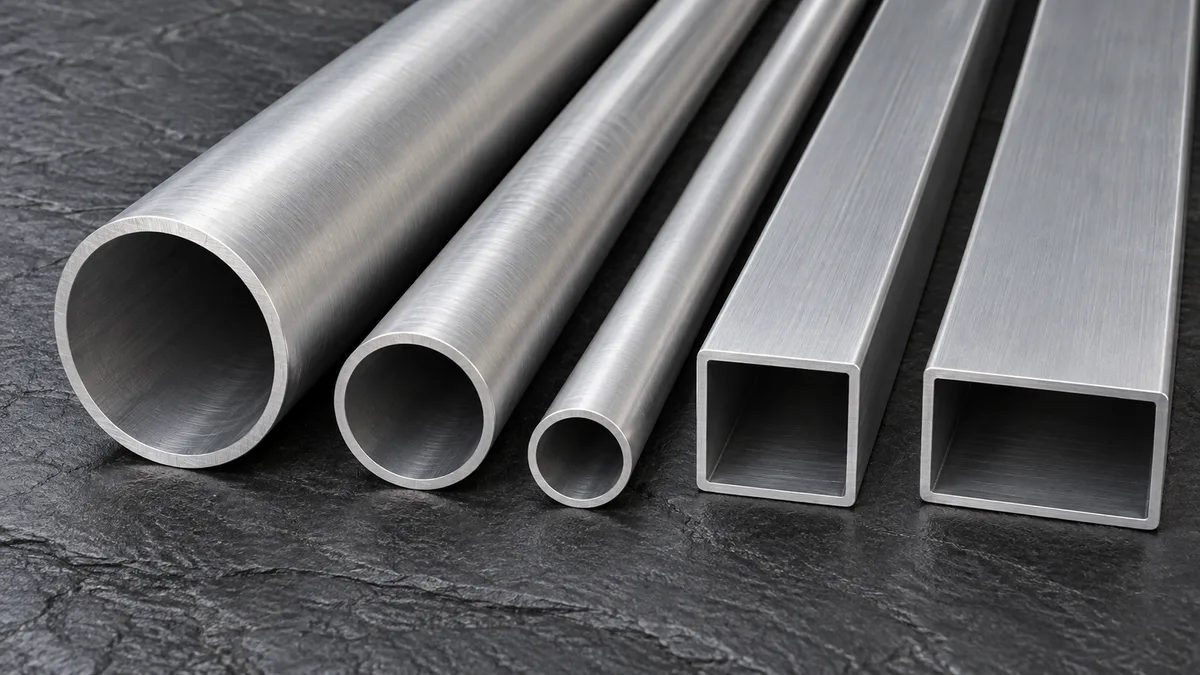
Every aluminium tube starts as a solid or hollow billet. What separates a seamless tube from the rest is how the hole is formed. In a seamless tube the hole is made by a mandrel that passes through the centre of a hollow or pierced billet, so the metal flows around it as a single, continuous ring. Nothing is split and rejoined, and the finished wall is metallurgically uniform all the way round.
Two other kinds of tube are sold alongside seamless tube, and buyers often mix them up. Porthole or bridge-die tube (called "structural" tube in ASTM B221 and "porthole tube" in EN 755-8) is extruded from a solid billet through a die that splits the metal into several streams and then rewelds them under pressure in a welding chamber. The result looks identical to seamless tube, and the solid-state extrusion welds are sound enough for frames, furniture and architecture, but they are lines of different grain structure along the length. Welded tube is roll-formed from strip and joined by high-frequency or other welding, leaving a visible or trimmed seam.
Those seam lines are where the differences start to matter. Under internal pressure, during flaring or expanding, in high-cycle fatigue and in heavily machined parts, a weld line can be the first place a crack starts. Standards reflect this: ASTM B221 states that its structural tube is not intended for pressure applications, and points pressure users to ASTM B241 seamless pipe and tube and B210 drawn seamless tube. Aerospace hydraulic specifications such as AMS 4081 and AMS 4083 likewise cover seamless drawn tubing only.
All seamless tube begins on an extrusion press fitted with a mandrel. Smaller diameters and tight tolerances are then reached by cold drawing; very large diameters may be produced on heavy presses or by forging and rolling. The route chosen decides the size range, the tolerance class and the surface finish you can expect.
| Route | Typical size window | Tolerance and finish | Best for |
|---|---|---|---|
| Direct extrusion with mandrel | Medium to very large OD, thick walls | Commercial (ANSI H35.2 / EN 755-7 extruded tolerances); mill finish | Pressure pipe, structural and machining blanks |
| Indirect extrusion with mandrel | Small to large OD | Better concentricity and uniformity than direct extrusion | Aerospace 2024 / 7075 tube, high-quality 6061 |
| Cold drawing | Roughly 3 mm to about 300 mm OD, walls from fractions of a millimetre | Close tolerances (drawn tables), smooth bright surface | Hydraulic, fuel and instrument tube, heat-exchanger tube |
| Forging / ring rolling | Very large OD, short lengths | Machined to size | Rings, sleeves, flanges, large cylinders |
Size windows depend on the press, the alloy and the wall-to-diameter ratio. Very thin walls on large diameters, and very thick walls on small diameters, are the hardest combinations to produce seamlessly.
The specification on your drawing tells the producer far more than the alloy does. It fixes the manufacturing route, the tests, the tolerance tables and the certificate content. These are the ones we see most often on seamless tube enquiries:
| Standard | Scope | Typical use |
|---|---|---|
| ASTM B241 / B241M | Seamless pipe and seamless extruded tube | Pressure piping, process plant, gas and liquid lines; listed in ASME B31.3 |
| ASTM B210 / B210M | Drawn seamless tube | General-purpose precision tube, instrument and fluid tube |
| ASTM B234 / B234M | Drawn seamless tube for condensers and heat exchangers | Shell-and-tube heat exchangers, surface condensers |
| ASTM B345 / B345M | Seamless pipe and seamless extruded tube for gas and oil transmission and distribution piping systems | Pipelines under ASME B31.8 and similar codes |
| ASTM B221 / B221M | Extruded bar, rod, wire, profiles and tube (seamless or structural) | General engineering; specify "seamless" if you need it |
| ASTM B429 / B429M | Extruded structural pipe and tube | Structural applications, not pressure |
| SAE AMS 4081 / 4083 | Hydraulic tubing, seamless drawn, 6061-T4 / 6061-T6 | Aircraft hydraulic, fuel and oil lines |
| SAE AMS 4082 | Seamless drawn tubing, 6061-T6 | Aerospace structural tube |
| SAE AMS 4088 | Seamless drawn tubing, 2024-T3 | High-strength aerospace tube |
| SAE AMS-QQ-A-200 (series) | Extruded bar, rod, shapes and tube by alloy | Defence and aerospace extrusions; replaces federal QQ-A-200 |
| EN 755-2 / EN 755-7 | Extruded products: mechanical properties / seamless tube tolerances | European and international projects |
| EN 754-2 / EN 754-7 | Cold-drawn products: mechanical properties / seamless drawn tube tolerances | Precision drawn tube in Europe |
Two older designations still appear on legacy drawings. Federal specification WW-T-700 (drawn tube, with slash sheets by alloy) has been cancelled and is normally replaced by ASTM B210 or the equivalent AMS tubing specification. Federal QQ-A-200 for extrusions has likewise been taken over by the SAE AMS-QQ-A-200 series. If your drawing calls up either, tell us; we will propose the current replacement and confirm it with you before ordering.
Note the distinction in the European system: EN 755-7 and EN 754-7 are the seamless tube parts, while EN 755-8 and EN 754-8 cover porthole tube. An order "to EN 754-8" therefore does not guarantee a seamless product, even though the tube is cold drawn.
Almost any wrought alloy can be made into seamless tube, but a dozen grades cover most orders. The high-strength 2xxx and 7xxx alloys and the high-magnesium 5xxx alloys are hard to push through porthole dies and weld poorly in the welding chamber, so in practice tube in those grades is nearly always seamless.
| Alloy | Common tempers | Character | Typical seamless tube uses |
|---|---|---|---|
| 1100 / 1060 | O, H14, H18, H112 | Commercially pure; highest conductivity and formability, low strength | Food and chemical lines, low-pressure fluid tube, bus conductors |
| 3003 | O, H14, H18, H112 | Mn-alloyed; good formability and corrosion resistance, brazeable | Heat-exchanger and condenser tube, refrigeration, automotive cooling lines |
| 5052 | O, H32, H34, H38 | Mg-alloyed; good strength without heat treatment, very good corrosion resistance | Fuel and oil lines, marine tubing, instrument tube |
| 5083 / 5086 | O, H111, H112, H32 | High-Mg marine alloys; excellent seawater resistance and weldability | Ship piping, offshore lines, cryogenic and LNG duty |
| 6061 | O, T4, T6, T6511 | Heat-treatable all-rounder: strong, machinable, weldable | Hydraulic tube, frames, masts, machined sleeves, pressure pipe |
| 6063 | T5, T52, T6 | Lower strength than 6061 but excellent surface and anodising response | Architectural and decorative tube, low-pressure pipe, heat-transfer tube |
| 6082 / 6060 | T5, T6 | European structural (6082) and decorative (6060) grades | Structural tube in EN projects, scaffolding-type sections |
| 2024 | T3, T351x, T4 | Al-Cu; high strength and fatigue resistance, poorer corrosion resistance | Aircraft structures, hydraulic tube, motorsport parts |
| 2219 | T6, T8x | Al-Cu; keeps strength at elevated and cryogenic temperatures, weldable | Aerospace pressure and propellant tube |
| 7075 | T6, T73, T6511 | Al-Zn-Mg-Cu; very high strength, not fusion-weldable | Aerospace fittings, arrow and sports tube, high-load machined tube |
A short decision rule: start with 6061-T6 for any general engineering or pressure duty; move to 5083/5086 if the tube lives in seawater or must be welded without heat treatment; choose 3003 or 1100 when formability, brazing or conductivity matter more than strength; and go to 2024 or 7075 only when the strength-to-weight requirement justifies the extra cost and the corrosion protection they need.
The values below are typical room-temperature properties published by the Aluminum Association and ASM for each alloy and temper. They are useful for comparing grades. For design, use the specified minimums in the governing standard (which vary with wall thickness and with drawn versus extruded product) and the actual results on the mill test certificate.
| Alloy and temper | Tensile strength | Yield strength (0.2 %) | Elongation | Density |
|---|---|---|---|---|
| 1100-H14 | 125 MPa | 115 MPa | ≈ 9 – 20 % | 2.71 g/cm³ |
| 3003-H14 | 150 MPa | 145 MPa | ≈ 8 – 16 % | 2.73 g/cm³ |
| 5052-H32 | 230 MPa | 195 MPa | ≈ 12 – 18 % | 2.68 g/cm³ |
| 5086-H32 | 290 MPa | 205 MPa | ≈ 12 % | 2.66 g/cm³ |
| 6063-T6 | 240 MPa | 215 MPa | ≈ 12 % | 2.70 g/cm³ |
| 6061-T6 | 310 MPa | 275 MPa | ≈ 12 – 17 % | 2.70 g/cm³ |
| 2024-T3 (drawn tube) | 485 MPa | 345 MPa | ≈ 18 % | 2.78 g/cm³ |
| 7075-T6 | 570 MPa | 505 MPa | ≈ 11 % | 2.81 g/cm³ |
Elongation depends strongly on wall thickness and test-piece geometry; ranges shown are indicative. Specified minimums for extruded tube are normally lower than these typical values.
Two practical consequences follow from the table. First, drawn tube in a strain-hardened temper (such as 3003-H14 or 5052-H32) gains its strength from cold work, so it softens if heated for brazing or welding; design the joint for annealed (O-temper) properties. Second, heat-treatable tube welded in the T6 condition loses strength in the heat-affected zone; 6061-T6 drops to roughly T4-level strength next to the weld unless the assembly is solution treated and aged again.
Hot-extruded over a mandrel and supplied in the extruded or heat-treated temper. Economical for medium and large diameters and thick walls, to commercial extruded tolerances. Ordered to ASTM B241, B221 (seamless) or EN 755.
Extruded mother tube reduced through dies for close tolerances, thin walls and a smooth surface. The usual choice for hydraulic, fuel, instrument and heat-exchanger tube. Ordered to ASTM B210, B234, AMS specs or EN 754.
Seamless tube made to nominal pipe sizes and schedule wall thicknesses so it fits standard flanges and fittings. ASTM B241 covers 6061 and 6063 pipe widely used in process and pneumatic systems.
Round tubular conductors in 6063, 6101 or 1xxx alloys for outdoor substations. The tube shape gives a large surface for heat loss, low skin-effect losses and a stiff span between insulators.
Produced on heavy presses or by forging and ring rolling for cylinders, rollers, sleeves and pressure shells. Often supplied as rough-machined hollows. Sizes are confirmed project by project.
Small-diameter 1xxx or 3xxx tube in long annealed coils for refrigeration, air-conditioning and instrument lines, where joints must be minimised.
Shape options follow the same processes. Round tube is by far the most common, but seamless square, rectangular, oval (elliptical) and streamlined (aerofoil) tubes can be drawn from round mother tube through shaped dies. Streamlined tube is used for aircraft struts and fairings; oval and flattened tube appears in heat exchangers and furniture. Non-round seamless shapes carry corner-radius and convexity tolerances in addition to width and wall tolerances.
Feasibility depends on the combination of alloy, OD and wall. Send the full size and specification and we will confirm what can be supplied.
Weight of a round tube is π/4 × (OD² − ID²) × density. With 2.70 g/cm³ (6061, 6063) the table gives kilograms per metre for common seamless sizes; for 2024 multiply by about 1.03, for 7075 by about 1.04, and for 5083 by about 0.985. Use the tube weight calculator for any other size.
| OD (mm) | Wall (mm) | ID (mm) | kg per metre | kg per 6 m length |
|---|---|---|---|---|
| 10 | 1 | 8 | 0.076 | 0.46 |
| 12 | 1.5 | 9 | 0.134 | 0.80 |
| 16 | 2 | 12 | 0.238 | 1.43 |
| 20 | 2 | 16 | 0.305 | 1.83 |
| 25 | 2 | 21 | 0.390 | 2.34 |
| 25 | 3 | 19 | 0.560 | 3.36 |
| 30 | 3 | 24 | 0.687 | 4.12 |
| 32 | 4 | 24 | 0.950 | 5.70 |
| 40 | 3 | 34 | 0.942 | 5.65 |
| 40 | 5 | 30 | 1.484 | 8.91 |
| 50 | 3 | 44 | 1.196 | 7.18 |
| 50 | 5 | 40 | 1.909 | 11.45 |
| 60 | 4 | 52 | 1.900 | 11.40 |
| 60 | 10 | 40 | 4.241 | 25.45 |
| 70 | 5 | 60 | 2.757 | 16.54 |
| 80 | 5 | 70 | 3.181 | 19.09 |
| 80 | 10 | 60 | 5.938 | 35.63 |
| 100 | 5 | 90 | 4.029 | 24.17 |
| 100 | 10 | 80 | 7.634 | 45.80 |
| 120 | 10 | 100 | 9.331 | 55.98 |
| 120 | 20 | 80 | 16.965 | 101.79 |
| 150 | 10 | 130 | 11.875 | 71.25 |
| 150 | 25 | 100 | 26.507 | 159.04 |
| 200 | 15 | 170 | 23.538 | 141.23 |
| 200 | 30 | 140 | 43.260 | 259.56 |
| 250 | 25 | 200 | 47.713 | 286.28 |
| 300 | 30 | 240 | 68.707 | 412.24 |
| 300 | 50 | 200 | 106.029 | 636.17 |
| 400 | 40 | 320 | 122.145 | 732.87 |
| 500 | 50 | 400 | 190.852 | 1145.11 |
Seamless pipe is ordered by nominal pipe size (NPS) and schedule. The outside diameters and wall thicknesses below are the standard ASME B36.10 dimensions used by ASTM B241 pipe; the weights are calculated for 6061/6063 at 2.70 g/cm³.
| NPS | OD (mm) | SCH 40 wall (mm) | SCH 40 kg/m | SCH 80 wall (mm) | SCH 80 kg/m |
|---|---|---|---|---|---|
| 1/2 | 21.34 | 2.77 | 0.44 | 3.73 | 0.56 |
| 3/4 | 26.67 | 2.87 | 0.58 | 3.91 | 0.75 |
| 1 | 33.40 | 3.38 | 0.86 | 4.55 | 1.11 |
| 1 1/4 | 42.16 | 3.56 | 1.17 | 4.85 | 1.53 |
| 1 1/2 | 48.26 | 3.68 | 1.39 | 5.08 | 1.86 |
| 2 | 60.33 | 3.91 | 1.87 | 5.54 | 2.57 |
| 2 1/2 | 73.03 | 5.16 | 2.97 | 7.01 | 3.93 |
| 3 | 88.90 | 5.49 | 3.88 | 7.62 | 5.25 |
| 4 | 114.30 | 6.02 | 5.53 | 8.56 | 7.68 |
| 5 | 141.30 | 6.55 | 7.49 | 9.53 | 10.65 |
| 6 | 168.28 | 7.11 | 9.72 | 10.97 | 14.64 |
| 8 | 219.08 | 8.18 | 14.63 | 12.70 | 22.23 |
| 10 | 273.05 | 9.27 | 20.74 | 15.09 | 33.02 |
| 12 | 323.85 | 10.31 | 27.42 | 17.48 | 45.43 |
Unless a drawing says otherwise, ASTM and AMS seamless tube is supplied to the tolerance tables of ANSI H35.2 (published in the Aluminum Association's Aluminum Standards and Data), and EN orders to EN 755-7 or EN 754-7. The extracts below show the scale of the difference between extruded and drawn tube. Each value is a plus-and-minus figure in inches; "mean" is the average of two diameters measured at right angles, and "any point" is the largest permitted single reading.
| Specified OD (in) | Mean OD, 5083 / 5086 / 5454 | Mean OD, other alloys | Any point, 5083 / 5086 / 5454 | Any point, other alloys |
|---|---|---|---|---|
| 0.500 – 0.999 | 0.015 | 0.010 | 0.030 | 0.020 |
| 1.000 – 1.999 | 0.018 | 0.012 | 0.038 | 0.025 |
| 2.000 – 3.999 | 0.023 | 0.015 | 0.045 | 0.030 |
| 4.000 – 5.999 | 0.038 | 0.025 | 0.075 | 0.050 |
| 6.000 – 7.999 | 0.053 | 0.035 | 0.113 | 0.075 |
| 8.000 – 9.999 | 0.068 | 0.045 | 0.150 | 0.100 |
| 10.000 – 11.999 | 0.083 | 0.055 | 0.188 | 0.125 |
| 12.000 – 13.999 | 0.098 | 0.065 | 0.225 | 0.150 |
| 14.000 – 15.999 | 0.113 | 0.075 | 0.263 | 0.175 |
| 16.000 – 17.999 | 0.128 | 0.085 | 0.300 | 0.200 |
Extruded seamless round tube, diameter tolerances. Mean-diameter limits do not apply to T3510, T4510, T6510 and T8510 tempers; any-point limits do not apply to O temper or to walls thinner than 2.5 % of the OD.
| Specified OD (in) | Mean OD, all alloys | Any point, 1100 / 3003 / 5052 / 5086 | Any point, 2014 / 2024 / 6061 / 6063 / 7075 |
|---|---|---|---|
| Up to 0.500 | 0.003 | 0.003 | 0.006 |
| 0.501 – 1.000 | 0.004 | 0.004 | 0.008 |
| 1.001 – 2.000 | 0.005 | 0.005 | 0.010 |
| 2.001 – 3.000 | 0.006 | 0.006 | 0.012 |
| 3.001 – 5.000 | 0.008 | 0.008 | 0.016 |
| 5.001 – 6.000 | 0.010 | 0.010 | 0.020 |
| 6.001 – 8.000 | 0.015 | 0.015 | 0.030 |
| 8.001 – 10.000 | 0.020 | 0.020 | 0.040 |
| 10.001 – 12.000 | 0.025 | 0.025 | 0.050 |
Drawn seamless round tube, diameter tolerances. Drawn tube is held roughly three to ten times closer than extruded tube of the same size.
| Specified wall (in) | Mean wall, 1100 / 3003 / 5052 / 5086 | Mean wall, 2024 / 6061 / 6063 / 7075 |
|---|---|---|
| 0.010 – 0.035 | 0.002 | 0.002 |
| 0.036 – 0.049 | 0.003 | 0.003 |
| 0.050 – 0.083 | 0.004 | 0.004 |
| 0.084 – 0.120 | 0.005 | 0.006 |
| 0.121 – 0.203 | 0.006 | 0.008 |
| 0.204 – 0.300 | 0.008 | 0.012 |
| 0.301 – 0.375 | 0.015 | 0.020 |
| 0.376 – 0.500 | 0.020 | 0.030 |
Drawn seamless round tube, wall-thickness tolerances. The wall at any single point may deviate by ±10 % of the specified wall (minimum ±0.003 in).
| Sector | Typical parts | Usual alloys |
|---|---|---|
| Aerospace and defence | Hydraulic and fuel lines, control rods, structural tube, struts, launch-tube and casing blanks | 6061-T6, 2024-T3, 7075-T6, 2219, 5052-O |
| Automotive and motorsport | Brake and cooling lines, air-conditioning tube, roll-cage and chassis tube, drive shafts | 3003, 6061, 6082, 7075 |
| Refrigeration and HVAC | Condenser and evaporator tube, suction and liquid lines, capillary tube | 1100, 1060, 3003 |
| Process and oil and gas | Pressure piping, instrument and sampling lines, cryogenic and LNG piping | 6061, 6063, 5083, 5086 |
| Marine | Seawater and fuel piping, masts, davits, handrails, offshore lines | 5083, 5086, 6061, 6082 |
| Electrical power | Substation bus pipe, conductor tube, cooling tube for power electronics | 6063, 6101, 1060 |
| Machinery and hydraulics | Pneumatic and hydraulic cylinder barrels, rollers, sleeves and bushings machined from thick-wall tube | 6061, 6082, 2024, 7075 |
| Medical and scientific | Instrument tube, frames, equipment for MRI rooms where non-magnetic material is needed | 6061, 6063, 5052 |
| Sports and leisure | Bicycle frames, tent and ski poles, arrows, telescopic poles | 6061, 7075, 7005 |
A typical example shows how the choice is made. A hydraulic return line on an aircraft is drawn from 6061 to AMS 4083 (T6) because the specification demands seamless, eddy-current-inspected tube with flaring and flattening tests. A substation bus run, by contrast, is extruded 6063-T6 or 6101 seamless tube chosen for conductivity, stiffness between supports and good weathering, with tight tolerances only where it meets the clamps. A hydraulic cylinder barrel starts as thick-wall 6061-T6 seamless extruded tube that is then bored and honed, so concentricity and the absence of seam lines matter more than outside-diameter tolerance.
| Point of comparison | Seamless (mandrel extruded or drawn) | Porthole / structural extruded | Welded (roll-formed strip) |
|---|---|---|---|
| Seam | None | Solid-state extrusion welds along the length | Fusion or HF weld seam |
| Pressure service | Yes, under ASTM B241, B210, B345, AMS | Not intended for pressure (ASTM B221 note) | Only where a specification qualifies it |
| Expanding, flaring, tight bends | Best | Risk of splitting at weld lines | Risk of splitting at the seam |
| Alloys available | Almost all, including 2xxx, 7xxx, 5083 | Mostly 6xxx and softer alloys | Mostly 1xxx, 3xxx, 5xxx, 6xxx |
| Wall thickness range | Very thin (drawn) to very thick | Moderate | Thin walls only |
| Concentricity | Good; excellent from indirect presses and drawing | Very good | Very good (from strip) |
| Cost | Higher | Lower; dies are cheaper per shape | Lowest for long thin-wall runs |
| Typical use | Hydraulics, aerospace, pressure pipe, machining blanks | Frames, furniture, architecture, general structure | Radiators, furniture, automotive tube, signage |
Our advice: if the tube carries pressure, is fatigue critical or will be expanded or bored, specify seamless explicitly on the purchase order and name a seamless specification. If it is purely structural or decorative, porthole tube in 6063 or 6061 is usually the lower-cost and perfectly adequate choice. See our pages on welded aluminium tube and extruded tube for those alternatives.
They look the same. The reliable way is the paperwork: the certificate should name a seamless specification (ASTM B241, B210, B234, B345 or an AMS seamless spec) or state "seamless". Physically, a macro-etched cross-section of porthole tube usually shows extrusion weld lines as faint radial bands; seamless tube shows a uniform grain ring.
The base metal has the same properties, but a seamless tube has no weld or extrusion-weld line, so it performs better under internal pressure, in fatigue and in expanding, flaring and tight bending. That is why pressure and aerospace specifications require it.
Extruded seamless tube is hot-extruded over a mandrel and held to commercial extruded tolerances. Drawn seamless tube is then cold drawn through dies, giving much closer diameter and wall tolerances, thinner walls, a smoother surface and higher strength in strain-hardened tempers.
6061-T6 and 6063-T6 to ASTM B241 are the most common for process, compressed-air and gas lines. 5083 and 5086 are chosen for seawater and cryogenic service. The allowable pressure is set by the piping code (for example ASME B31.3), the alloy, temper, wall thickness and temperature.
Multiply π/4 × (OD² − ID²) in mm by 2.70 and divide by 1000 for kg per metre. A 50 × 5 mm 6061 tube weighs about 1.91 kg/m; a 100 × 10 mm tube about 7.63 kg/m.
Yes. Metline supplies seamless tube to ASTM, AMS and EN specifications, including 6061 and 2024 drawn tubing, with EN 10204 3.1 mill certificates. Send the AMS number and revision on your drawing so we can confirm availability and testing.
Yes. We supply customers worldwide from Mumbai, with capped and cased export packing and shipping by sea or air on EXW, FOB, CIF or DAP terms.
Send the alloy, temper, size, specification, quantity and destination. Our team will confirm availability, testing and a delivered price.





