An aluminium pneumatic cylinder tube is the extruded barrel that the piston slides in: usually 6063-T5 or 6061-T6, with a precision-finished bore held to H9–H11 and a hard-anodised wearing surface. This guide explains the profile types used for ISO 15552, ISO 6432 and compact cylinders, how to specify the bore, and what to check before you order barrel stock from Metline.
The barrel of a pneumatic cylinder is a pressure vessel, a bearing surface and a mounting frame at the same time. It holds compressed air at typically 6–10 bar, guides a piston seal over millions of strokes, and carries the end caps, tie rods or screws, sensor slots and mounting accessories that hold the whole actuator together.
Aluminium took over this job from steel and brass because an extruded 6xxx-series profile can deliver all of those features in one section. The die forms the bore, the outer shape, the tie-rod or screw channels and the T-slots for reed or magnetic sensors in a single pass, so the machinist only has to cut to length, finish the bore, drill and tap the ends, and anodise. The result is a barrel that weighs roughly a third of an equivalent steel tube, does not rust in humid factories, and lets a magnetic piston ring be sensed through the wall.
Because the piston seal rides directly on the bore, the inside diameter, roundness, straightness and surface finish matter far more than on structural tube. A barrel that is slightly oval, wavy or rough will leak past the seal, wear it quickly or cause stick-slip at low speed. Most of this guide is therefore about how the bore is made and specified.
Material
Which alloy and temper for a cylinder barrel?
Almost every aluminium cylinder barrel is a 6xxx alloy. They extrude well into complex hollow sections, can be press-quenched at the extrusion press, and respond well to hard anodising. The choice between them is a balance of extrudability, strength and anodised appearance.
Alloy and temper
Min. tensile (EN 755-2)
Min. 0.2 % yield
Typical tensile
Where it is used
6063-T5
175 MPa (wall ≤ 3 mm)
130 MPa
186 MPa
Standard ISO profile barrels and round tubes; best surface and anodised colour
6063-T6
215 MPa (wall ≤ 10 mm)
170 MPa
241 MPa
Barrels that need a little more strength or a harder base under the anodic film
6061-T6 / T6511
260 MPa
240 MPa
310 MPa
Larger bores, higher pressures, heavy-duty and hydraulic-pneumatic cylinders
6005A-T6
255 MPa (hollow, wall ≤ 5 mm)
215 MPa
—
Thin-wall complex profiles where 6061 is hard to extrude
6082-T6
290 MPa (profile, wall ≤ 5 mm)
250 MPa
—
European heavy-duty barrels and end caps
Minimums depend on wall thickness band and are confirmed on the mill certificate. Typical values are from Aluminum Association / ASM data and are not guaranteed.
6063 is the default because it gives the smoothest extruded surface, the most uniform anodised colour and the easiest die design for thin webs and sensor slots. Its lower strength is rarely a limit at normal air pressures: a Ø63 mm barrel with a 2.5 mm wall at 10 bar sees a hoop stress of only about 13 MPa. Move to 6061 or 6082 when the bore is large, the wall is thin relative to the bore, the cylinder is a hydro-pneumatic or high-pressure design, or the barrel also carries significant bending loads from side-mounted guides.
Temper matters for the bore finish too. A harder T6 base supports a hard-anodised film better and is less likely to tear during honing or roller burnishing, while T5 is easier to burnish to a mirror finish. Many cylinder makers standardise on 6063-T5 for ISO profile barrels and 6061-T6 for round heavy-duty tubes.
Profile types
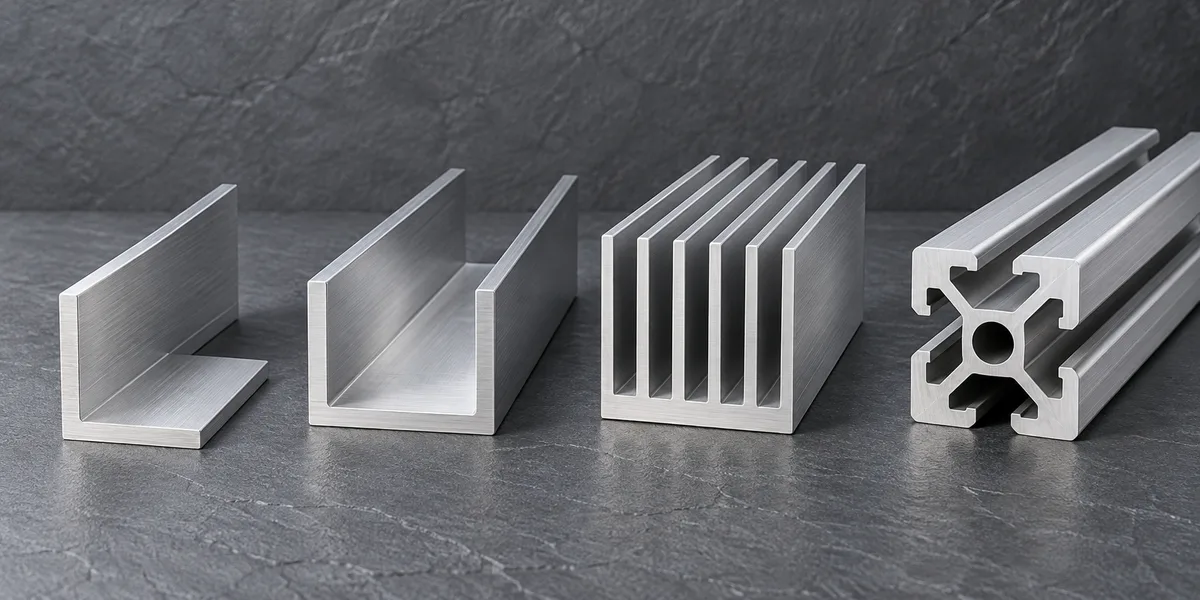
Cylinder tube profile types
ISO 15552 profile barrel
Square outer shape with integral screw channels and sensor slots, for bores Ø32 to Ø320 mm. ISO 15552 replaced the older ISO 6431 and VDMA 24562 and fixes the mounting interface, not the barrel section, so each cylinder maker has its own profile.
Tie-rod ("Mickey Mouse") profile
Round bore with four external lobes or grooves that locate the tie rods. Common in SI/SU-style cylinders where tie rods clamp the end caps.
Round tube
Plain round barrel for ISO 6432 mini cylinders (Ø8–Ø25 mm), round-body cylinders and stainless-end-cap designs. Ends are rolled, crimped or threaded.
Compact cylinder profile
Short, square section with through-holes for screws, used for short strokes where installed length is limited (ISO 21287 compact cylinders and similar).
Guided and twin-rod profiles
Wide sections with two bores or guide-rod passages for anti-rotation and side-load capacity in pick-and-place and stopper cylinders.
Rodless and special sections
Slotted barrels for band-type rodless cylinders, oval bores and customer-specific actuator housings, made from a new die to drawing.
For square ISO profiles, the bore and the external interface are what the standard controls. Typical external widths run from about 44 mm for a Ø32 bore to about 134 mm for a Ø125 bore, but you should always send the drawing of your own section: two barrels for the same bore from different cylinder makers are rarely interchangeable.
About Ø10 – Ø300 mm as standard extrusions; larger diameters to order
Lengths
Mill lengths about 1 – 6 m, or cut to stroke length plus end-cap allowance
Processing
Precision cut, deburred, bore honed or burnished, drilled and tapped, anodised
Square and tie-rod profiles are supplied to your drawing. Weight per metre is calculated from the section area on the drawing.
For plain round barrels, the weight per metre follows directly from the outside and inside diameters and the density of 2.70 g/cm³. The table uses common bore/OD pairs found in round-body cylinders.
Bore (mm)
OD (mm)
Wall (mm)
Weight (kg/m)
Ø16
Ø20
2
0.31
Ø20
Ø25
2.5
0.48
Ø25
Ø29
2
0.46
Ø32
Ø37
2.5
0.73
Ø40
Ø44
2
0.71
Ø50
Ø54
2
0.88
Ø63
Ø68
2.5
1.39
Ø80
Ø86
3
2.11
Ø100
Ø106
3
2.62
Ø125
Ø133
4
4.38
Ø160
Ø170
5
7.00
Ø200
Ø210
5
8.69
Ø250
Ø262
6
13.03
Bore quality
Specifying bore tolerance, roundness and finish
The bore tolerance is normally given as an ISO 286 hole class. "H" means the bore can be larger than nominal but never smaller, so the seal always has its design squeeze. The number sets the band width. Values below are the standard ISO 286-2 upper deviations (the lower deviation is zero).
Nominal bore
H8
H9
H10
H11
> 10 – 18 mm
+0.027
+0.043
+0.070
+0.110
> 18 – 30 mm
+0.033
+0.052
+0.084
+0.130
> 30 – 50 mm
+0.039
+0.062
+0.100
+0.160
> 50 – 80 mm
+0.046
+0.074
+0.120
+0.190
> 80 – 120 mm
+0.054
+0.087
+0.140
+0.220
> 120 – 180 mm
+0.063
+0.100
+0.160
+0.250
> 180 – 250 mm
+0.072
+0.115
+0.185
+0.290
> 250 – 315 mm
+0.081
+0.130
+0.210
+0.320
An H9 Ø63 bore, for example, may measure 63.000 to 63.074 mm. H9 suits most double-acting cylinders with lip seals. H8 is used where low friction, low leakage or slow, smooth motion is required; H10–H11 can be acceptable for short-stroke or single-acting designs with forgiving seals. Specify roundness and straightness separately: tolerance class alone does not stop a barrel from being oval or bowed within the band.
Typical barrel quality requirements
Bore surface roughness
Commonly Ra ≤ 0.4 µm after finishing; Ra 0.2 µm or better for low-friction cylinders
Straightness
Often specified per metre, for example 0.2 – 0.5 mm/m depending on bore and stroke
Roundness and wall
Ovality within a fraction of the bore tolerance; wall thickness variation kept low so the bore stays concentric with the outside
Hard-anodised film
Typically 25 – 50 µm in the bore, measured by eddy current
Inspection
Air gauge or bore gauge on samples per lot, roughness profilometer, visual check under light
Agree measuring method and sampling plan on the drawing; the values above are typical industry practice, not a standard requirement.
Process
From extrusion to finished barrel
ExtrusionHomogenised 6063 or 6061 billet is extruded through a porthole or bridge die that forms the bore, outer profile and slots. Press quenching and controlled cooling set the temper base.
Stretching and ageingProfiles are stretched to straighten them and relieve stress, then artificially aged to T5 or T6.
Bore sizingFor tighter classes, the bore is cold drawn over a mandrel, honed or skived and roller burnished to size and finish. Drawn and burnished bores give the smoothest seal surface.
Cutting and end machiningBarrels are cut to length, faced square, chamfered for seal entry, and drilled and tapped for end-cap screws.
AnodisingClear or hard anodising protects the bore and outside. Hard anodising gives a much harder, wear-resistant surface that suits lubricated-for-life seals.
Inspection and packingBore, length and finish are checked; each barrel is end-capped or sleeved so the bore cannot be scratched in transit.
Finishing
Anodising and other finishes for cylinder tubes
Finish
Typical film
Purpose
Clear (natural) anodising
10 – 20 µm
Corrosion protection and clean appearance for standard barrels
Hard anodising (Type III)
25 – 60 µm
High hardness and wear resistance in the bore; extends seal and barrel life
Black or coloured anodising
10 – 25 µm
Machine-builder colour schemes; dyed after anodising, then sealed
Bead blast + anodise
10 – 20 µm
Uniform matt outer surface that hides handling marks
PTFE-impregnated hard anodise
25 – 50 µm
Lower friction and better dry-running for low-lubrication cylinders
Hard anodising slightly reduces the bore diameter because the film grows both into and out of the metal, roughly half each way. Machine the bore allowing for this, or specify the bore tolerance after anodising. Hard anodic films on 6063 and 6061 are typically several times harder than the base metal, which is why they protect the bore so well. Sealing improves corrosion resistance but can lower film hardness slightly, so many cylinder makers leave the bore unsealed or use a light seal.
Applications
Where aluminium cylinder barrels are used
Factory automation: grippers, clamps, pick-and-place units, stoppers and transfer stations
Packaging lines: sealing, cutting, labelling and carton-forming cylinders that cycle at high speed
Machine tools: workholding, door actuators, tool changers and feeding devices
Logistics: sorters, diverters, palletisers and lifting modules
Food, pharmaceutical and laboratory equipment: anodised barrels that are easy to clean
Textile, printing and woodworking machinery: long-stroke and guided cylinders
Vehicles and transport: door actuators on buses and rail vehicles, tail-lift and seat mechanisms
Aluminium also suits hydro-pneumatic boosters and some low-pressure hydraulic cylinders when 6061-T6 or 6082-T6 is used with an adequate wall. For high-pressure hydraulic service, steel barrels remain the norm; aluminium is chosen there only after a proper pressure and fatigue calculation.
Buyer checklist
Common mistakes when ordering barrel stock
Ordering by bore alone for a square profile: send the full section drawing, including sensor slots and screw channels
Specifying the tolerance class but not the condition (before or after anodising)
Leaving out straightness and roughness, then rejecting barrels that meet the stated tolerance
Choosing 6061 for a thin, complex ISO profile that would extrude better and anodise more evenly in 6063 or 6005A
Packing barrels loose, so bores are scratched in transit; ask for end caps or individual sleeves
Forgetting the end-cap allowance when giving cut lengths for a stroke
Related
Related tubes, alloys and guides
Cylinder barrels draw on the same alloys and processes as other precision tube. These pages cover the material and the neighbouring products:
Send the specificationProfile drawing or bore/OD, alloy and temper, bore tolerance and finish, straightness, anodising, cut lengths and annual volume.
Technical reviewWe confirm whether an existing die fits or a new die is needed, and which finishing route meets your bore requirement.
SamplesSample lengths can be supplied for seal and assembly trials before series orders.
Production and inspectionEach lot is checked for bore size, roughness, length and film thickness; the mill test certificate (EN 10204 3.1) reports chemistry and mechanical results.
ShippingBarrels are end-capped, bundled or cased and shipped on EXW, FOB, CIF or DAP terms worldwide.
Sources
References and standards
ISO 15552 – Pneumatic fluid power: cylinders with detachable mountings, 1000 kPa, bores 32 – 320 mm
ISO 286-2 – Geometrical product specifications: ISO code system for tolerances on linear sizes, tables of tolerance classes
EN 755-2 – Aluminium and aluminium alloys: extruded rod/bar, tube and profiles, mechanical properties
ISO 10074 – Anodizing of aluminium and its alloys: specification for hard anodic oxidation coatings
ASTM B221 – Aluminum and Aluminum-Alloy Extruded Bars, Rods, Wire, Profiles, and Tubes
FAQ
Aluminium (aluminum) pneumatic cylinder tube: FAQ
Which aluminium alloy is used for pneumatic cylinder tubes?
6063-T5 is the most common, because it extrudes complex ISO profiles well and gives a smooth, evenly anodised surface. 6061-T6 or 6082-T6 is used for large bores, thin walls relative to bore, or higher pressures.
What bore tolerance should a cylinder barrel have?
H9 to ISO 286 is the usual choice for double-acting cylinders with lip seals. H8 is used for low-friction or precision cylinders, and H10–H11 only for forgiving short-stroke designs. Always state whether the tolerance applies before or after anodising.
Why are cylinder tubes hard anodised?
Hard anodising creates a dense oxide layer, typically 25–50 µm, that is far harder than the base aluminium. It resists wear from the piston seal and protects against corrosion, extending both seal and barrel life.
Is ISO 15552 the same as ISO 6431 and VDMA 24562?
ISO 15552 replaced both. It keeps the same mounting interface for bores Ø32–Ø320 mm, so cylinders and accessories remain interchangeable, but it does not define the barrel cross-section, which varies by manufacturer.
Can you supply a barrel profile to our own drawing?
Yes. Send the section drawing; if no existing die matches, a new die is made to the drawing. Sample lengths can be supplied for trials before series production.
How much does an aluminium cylinder tube weigh?
For a round tube, weight per metre is π × (OD² − bore²) ÷ 4 × 0.0027 kg, with dimensions in millimetres. A Ø63 bore × Ø68 OD tube weighs about 1.39 kg/m. Square profiles are calculated from the drawing section area.
Need cylinder barrel tube?
Send your profile drawing, bore tolerance, finish and quantities. Our team will review the section and reply with options and a delivered price.