Seamless extruded pipe (ASTM B241)
Extruded from a hollow or pierced billet over a mandrel, so the wall has no longitudinal weld seams. Required for pressure piping, gas lines and critical fluid service.



Aluminium pipe is tubular product sized by nominal pipe size (NPS) and schedule, so it fits standard flanges, fittings and pipe supports. It is used for compressed air, process and cryogenic piping, handrails and structures where light weight and corrosion resistance matter. Metline supplies seamless and structural aluminium pipe in 6061, 6063, 5083 and 3003, cut and certified, worldwide.
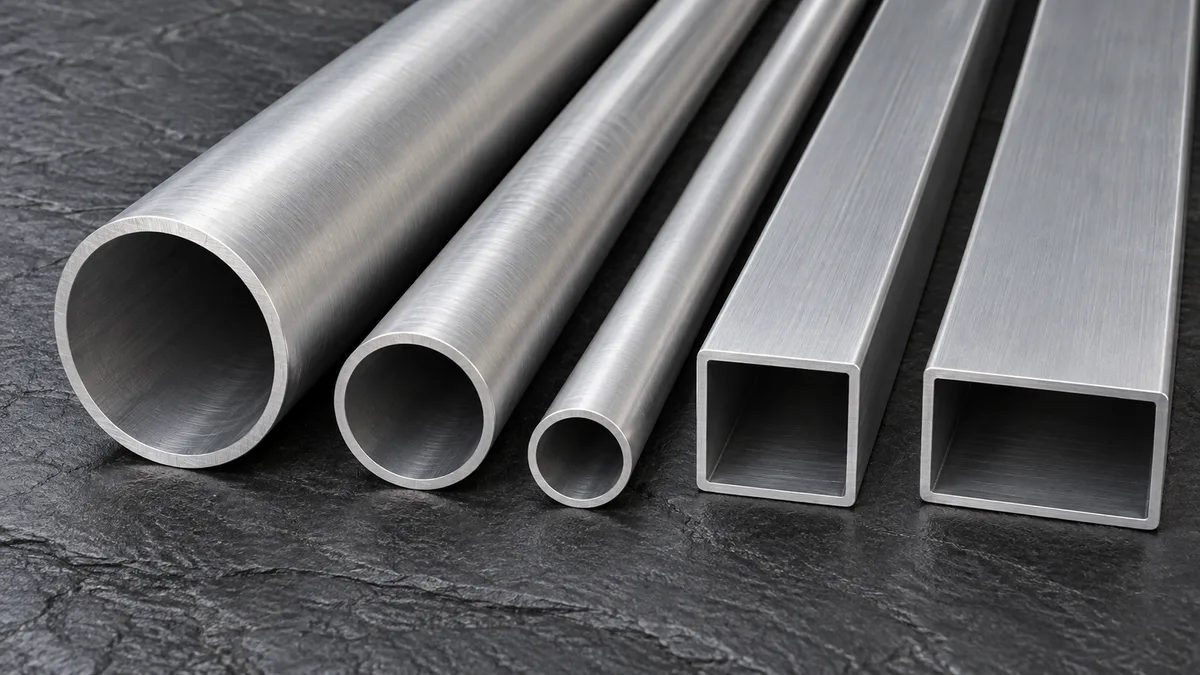
Pipe and tube are both hollow sections, but they are specified differently. Tube is ordered by its actual outside diameter and wall thickness. Pipe is ordered by a nominal pipe size and a schedule number, which together fix a standard outside diameter and wall from the ASME B36.10M table. The nominal size is a designation, not a measurement: 2 in NPS pipe actually has a 2.375 in (60.3 mm) outside diameter.
The advantage of the pipe system is interchangeability. An aluminium 4 in schedule 40 pipe has the same outside diameter as a steel one, so standard flanges, couplings, clamps and supports fit. Within a given NPS the outside diameter stays fixed and the bore gets smaller as the schedule number (and wall) increases.
Aluminium pipe is used where steel is too heavy or would corrode, and where stainless steel is too costly: compressed-air networks, chemical and food process lines, cryogenic LNG and liquid-oxygen piping, offshore and marine systems, bus pipe for substations, handrails and space frames. It weighs about one-third as much as steel pipe of the same size and needs no painting in most atmospheres.
Extruded from a hollow or pierced billet over a mandrel, so the wall has no longitudinal weld seams. Required for pressure piping, gas lines and critical fluid service.
Extruded through a porthole (bridge) die that splits the metal and re-joins it, leaving solid-state seam welds along the length. Strong and economical for handrails, frames and low-pressure service.
Extruded then cold drawn for tighter tolerances, a smoother surface and higher strength in non-heat-treatable alloys. Used for smaller diameters.
Seamless pipe and tube for gas and oil transmission and distribution piping, with additional requirements for that service.
Formed from strip and longitudinally welded. Economical for thin-wall and large-diameter pipe in non-pressure or low-pressure service.
Very large sizes are extruded on large presses or rolled and welded from plate. Ask with the exact OD and wall.
Pressure codes such as ASME B31.3 permit both seamless and some welded constructions but with different allowable stresses. If your line carries pressure, specify the code and design conditions so the right pipe type and certification are supplied.
6061-T6 and 6063-T6 cover most pipe orders. 6061 is stronger and used for pressure and structural service; 6063 has a smoother surface and is popular for handrails and architectural pipe. 5083 and 5086 are chosen for marine and cryogenic piping because they keep their strength after welding and become stronger and tougher at low temperature. 3003 is used where formability and corrosion resistance matter more than strength.
| Alloy / temper | Min. tensile strength | Min. yield strength | Typical use |
|---|---|---|---|
| 6061-T6 | 260 MPa (38 ksi) | 240 MPa (35 ksi) | Pressure piping, structures, compressed air |
| 6063-T6 | 205 MPa (30 ksi) | 170 MPa (25 ksi) | Handrails, architectural and low-pressure pipe |
| 5083-H112 | 270 MPa (39 ksi) | 110 MPa (16 ksi) | Marine and cryogenic piping, welded systems |
| 3003-H112 | 95 MPa (14 ksi) | 35 MPa (5 ksi) | Formable, corrosion-resistant low-pressure lines |
Minimum values for extruded pipe per ASTM B241 / B221 for common wall thicknesses; limits vary by wall and are reported on the mill certificate. Density 2.70 g/cm³ (6061, 6063) and 2.66 g/cm³ (5083).
Dimensions follow ASME B36.10M. Weights are calculated for 6061 / 6063 at 2.70 g/cm³; for 5083 multiply by 0.985. Schedules 5, 10 and 160 are also available in many sizes.
| NPS (in) | OD (mm) | Sch 40 wall (mm) | Sch 40 kg/m | Sch 80 wall (mm) | Sch 80 kg/m |
|---|---|---|---|---|---|
| 1/2 | 21.3 | 2.77 | 0.44 | 3.73 | 0.56 |
| 3/4 | 26.7 | 2.87 | 0.58 | 3.91 | 0.76 |
| 1 | 33.4 | 3.38 | 0.86 | 4.55 | 1.11 |
| 1-1/4 | 42.2 | 3.56 | 1.16 | 4.85 | 1.54 |
| 1-1/2 | 48.3 | 3.68 | 1.39 | 5.08 | 1.86 |
| 2 | 60.3 | 3.91 | 1.87 | 5.54 | 2.57 |
| 2-1/2 | 73.0 | 5.16 | 2.97 | 7.01 | 3.93 |
| 3 | 88.9 | 5.49 | 3.88 | 7.62 | 5.25 |
| 4 | 114.3 | 6.02 | 5.53 | 8.56 | 7.68 |
| 5 | 141.3 | 6.55 | 7.49 | 9.52 | 10.65 |
| 6 | 168.3 | 7.11 | 9.72 | 10.97 | 14.64 |
| 8 | 219.1 | 8.18 | 14.63 | 12.70 | 22.23 |
| 10 | 273.1 | 9.27 | 20.74 | 15.09 | 33.01 |
| 12 | 323.8 | 10.31 | 27.43 | 17.48 | 45.41 |
For any other size, the weight in kg/m is π × (OD − t) × t × 0.0027, with OD and wall t in mm. The tube weight calculator does the arithmetic.
The working pressure of a pipe follows from its wall thickness, diameter and the allowable stress of the alloy at the design temperature. Simple estimates use the Barlow relationship, P = 2·S·t / D, but pressure piping should be designed to the applicable code (for example ASME B31.3), which sets allowable stresses, corrosion allowances and weld factors.
Welding matters more for aluminium than for steel. Heat-treatable 6061-T6 and 6063-T6 lose much of their strength in the heat-affected zone, so codes use a lower welded allowable stress. Non-heat-treatable 5083 and 5086 lose much less, which is why they are preferred for welded cryogenic and marine systems. TIG and MIG with 4043 or 5356 filler are standard; 5356 or 5183 is used with 5xxx pipe.
Schedule 80 and heavier walls can be threaded (NPT or BSP). Thin schedules are better joined by welding, flanges or grooved couplings.
Aluminium slip-on and weld-neck flanges, elbows, tees and reducers match the pipe OD. Insulate joints to steel or copper to prevent galvanic corrosion.
6061-T4 or O-temper and 6063 bend more easily than T6; heat-treat after bending where full strength is needed.
2.375 in (60.3 mm). Nominal pipe size is a designation; the actual OD is fixed by ASME B36.10M and is the same for every schedule of that size. Only the wall thickness and bore change with schedule.
Same outside diameter, thicker wall. Schedule 80 has a smaller bore, higher pressure capacity and roughly 30 – 65 % more weight per metre than schedule 40 (the gap grows with size), and it is thick enough to be threaded.
Use seamless pipe (ASTM B241) for pressure and gas service. Structural pipe (ASTM B429), made through a porthole die with seam welds, is economical and suitable for handrails, frames and non-critical low-pressure use.
6061-T6 for most pressure and structural service, 6063-T6 for handrails and architectural pipe, and 5083 or 5086 for welded marine and cryogenic piping.
Weight in kg/m equals π × (OD − wall) × wall × 0.0027 with dimensions in mm. For example, 2 in Sch 40 weighs about 1.9 kg/m and 4 in Sch 40 about 5.5 kg/m in 6061.
Yes. Metline supplies aluminium pipe cut to length with mill certificates, bundled or crated for export, to customers worldwide.
Send the size, schedule, alloy, length and quantity. We will reply with availability, certification and a delivered price.





