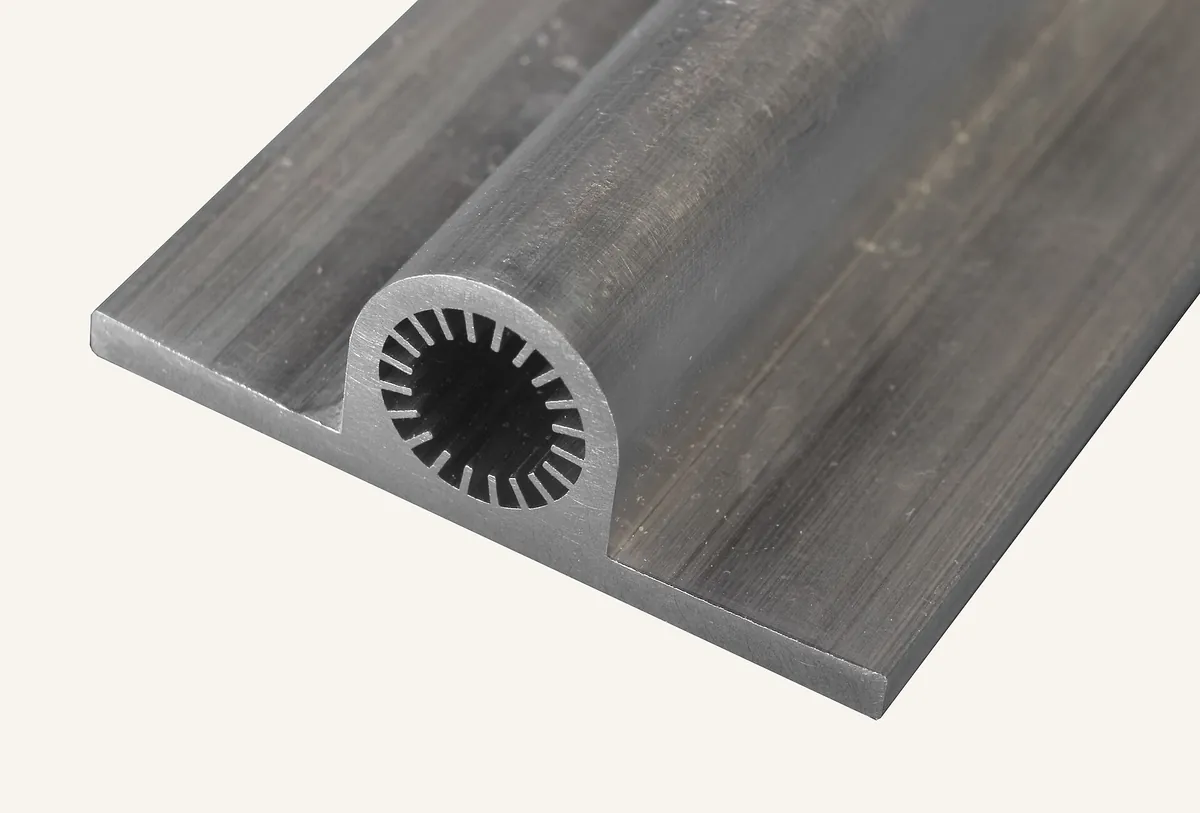
Inner-grooved aluminium tube is a thin-wall round tube with fine helical or straight fins formed on its bore. The grooves enlarge the inner surface and stir the refrigerant, raising heat transfer in fin-and-tube condensers and evaporators. It lets manufacturers build all-aluminium coils that are lighter, cheaper and free of copper–aluminium galvanic corrosion.
In a round-tube plate-fin (RTPF) heat exchanger, refrigerant flows inside the tubes while air passes over thin fins pressed onto them. Most of the thermal resistance on the refrigerant side sits in a thin liquid film on the tube wall. Grooves on the inside break up that film, increase wetted area and promote mixing, so the same tube carries more heat during condensation and evaporation.
Copper inner-grooved tube has been the industry norm for room air conditioners and heat pumps for decades. Aluminium versions have grown as manufacturers look to cut material cost and weight, avoid copper price swings, and make coils from a single metal. An all-aluminium coil has aluminium fins on aluminium tubes, so there is no galvanic couple between dissimilar metals, and aluminium tubes are not attacked by the formicary ("ant-nest") corrosion that affects copper tubes in some indoor environments.
The trade-off is that aluminium is softer and weaker than copper, more sensitive to groove damage during expansion, and harder to join. A successful switch depends on the tube geometry, the alloy, the expansion tooling and the brazing method being designed together, not on substituting one tube for another.
Tube geometry
The geometry parameters you need to specify
An inner-grooved tube is defined by more than its outside diameter. Each parameter below affects heat transfer, pressure drop, burst strength and how the tube behaves when it is expanded into the fin collars. Agree a drawing that shows all of them, with tolerances.
Parameter
What it is
Why it matters
Outside diameter (OD)
Commonly 5, 7, 7.94 (5/16 in) or 9.52 mm (3/8 in) to match fin collar sizes
Must suit the fin die and the expansion bullet
Bottom wall thickness
Wall measured at the groove root
Sets burst pressure; aluminium needs more wall than copper for the same pressure
Groove (fin) height
Height of the internal fins above the root
Higher fins add area but are more easily flattened during expansion
Number of grooves
Count of internal fins around the bore
More fins add area and increase pressure drop
Helix angle
Angle of the grooves to the tube axis; zero for straight grooves
Helical grooves swirl the flow and improve heat transfer; straight grooves are easier to make in aluminium
Fin apex angle and profile
Shape of each internal fin
Affects drainage of condensate film and resistance to deformation
Aluminium grooved tube is produced either by extruding the grooves directly with a profiled mandrel or by drawing over a grooved plug; helical grooves may be added by twisting. The route affects achievable geometry, so confirm it with us at enquiry stage.
Alloys & composition
Alloys for inner-grooved tube (wt %)
Tube alloys need high formability in the annealed state, good brazeability and adequate corrosion resistance. Manganese-bearing 3xxx alloys are the most common; leaner 3102 extrudes more easily into fine internal detail. Long-life alloys, which are 3xxx variants with tuned copper, manganese and zinc, are also used to shift corrosion into a lateral, non-perforating mode.
Element
3003
3102
1100
Silicon (Si)
≤ 0.60
≤ 0.40
Si + Fe ≤ 0.95
Iron (Fe)
≤ 0.70
≤ 0.70
(see Si)
Copper (Cu)
0.05 – 0.20
≤ 0.10
0.05 – 0.20
Manganese (Mn)
1.0 – 1.5
0.05 – 0.40
≤ 0.05
Zinc (Zn)
≤ 0.10
≤ 0.30
≤ 0.10
Titanium (Ti)
—
≤ 0.10
—
Aluminium
Remainder
Remainder
≥ 99.00
Alloy / temper
Typical tensile strength
Typical yield strength
Typical elongation
3003-O
110 MPa
40 MPa
30 – 40 %
1100-O
90 MPa
35 MPa
35 – 45 %
Typical values for annealed tube; 3102-O sits close to 1100-O in strength and ductility. The governing limits are those agreed in the tube specification and reported on the certificate for each lot.
Design & fabrication
Designing a coil around aluminium grooved tube
Pressure rating
Modern refrigerants such as R32 and R410A run at high condensing pressures. Size the bottom wall so the tube meets the burst and fatigue requirements of your safety standard with margin, allowing for the lower strength of annealed aluminium.
Mechanical expansion
Tubes are expanded into fin collars with a bullet. Aluminium grooves flatten more easily than copper ones, so bullet size, expansion ratio and lubricant must be tuned to keep groove height after expansion.
Hairpin bending
Hairpins are bent from O-temper tube. Tight bends can thin the outer wall and collapse grooves; tooling designed for aluminium and correct bend radius are essential.
Joining
Return bends and headers are flame or induction brazed with Al-Si filler and a non-corrosive flux, or joined with brazing ring preforms. Copper-to-aluminium transition joints, where needed, require careful design and protection.
Corrosion protection
Fins are usually made slightly anodic to the tube so they corrode first. A zinc layer on the tube outside or a long-life alloy gives further sacrificial protection in aggressive air.
Cleanliness
Residual drawing oil and particles inside the tube can contaminate the refrigerant circuit. Agree an internal cleanliness limit and a dehydrated, capped delivery condition.
Inspection
Inspection and testing
Grooved tube for refrigerant circuits is checked more closely than general-purpose tube, because a single pinhole means a field leak.
Typical inspection plan
Dimensions
OD, bottom wall, groove height, groove count and helix angle by sectioning and optical measurement
Eddy-current testing
In-line testing of the full coil length to detect wall defects and pinholes
Pressure / leak test
Pressure or burst testing on samples; helium leak testing on assembled coils
Mechanical tests
Tensile strength, elongation and expansion or flare test on samples from each lot
Cleanliness
Residual oil and particulate inside the tube, against the agreed limit
Certification
Mill test certificate to EN 10204 3.1 with chemistry and mechanical results
Supply range
Supply formats
Supply range
Outside diameter
Typically 5 – 12.7 mm for RTPF coils; other sizes on request
Groove type
Straight or helical, to your drawing
Temper
O (annealed) as standard for hairpin bending and expansion
Formats
Level-wound coils (LWC) for hairpin benders, pancake coils, straight lengths or bent hairpins
Outer surface
Bare, or zinc-coated for sacrificial protection
Delivery condition
Clean, dry, end-capped and nitrogen-sealed on request
Comparison
Aluminium grooved tube vs copper grooved tube vs micro-channel
Factor
Aluminium grooved tube (RTPF)
Copper grooved tube (RTPF)
Micro-channel (MCHX)
Material cost
Low
High and volatile
Low
Weight
Light
Heavy
Lightest
Refrigerant charge
Similar to copper RTPF
Reference
Much lower
Production line change
Moderate: same RTPF process, retuned tooling and brazing
None
Major: new brazing furnace and coil design
Galvanic risk with Al fins
None
Present at tube–fin contact
None
Field repair
Harder; aluminium brazing skills needed
Easy
Harder
Aluminium grooved tube is attractive for manufacturers who want to keep their existing fin-and-tube lines. Micro-channel coils give larger gains in charge and compactness but require a full redesign; see our micro-channel tube page and folded vs extruded micro-channel comparison.
SpecifyTube drawing with OD, bottom wall, groove height, groove count and helix angle; alloy and temper; coil format and weight; outer coating; cleanliness and test requirements; annual and call-off quantities.
QuoteWe confirm alloy, temper, tolerances, certification, packing and delivery terms (EXW, FOB, CIF or DAP) for your destination.
ProcessSamples are produced and measured for geometry and expansion behaviour; after approval, coils are produced, eddy-current tested, cleaned and sealed.
DocumentEach delivery carries a mill test certificate to EN 10204 3.1 with the cast analysis and mechanical results; third-party inspection can be arranged on request.
ShipCoils are packed on pallets or in cases with moisture protection and shipped by sea or air on EXW, FOB, CIF or DAP terms.
Sources
References and standards
ASTM B234 – Standard Specification for Aluminum and Aluminum-Alloy Drawn Seamless Tubes for Condensers and Heat Exchangers
EN 573-3 – Chemical composition and form of wrought products
EN 378 / ISO 5149 – Refrigerating systems and heat pumps: safety and environmental requirements
Can aluminium grooved tube replace copper in an air-conditioner coil?
Yes, in many round-tube plate-fin designs, but not as a straight swap. Wall thickness, groove geometry, expansion tooling and the brazing of return bends must be redesigned for aluminium. Prototype coils should be tested for capacity, pressure and corrosion before production.
Which alloy is used for inner-grooved aluminium tube?
Mostly 3xxx alloys such as 3003 and 3102, plus 1100 and proprietary long-life alloys. All are supplied in the annealed O temper so they can be bent into hairpins and expanded into the fins.
Why do aluminium grooves need special expansion tooling?
Aluminium is softer than copper, so the internal fins flatten more easily when a bullet expands the tube into the fin collars. Bullet size, expansion ratio and lubrication must be tuned to preserve groove height and heat transfer.
Does aluminium tube suffer formicary corrosion?
No. Formicary or ant-nest corrosion is a copper problem caused by organic acids in indoor air. Aluminium tubes are not attacked this way, which is one reason all-aluminium coils are used for indoor units.
How are aluminium hairpins joined?
Return bends and headers are brazed with aluminium-silicon filler, by flame or induction, using non-corrosive flux or flux-containing ring preforms. Where a copper line must connect, a purpose-made copper–aluminium transition joint is used.
In what format is grooved tube supplied?
Usually as level-wound coils that feed hairpin benders directly, or as pancake coils, straight lengths or pre-bent hairpins, cleaned and end-capped. Metline supplies these formats with certificates to customers worldwide.
Building an all-aluminium coil?
Send your tube drawing, alloy and volumes. We will reply with geometry feasibility, test plan, packing and a delivered price.