Pressing
Use the O temper for deep embossing; lubricate with an evaporative or easily removed oil. Heavy lubricants left on the clad cause brazing defects.



Brazing composite sheet is clad aluminium sheet, cut to length rather than coiled, used for the heavier and more deeply formed parts of brazed heat exchangers: stacked plates, headers, tanks, side plates and cold plates. Deep-drawing grades are supplied in the O temper with guaranteed cupping values so they can be pressed into embossed plates without splitting. Metline supplies both, 0.21 – 5 mm thick, to vehicle and heat-exchanger makers worldwide.
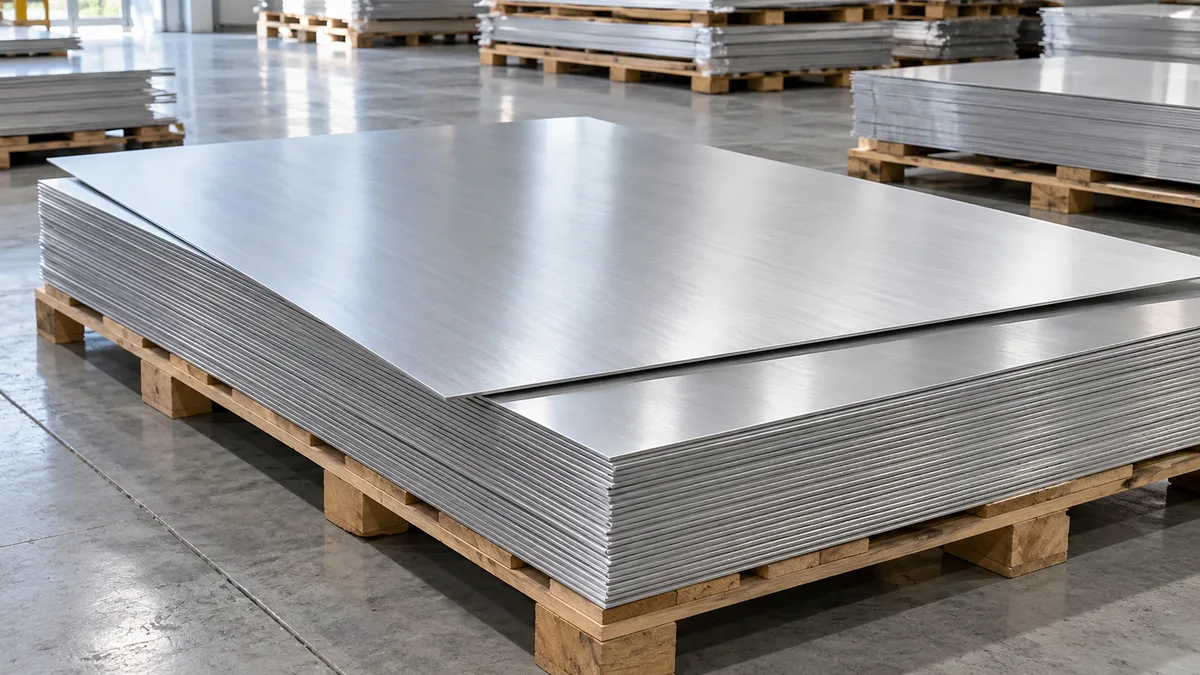
Brazing composite sheet uses the same roll-bonded construction as clad coil: an Al-Si filler layer on one or both faces of a stronger core. The difference is form and purpose. Sheet is supplied flat in cut lengths for presses and transfer lines that make plates, headers and housings, and it is often thicker, up to about 5 mm, for parts that carry pressure or bolts.
Deep-drawing brazing sheet is the specialised version for stacked-plate heat exchangers. Each plate of an engine-oil cooler, transmission cooler or battery chiller is pressed with dimples, ribs and a raised rim, then stacked with others and brazed into a single block. The sheet must stretch and draw without cracking the clad or core, so it is supplied fully annealed and tested for cupping height.
Many sheet structures add a third layer. A 7072 liner gives sacrificial protection on the coolant side; a second filler layer allows brazing on both faces; and a 1100 interlayer can slow silicon diffusion into a sensitive core. The structure is written from outside to inside, for example 4343 / 3003 / 7072.
| Structure | Brazing process | Typical part |
|---|---|---|
| 4343 / 3003 and 4343 / 3003 / 4343 | CAB | Headers, side plates, cooler plates |
| 4343 / 3003 / 7072 | CAB | Tubes and plates with sacrificial coolant-side liner |
| 4045 / 3003 / 4045 | CAB | Plates needing more filler flow |
| 4343 / 6951 / 4343, 4045 / 6951 / 4045 | Vacuum or CAB (low Mg) | High-strength plates after ageing |
| 4004 / 3003, 4004 / 6063 | Vacuum | Evaporator and oil-cooler plates |
| 4104 / 3003 / 4104, 4104 / 6063 | Vacuum | Plates where bismuth-improved wetting helps |
| 4047 / 3003 | CAB, flame | Joints that need high fluidity |
| 4343 / 3003 / 1100 | CAB | Designs with a pure-aluminium inner layer |
| Filler (clad) alloy | Silicon, wt % | Other key elements | Melting range (approx.) | Process | AWS class |
|---|---|---|---|---|---|
| 4343 | 6.8 – 8.2 | — | 577 – 613 °C | CAB (flux) | BAlSi-2 |
| 4045 | 9.0 – 11.0 | — | 577 – 591 °C | CAB (flux) | BAlSi-5 |
| 4047 | 11.0 – 13.0 | — | 577 – 582 °C | CAB, flame, induction | BAlSi-4 |
| 4004 | 9.0 – 10.5 | Mg 1.0 – 2.0 | about 559 – 591 °C | Vacuum (fluxless) | BAlSi-7 |
| 4104 | 9.0 – 10.5 | Mg 1.0 – 2.0, Bi 0.02 – 0.20 | about 559 – 591 °C | Vacuum (fluxless) | BAlSi-11 |
| Core or liner alloy | Key alloying | Why it is used |
|---|---|---|
| 3003 | Mn 1.0 – 1.5, Cu 0.05 – 0.20 | Standard core: solidus about 640 °C, well above brazing temperature; good formability |
| Long-life 3xxx cores | Mn with added Cu and Ti | Higher post-braze strength and a layered corrosion structure that resists perforation |
| 3005 | Mn 1.0 – 1.5, Mg 0.20 – 0.60 | More strength; magnesium must be limited for CAB because it reacts with flux |
| 6063 / 6951 | Mg-Si (6951 also Cu) | Heat-treatable cores for higher post-braze strength; mainly vacuum-brazed plates and evaporators |
| 7072 liner | Zn 0.8 – 1.3 | Sacrificial water-side liner that corrodes preferentially and protects the core |
| 1050 / 1100 liner | Commercially pure | Soft inner layer used in some tube and plate designs |
General-purpose composite sheet on 3003-type cores is supplied to the same strength bands as clad coil:
| Temper | Tensile strength Rm | Yield Rp0.2 (min.) | Elongation A50 (min., 0.2 – 1.3 mm) |
|---|---|---|---|
| O | 95 – 160 MPa | 35 MPa | 18 % |
| H12 / H22 | 120 – 170 MPa | 90 / 80 MPa | 4 / 6 % |
| H14 / H24 | 150 – 200 MPa | 125 / 115 MPa | 2 / 3 % |
| H16 / H26 | 170 – 230 MPa | 150 / 140 MPa | 1 / 2 % |
| H18 | ≥ 200 MPa | 170 MPa | 1 % |
Deep-drawing sheet is supplied in O temper with higher guaranteed elongation and a minimum cupping (Erichsen-type) value:
| Core group | Temper | Thickness (mm) | Rm | Rp0.2 (min.) | A50 (min.) |
|---|---|---|---|---|---|
| 3003, 3005, 7072-lined | O | 0.30 – 1.30 | 95 – 160 MPa | 35 MPa | 20 % |
| 3003, 3005, 7072-lined | O | > 1.30 – 6.00 | 95 – 160 MPa | 35 MPa | 25 % |
| 6063, 6951 (6xxx) | O | 0.30 – 6.00 | ≤ 160 MPa | — | 18 % |
| Core group | Thickness (mm) | Minimum cupping value |
|---|---|---|
| 3xxx cores | 0.30 – 0.60 | 7.0 mm |
| 3xxx cores | > 0.60 – 1.00 | 8.0 mm |
| 3xxx cores | > 1.00 – 1.30 | 9.0 mm |
| 3xxx cores | > 1.30 | 10.0 mm |
| 6xxx cores | 0.30 – 6.00 | 6.0 mm |
Values are typical requirements used for deep-drawing brazing sheet; the governing specification is agreed with each customer.
| Cladding ratio | Tolerance on ratio |
|---|---|
| 3.0 – 6.0 % | ±1.2 points |
| > 6.0 – 8.0 % | ±1.5 points |
| > 8.0 – 13.0 % | ±2.0 points |
| > 13.0 – 25.0 % | ±3.0 points |
| Thickness (mm) | Width ≤ 1000 mm | > 1000 – 1320 mm | > 1320 – 1600 mm |
|---|---|---|---|
| 0.2 – 3.0 | ±2.0 mm | ±3.0 mm | ±4.0 mm |
| 3.0 – 6.0 | ±3.0 mm | ±4.0 mm | ±5.0 mm |
Length tolerance is typically ±4 mm up to 3 m and ±6 mm above. Edge camber and diagonal difference are controlled so that blanks feed squarely into progressive dies; for example, a common rule limits diagonal difference to about 2.0 mm per 300 mm of width on sheet up to 3.7 m long.
Use the O temper for deep embossing; lubricate with an evaporative or easily removed oil. Heavy lubricants left on the clad cause brazing defects.
Mark which face carries the filler. Plates assembled with the clad on the wrong side will not braze.
Degrease after pressing; a clean, oxide-light surface gives even flux coverage and wetting.
CAB at roughly 595 – 610 °C with fluoride flux, or vacuum with 4004 / 4104 clad. Keep time above the filler liquidus short to limit erosion of thin plates.
6xxx-core plates gain strength by natural ageing or a short artificial age after brazing.
Brazed assemblies are helium or pressure-decay tested; burst and pressure-cycle tests follow the system maker's specification.
| Application | Typical structure | Why |
|---|---|---|
| Engine and transmission oil coolers | 4343 / 3003 / 4343, O temper | Deep-drawn stacked plates |
| Radiator and condenser headers | 4343 / 3003, H14 – H24 | Strength for tube slots and tank crimping |
| Battery cold plates | 4343 / 3003 or 4045 / 6951 / 4045 | Flat, leak-tight channels for coolant |
| Battery chillers and evaporators | 4004 / 3003 or 4343 / 3003 / 4343 | Stacked-plate refrigerant-to-coolant exchange |
| Side plates and brackets | 4343 / 3003 | Brazed to the core for stiffness |
Brazing composite sheet is a heat-exchanger material. It is not used for car body shells, doors or interior panels; those use unclad 5xxx and 6xxx body sheet.
Clad brazing sheet supplied fully annealed (O temper) with guaranteed elongation and cupping values, so it can be pressed into embossed plates for stacked-plate coolers without cracking.
The depth a sheet can be stretched by a spherical punch before it cracks, measured in millimetres. Brazing sheet on 3xxx cores typically requires 7 – 10 mm depending on thickness.
When the brazed part needs more strength than a 3003 core can give. 6951 gains strength by ageing after brazing and is common in vacuum-brazed plates.
No. It is designed for brazed heat exchangers. Body panels use unclad 5xxx and 6xxx sheet.
By marking or by agreed orientation in the pack. Always confirm clad orientation for one-side clad sheet before pressing.
From about 0.21 mm to 5 mm, in widths up to 1600 mm and lengths up to 10 m.
Send your structure, gauge, size and volume. We will reply with availability, certification and a delivered price.





