4047
Near-eutectic Al-Si with the narrowest melting range (about 577 – 582 °C) and the highest fluidity. Fills wide or long joints and suits torch, induction and furnace brazing with flux.



Non-clad brazing strip is a single-alloy strip, usually an aluminium-silicon filler alloy such as 4047, 4045, 4004 or 4104, used as a separate braze shim or preform where the parts being joined carry no cladding of their own. Bare 6951 strip is supplied alongside it as a heat-treatable core material for vacuum-brazed fins and plates. Metline supplies both in thin gauges and slit widths, worldwide.
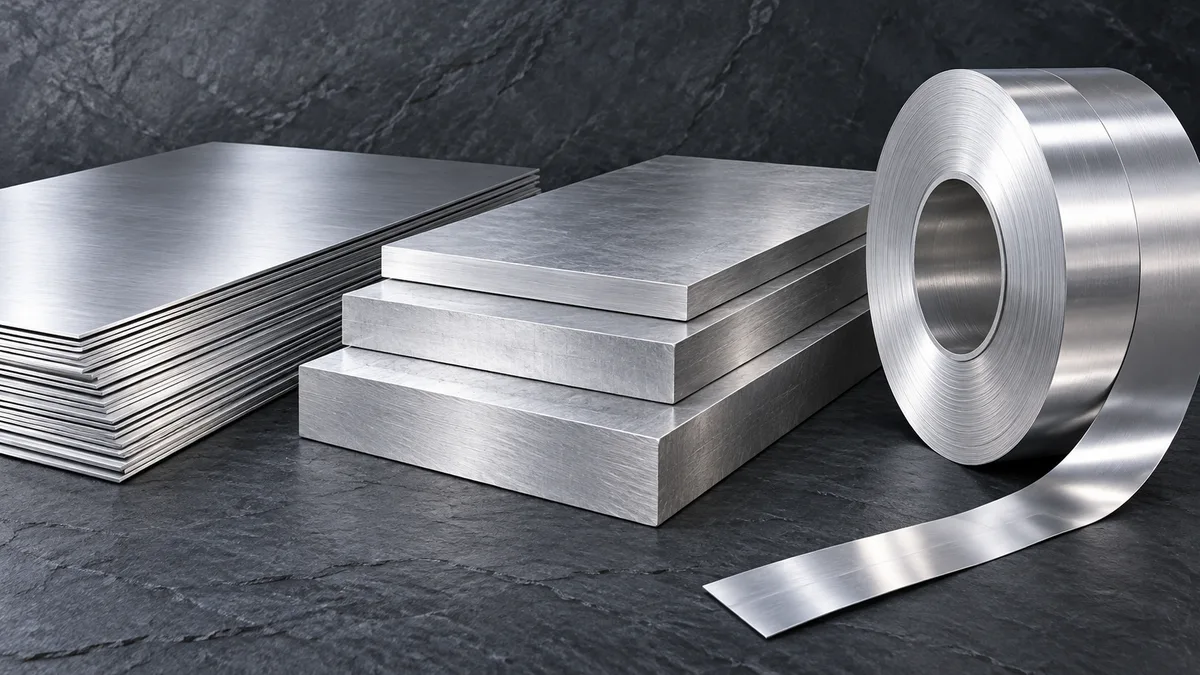
Clad brazing sheet carries its filler metal bonded to the core. Non-clad strip separates the two: the filler alloy is supplied on its own as thin strip, and the brazer cuts or stamps it into shims, washers or preforms placed between bare parts before heating. When the furnace reaches temperature, the shim melts and fills the joint.
This approach suits joints where clad material is not practical: thick machined fittings and blocks brazed to tubes, bare extrusions joined to plates, repair and prototype work, and assemblies where only one or two joints need filler. It is also used in vacuum brazing of plate-fin exchangers, where bare fins or bars are combined with clad separator sheets or loose filler foil.
Alongside the filler alloys, bare 6951 strip is supplied as a core material. It contains magnesium, silicon and copper, braze-cycles without melting, and gains strength by ageing afterwards, so it is used for fins and plates that need more post-braze strength than 3003.
Registered limits for the main alloys. Note that bismuth belongs to 4104, not 4004: the two are otherwise almost identical, and some published tables reverse them.
| Alloy | Si | Fe max | Cu | Mn max | Mg | Zn max | Other |
|---|---|---|---|---|---|---|---|
| 4047 | 11.0 – 13.0 | 0.8 | ≤ 0.30 | 0.15 | ≤ 0.10 | 0.20 | — |
| 4045 | 9.0 – 11.0 | 0.8 | ≤ 0.30 | 0.05 | ≤ 0.05 | 0.10 | Ti ≤ 0.20 |
| 4004 | 9.0 – 10.5 | 0.8 | ≤ 0.25 | 0.10 | 1.0 – 2.0 | 0.20 | — |
| 4104 | 9.0 – 10.5 | 0.8 | ≤ 0.25 | 0.10 | 1.0 – 2.0 | 0.20 | Bi 0.02 – 0.20 |
| 6951 (core) | 0.20 – 0.50 | 0.8 | 0.15 – 0.40 | 0.10 | 0.40 – 0.80 | 0.20 | — |
Aluminium is the remainder in every case. Each lot ships with its actual analysis.
Near-eutectic Al-Si with the narrowest melting range (about 577 – 582 °C) and the highest fluidity. Fills wide or long joints and suits torch, induction and furnace brazing with flux.
About 10 % silicon, melting about 577 – 591 °C. A general-purpose CAB filler, often used as strip shims with fluoride flux.
Al-Si with 1 – 2 % magnesium for vacuum brazing without flux. The magnesium evaporates and disrupts the oxide film.
4004 with a small bismuth addition that improves wetting and fillet formation and makes vacuum brazing more tolerant of furnace conditions.
Not a filler. A heat-treatable core strip for fins and plates; it survives the braze cycle and is then aged for strength. Typical O-temper values are about 110 MPa tensile and 40 MPa yield, rising markedly after ageing.
| Alloy | Tempers | Typical thickness (mm) | Typical width (mm) |
|---|---|---|---|
| 4047 | O, H18 | 0.07, 0.10, 0.20, 0.50 | 150 – 1000 |
| 4045 | O, H18, H24 | 0.07, 0.10, 0.20, 0.50 | 150 – 1000 |
| 4004 | H16, H18 | 0.07, 0.10, 0.20, 0.50 | 150 – 1000 |
| 4104 | H16, H18 | 0.07, 0.10, 0.20, 0.50 | 150 – 1000 |
| 6951 | O, H18 | to order, commonly ≤ 0.3 for fins | 150 – 1000 |
Hard tempers (H16, H18) are preferred when strip is stamped into flat shims and washers, because they cut cleanly and do not distort. Soft O temper suits strip that is wrapped, formed into rings or bent around parts. Slitting to narrow widths for automatic shim feeders is available.
Keep the joint gap small, roughly 0.05 – 0.2 mm, for good capillary action, and support parts so that they do not sag as the core softens near brazing temperature.
Brazing strip is a heat-exchanger joining material. It is not used to weld car body panels, axles or suspension parts, and aluminium-silicon fillers cannot survive exhaust temperatures.
Clad strip has the filler layer bonded to a core. Non-clad strip is the filler alloy alone, used as separate shims or preforms between bare parts.
4004 or 4104. Their magnesium content breaks up the oxide film without flux; the bismuth in 4104 improves wetting further.
No. Bismuth (0.02 – 0.20 %) is the feature that distinguishes 4104 from 4004.
It is a heat-treatable core material for fins and plates in brazed exchangers. It does not melt during brazing and gains strength by ageing afterwards.
A hard temper such as H18, which stamps cleanly into flat shapes.
Send the alloy, temper, gauge and width. We will reply with availability, certification and a delivered price.





