Stamped and brazed
Two sheets, at least one stamped with channels, brazed face to face. Clad brazing sheet is the natural material. Gives freedom in channel layout and good flatness.



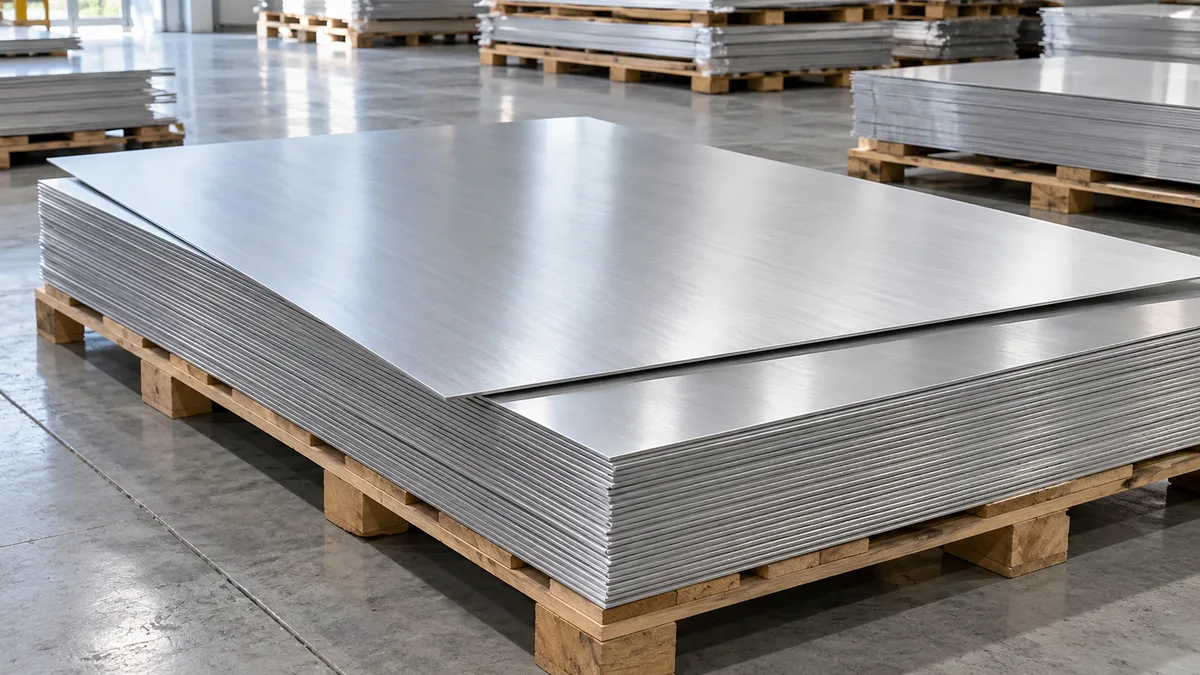
A battery liquid cold plate is a thin aluminium panel with internal coolant channels that sits under or between battery cells and carries their heat away. Most are made from 3003 sheet or from 3003 core clad with a 4xxx brazing alloy such as 4343 or 4045, stamped and brazed into a sealed unit. Metline supplies the bare and clad aluminium sheet, coil and blanks that cold-plate makers use, worldwide.
Lithium-ion cells work best in a narrow temperature window, roughly 20 – 40 °C, and lose life quickly if they run hot or unevenly. The cold plate keeps every cell in that window during fast charging and hard driving, so its material has to conduct heat well, stay leak-tight for the life of the vehicle and survive coolant corrosion.
Aluminium meets those needs at a third of the weight of copper. Non-heat-treatable 3003 (Al-Mn) is the base material because it forms well, brazes reliably and resists glycol-water coolant. Its weakness is strength: brazing at around 600 °C anneals it, so a plain 3003 plate ends up soft. As battery packs grow and cold plates double as structural floors, makers turn to clad sheet with stronger, longer-life 3xxx cores.
Metline does not make cold plates. We supply the aluminium they are made from: bare 3003 sheet and coil, clad brazing sheet with one or both sides coated, and blanks cut to size for stamping lines.
| Material | Construction | Joining route | Typical use |
|---|---|---|---|
| 3003 bare | Single alloy, no clad layer | Friction stir welding, laser welding, or brazing with separate filler foil or paste | Simple welded or FSW plates, covers and lower-cost designs |
| 3003 / 4343 | 3003 core clad on one or both sides with Al-7.5 % Si | Controlled-atmosphere (CAB) brazing with non-corrosive flux | Stamped two-piece brazed plates, the most common construction |
| 3003 / 4045 | 3003 core with Al-10 % Si clad | CAB brazing; more fluid filler for thicker joints | Plates with larger fillets or internal fins |
| 3003 / 4004 | 3003 core with Al-Si-Mg clad | Vacuum brazing without flux | Flux-free assemblies, often for high-cleanliness coolant circuits |
| Modified 3xxx core / 4343 | Higher-strength or long-life 3xxx core (Cu, Mg or Ti additions) with Al-Si clad | CAB brazing | Large or structural plates that need more post-braze strength and corrosion life |
Clad ratios of roughly 5 – 15 % of total thickness per side are common; the right figure depends on joint design and brazing cycle and is agreed with the cold-plate maker.
| Element | 3003 core | 4343 clad | 4045 clad | 4004 clad |
|---|---|---|---|---|
| Silicon (Si) | 0.6 max | 6.8 – 8.2 | 9.0 – 11.0 | 9.0 – 10.5 |
| Iron (Fe) | 0.7 max | 0.8 max | 0.8 max | 0.8 max |
| Copper (Cu) | 0.05 – 0.20 | 0.25 max | 0.30 max | 0.25 max |
| Manganese (Mn) | 1.0 – 1.5 | 0.10 max | 0.05 max | 0.10 max |
| Magnesium (Mg) | — | — | 0.05 max | 1.0 – 2.0 |
| Zinc (Zn) | 0.10 max | 0.20 max | 0.10 max | 0.20 max |
| Titanium (Ti) | — | — | 0.20 max | — |
| Aluminium | Remainder | Remainder | Remainder | Remainder |
Silicon lowers the melting range of the clad layer to about 577 – 615 °C, below the 3003 core (about 640 – 655 °C). In the furnace the clad melts, flows into the joints by capillary action and solidifies as a fillet, while the core stays solid. The magnesium in 4004 disrupts the oxide film in vacuum, which is why it can braze without flux.
| Temper (3003 sheet, ~1.6 mm) | Tensile strength | Yield strength (min) |
|---|---|---|
| O (annealed) | 97 – 131 MPa (14 – 19 ksi) | 34 MPa (5 ksi) |
| H12 | 117 – 159 MPa (17 – 23 ksi) | 83 MPa (12 ksi) |
| H14 | 138 – 179 MPa (20 – 26 ksi) | 117 MPa (17 ksi) |
| H16 | 165 – 207 MPa (24 – 30 ksi) | 145 MPa (21 ksi) |
| H18 | 186 MPa min (27 ksi) | 165 MPa (24 ksi) |
Specified limits per ASTM B209 for bare 3003 sheet. Clad sheet properties are reported on the certificate for the specific core, clad ratio and temper.
Temper choice is about forming, not final strength. Plates with deep channels are stamped from O or H22/H24 (partially annealed) stock that stretches well; flat cover sheets can use harder H14 or H24. Whatever the starting temper, the brazing cycle anneals the core, so post-braze strength depends mainly on the core alloy. Plain 3003 returns to roughly annealed strength (typical yield around 40 MPa), which is why higher-strength modified cores are used when the plate carries load or coolant pressure.
Thermal conductivity of 3003 is about 160 – 190 W/m·K depending on temper, lower than pure aluminium but ample for a plate a millimetre or two thick, where the thermal interface material and coolant film dominate total resistance.
Two sheets, at least one stamped with channels, brazed face to face. Clad brazing sheet is the natural material. Gives freedom in channel layout and good flatness.
Flat extruded multi-channel tubes joined to headers, used as long thin cooling ribbons between cylindrical or prismatic cells.
A wide extruded profile with internal channels, closed by friction stir welded end caps. Strong and suited to plates that form part of the pack floor.
Two sheets roll-bonded except along a printed channel pattern, then inflated by pressure. Thin, light and economical in volume.
Turbulator fins, pin arrays or offset-strip fins brazed inside the channel raise heat transfer at the cost of pressure drop.
Channels milled into thicker plate and closed by a brazed or welded lid. Used for prototypes and power-electronics cold plates.
A common mistake is selecting temper only for strength. A hard temper that cracks in a deep channel stamping costs more in scrap than any saving in material. Another is ignoring the coolant: inhibitor packages and flow velocity both affect pitting, so tell your supplier the coolant type so the core and clad combination can be matched.
3003 combines good formability, reliable brazing, adequate thermal conductivity and good resistance to glycol-water coolant at low cost. Its limitation is low strength after brazing, which is why stronger 3xxx cores are used for large plates.
4343 contains about 7.5 % silicon and 4045 about 10 %. 4045 melts over a narrower range and flows more readily, suiting thicker joints; 4343 is the most common clad for CAB-brazed cold plates.
Yes, in vacuum furnaces using clad alloys containing magnesium such as 4004. CAB brazing in nitrogen uses a non-corrosive fluoride flux.
Usually O or H22/H24 for plates with deep channels, and harder H14 or H24 for flat covers. Brazing anneals the core, so the temper mainly affects forming.
No. Metline supplies the bare and clad aluminium sheet, coil and cut blanks; stamping, brazing and leak testing are done by the cold-plate manufacturer.
Send the core and clad alloys, clad ratio, temper, thickness and quantity. We will reply with availability and a delivered price.





