Three-layer strip
Core plus braze clad on one or both sides. Gives good formability and brazing with long-life corrosion performance from the core chemistry.



A folded microchannel tube is a flat, multi-port heat exchanger tube made by roll-forming and folding clad aluminium strip, instead of extruding it through a die. Because the strip is rolled, the wall can be thinner and stronger, the inner channels can carry thin fins, and the braze and corrosion layers are built into the material. This guide explains how folded tube is made, how it compares with extruded microchannel tube, which material structures are used and what to specify for condensers, evaporators and heat pumps. Metline supplies folded tube and the clad strip it is made from to heat exchanger builders worldwide.
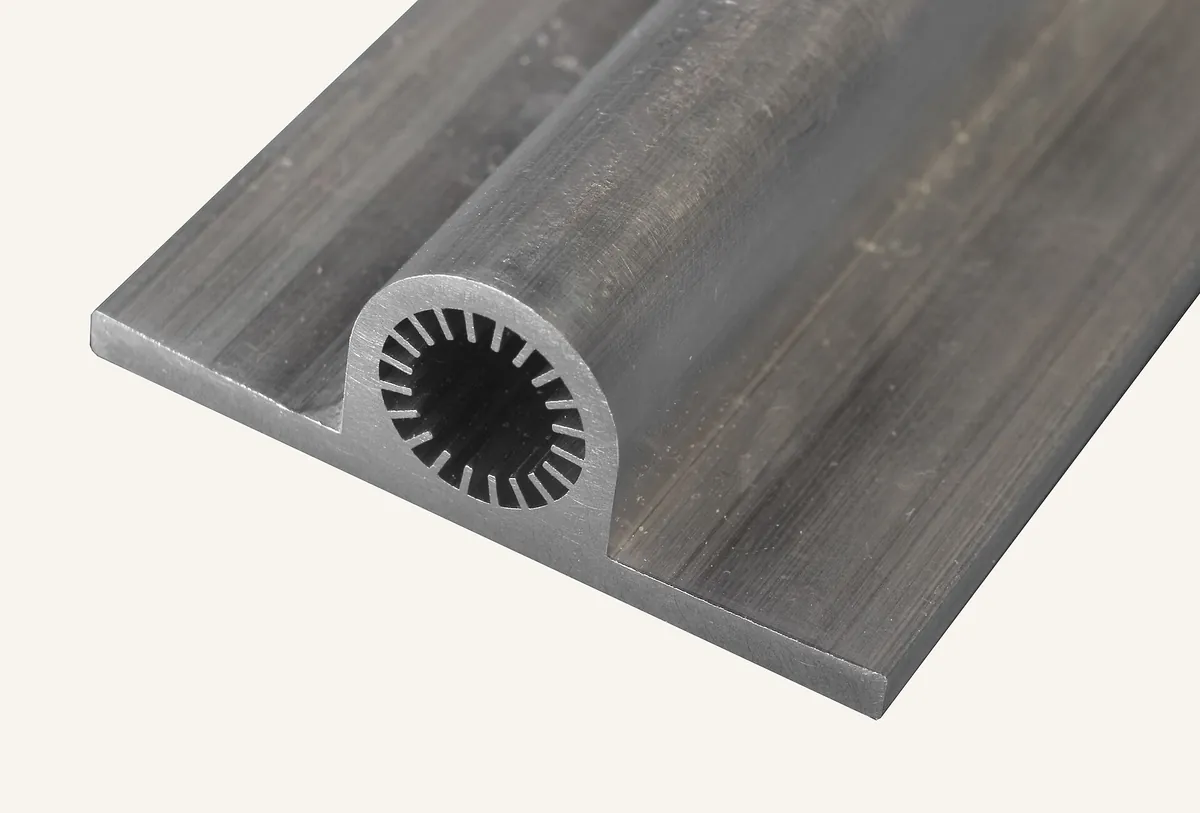
Microchannel (or multi-port) heat exchangers use flat aluminium tubes divided into many small parallel channels, brazed between louvred fins and connected by round headers. They hold far less refrigerant than round-tube-plate-fin coils, weigh less and are fully recyclable as a single metal.
Most microchannel tube is extruded: a billet is pushed through a porthole die that forms the outer wall and the internal webs in one pass. Folded tube takes a different route. A clad aluminium strip, a fraction of a millimetre thick, is fed through a sequence of forming rolls that bend it into a flat tube and, in many designs, fold part of it inward to make the webs. Two-piece designs instead insert a separately corrugated inner fin into a folded outer shell. The seam and the internal joints are closed during the same furnace brazing cycle that joins the coil.
The idea is not new. Folded "B-type" tubes have been used in automotive radiators and heater cores for many years. What has changed is the push for higher-pressure, lower-charge refrigerants and lighter coils in air conditioners, heat pumps and data-centre cooling, which plays to the strengths of rolled, clad material: a thin, strong wall with corrosion protection engineered through the thickness.
Because the tube remains unsealed until brazing, cleanliness and dimensional control of the strip are critical. A burr on the slit edge or an uneven clad layer can leave a channel unbonded, which shows up as a weak web or a leak at pressure test.
| Feature | One-piece folded tube | Two-piece folded tube |
|---|---|---|
| Construction | Single strip folded to form both the outer wall and the internal webs | Folded outer shell plus a separately formed inner fin |
| Typical example | 16 × 1.8 mm, about 12 ports, wall and webs about 0.24 mm | 12 × 1.4 mm, about 20 ports, wall about 0.20 mm, inner fin about 0.08 mm |
| Material choice | One clad strip must suit both wall and webs | Shell and fin can use different alloys, gauges and clads |
| Port count | Moderate | High; very fine ports possible |
| Strength and pressure | Robust, simple | High, thanks to the many brazed fin-to-wall joints |
| Typical use | Condensers, evaporators, radiators | High-efficiency condensers, heat pumps, low-GWP and high-pressure systems |
Example sizes illustrate common published designs; tube width, height, port count and gauges are set for each heat exchanger.
The tube strip is a laminated material. Each layer has a job, and the combination sets brazeability, strength and corrosion life.
| Layer | Typical alloy type | Purpose |
|---|---|---|
| Braze clad (outside) | 4343 or 4045 Al-Si | Melts in the furnace to bond fins and headers and close the seam |
| Core | Long-life 3xxx (Al-Mn with controlled Cu, Ti, sometimes Mg) | Carries pressure; dense precipitate band resists pitting penetration |
| Sacrificial or inter-liner | Zn-bearing Al alloy (e.g. 7072 type) or modified 3xxx | Corrodes preferentially and laterally, protecting the core |
| Inner fin | 3003-type or long-life 3xxx, bare or clad | Divides channels, adds heat transfer area and supports the wall against pressure |
Core plus braze clad on one or both sides. Gives good formability and brazing with long-life corrosion performance from the core chemistry.
Core with inter-liners and braze clads on both sides. The extra layers tune the corrosion potential through the wall and limit silicon diffusion into the core, raising post-braze strength and corrosion life.
The tube is made slightly more noble than the fins, and its outer layers more anodic than its core, so corrosion runs sideways along the surface instead of through the wall.
Extruded tube relies on a zinc arc-spray layer applied after extrusion to create the same sacrificial effect. With folded tube the protection is rolled in, so its thickness and zinc content are uniform along the tube and around the edges.
Tube strip is usually supplied in H24 or a similar partially annealed temper, hard enough to roll-form accurately but ductile enough to fold without cracking. Brazing anneals the material, so the number that matters for burst and fatigue design is the post-braze strength.
| Condition | Yield strength Rp0.2 | Tensile strength Rm | Elongation A50 |
|---|---|---|---|
| Long-life clad strip, H24 as supplied | ≈ 160 MPa and above | ≈ 180 – 235 MPa | ≥ 6 % |
| Three-layer strip after brazing (indicative) | ≈ 50 MPa | ≈ 140 – 150 MPa | ≥ 6 % |
| Five-layer strip after brazing (indicative) | ≈ 55 – 65 MPa | ≈ 160 – 170 MPa | ≥ 6 % |
| Plain 3003 after brazing, for comparison | ≈ 40 MPa | ≈ 110 MPa | — |
Indicative ranges for commercial long-life tube stock; values depend on the specific core chemistry, clad ratio and brazing cycle and are confirmed on the material certificate. 3003 comparison is its annealed typical value.
Higher post-braze strength is what lets the wall come down from the 0.25 – 0.40 mm common in extruded tube to around 0.18 – 0.26 mm in folded tube while keeping the same burst margin. Many internal fin-to-wall braze joints also act like tie-bars, holding the flat walls together under pressure.
The table shows approximate outer-wall metal per metre for flat tubes, calculated as perimeter × wall × 2.70 g/cm³ and ignoring the webs or inner fin. It illustrates how much material a thinner wall saves on a coil containing hundreds of metres of tube.
| Tube W × H (mm) | Outer perimeter (mm) | g/m at 0.20 mm wall | g/m at 0.25 mm wall | g/m at 0.30 mm wall |
|---|---|---|---|---|
| 12 × 1.4 | 26.8 | 14.5 | 18.1 | 21.7 |
| 16 × 1.8 | 35.6 | 19.2 | 24.0 | 28.8 |
| 16 × 2 | 36.0 | 19.4 | 24.3 | 29.2 |
| 25 × 2 | 54.0 | 29.2 | 36.5 | 43.7 |
| 32 × 2 | 68.0 | 36.7 | 45.9 | 55.1 |
| Aspect | Extruded microchannel tube | Folded microchannel tube |
|---|---|---|
| Forming | Hot extrusion through a porthole die | Roll forming and folding of clad strip |
| Material | Dilute extrusion alloys (1xxx, 3102, 3003-type) | Rolled long-life 3xxx core with engineered clad layers |
| Wall thickness | Typically about 0.22 – 0.40 mm | About 0.18 – 0.26 mm |
| Tube weight | Baseline | Lower, typically by around 10 – 20 % for similar duty |
| Ports and webs | Webs limited by die strength | Very thin inner fins and many small ports possible |
| Corrosion protection | Zinc arc spray or coating after extrusion | Sacrificial layers rolled into the strip |
| Braze filler | Supplied by clad fins and/or flux-filler coatings | Built into the tube clad |
| Tooling and change | New die per profile; fast to prototype | Roll tooling per size; best for high-volume standard sizes |
| Refrigerant side | Lower pressure drop with fewer, larger ports | Higher heat transfer, often with higher pressure drop |
Neither route is universally better. Extruded tube is flexible, quick to tool for a new profile and well proven in automotive and HVAC coils. Folded tube wins when wall thickness, material efficiency, corrosion life and high-pressure performance justify investment in roll tooling. A fuller discussion is in our insight article on folded vs extruded microchannel tube.
More, smaller ports and inner fins give the refrigerant more wetted surface, so a folded tube can transfer more heat than an extruded tube of the same outside size. Published comparisons on R134a condensers report capacity gains of a few per cent up to around 10 % at the same air flow. The price is often a higher refrigerant-side pressure drop at high mass flux, so the circuit (number of passes and tubes per pass) is usually re-balanced when switching tube types.
For pressure, the relevant tests are those of the equipment standard and refrigerant: strength or burst tests, pressure cycling and leak tests under UL 207 or UL 60335-2-40, EN 378 or ISO 5149 and the customer's own specification. Higher-pressure refrigerants such as R32, R410A replacements and especially R744 (CO2) raise the required burst pressure considerably, which is where the thin, strong, many-webbed folded tube is most useful. Always qualify the brazed coil, not just the tube, because the header joints and tube ends are part of the pressure boundary.
Residential and commercial outdoor units, where coil weight, refrigerant charge and corrosion life in coastal air all matter.
Reversible coils working as both condenser and evaporator, increasingly with R32, R454B, R290 or R744.
Compact evaporators where fine ports and inner fins improve refrigerant distribution and support thin walls.
Dry coolers, condensers and rear-door coils that run continuously and need long corrosion life.
Radiators, condensers, heater cores and EV battery chillers, where folded tube has a long history.
Commercial refrigeration condensers and gas coolers for CO2 systems.
Common mistakes. Changing fin alloy without re-checking corrosion potentials, so the tube becomes anodic to the fin and pits first. Copying an extruded-tube circuit unchanged, so pressure drop rises. Ignoring end deformation at cut-off, which causes header leaks. And comparing tubes on burst pressure alone, when fatigue under pressure cycling and corrosion after brazing decide field life.
Extruded tube is pushed through a die from a billet; folded tube is roll-formed from clad aluminium strip and sealed during brazing. Folded tube allows thinner, stronger walls, finer internal ports and built-in braze and sacrificial layers.
Typical walls are about 0.18 – 0.26 mm, compared with roughly 0.22 – 0.40 mm for extruded tube, with inner fins as thin as about 0.08 mm in two-piece designs.
Yes, it is used for these refrigerants, but the tube and the complete brazed coil must be qualified to the burst, cycling and leak requirements of the applicable standard for the specific refrigerant and pressure.
Its sacrificial zinc-bearing layer is rolled into the strip at uniform thickness, and the long-life core resists pitting, so corrosion spreads sideways instead of through the wall. Extruded tube depends on a sprayed zinc layer instead.
Usually not. The Al-Si braze clad on the strip supplies filler for the seam, internal webs, fins and header joints; flux is still used in CAB brazing.
Folded tube to drawing and the clad tube strip, fin stock, header tube and brazing materials, with material certificates for each lot.
Send the tube geometry, refrigerant, pressure and volume. We will propose a material structure and confirm availability and a delivered price.






