Pre-flux coating
A flux-containing coating applied to the tube before brazing, so separate fluxing of the assembly is reduced or eliminated and joint filling is more consistent.



Ultra-wide microchannel tubes are flat, multi-port aluminium extrusions, from about 100 mm to several hundred millimetres wide, with thin walls and many parallel internal channels. A single extrusion can replace two or more welded profiles in battery cooling plates, tray floors and large heat exchangers, cutting weld seams, leak paths and weight. This guide covers design, alloys, tolerances, coatings and testing for engineers and buyers.
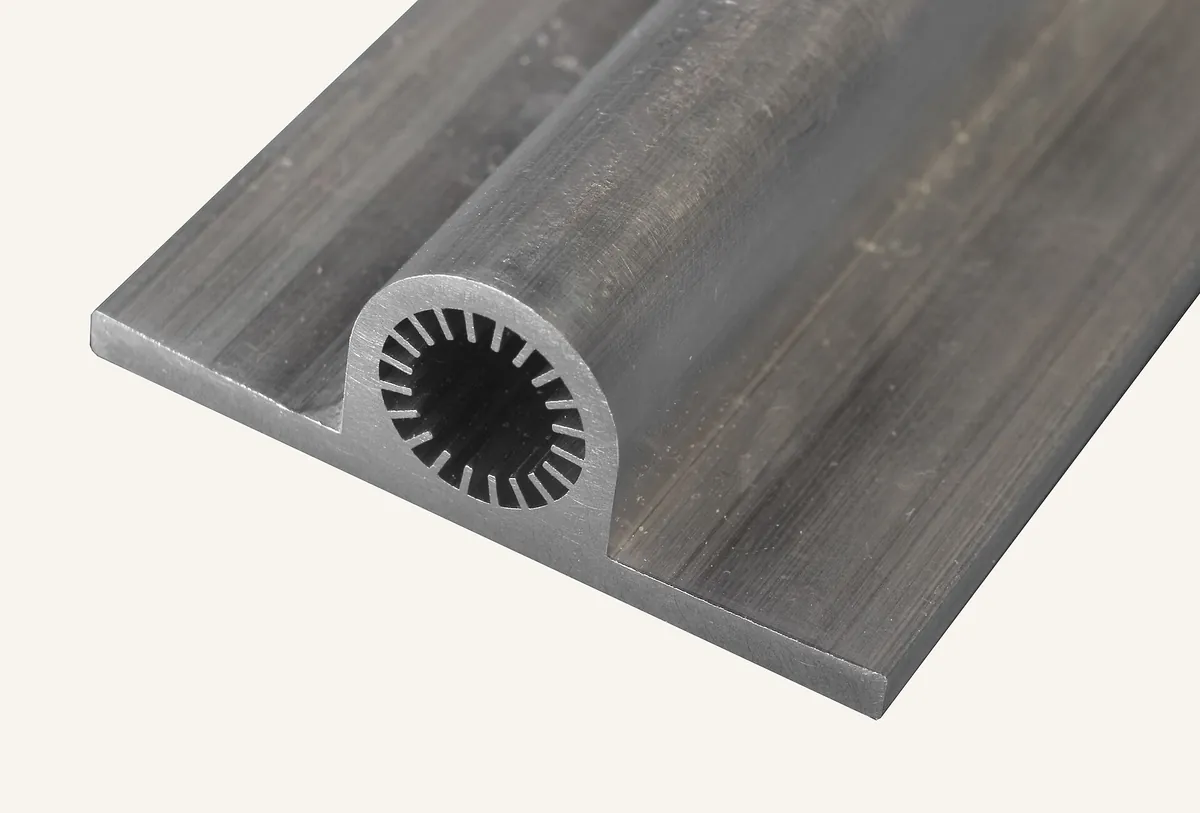
Conventional microchannel (multi-port) tube for air-conditioning condensers is typically 12 – 50 mm wide and 1 – 3 mm high, with walls of a few tenths of a millimetre. Ultra-wide microchannel tubes keep the same principle, a flat hollow profile divided into many small parallel channels, but scale the width up to cover a battery module, cold plate or panel in one piece.
The channels give a very large wetted surface for the coolant, while the flat outer faces sit directly against battery cells, power semiconductors or fins. Because the part is extruded in one piece, the channels, ribs and mounting features are all integral, and there is no weld along the length that could leak or distort.
Producing these sections is demanding. The die has to feed metal evenly into dozens of thin webs across a wide section, and the press must deliver enough force through a container large enough for the width. Flat (oval) containers help, because they allow a wider profile from a given press size than a round container. Wide thin-wall extrusions therefore have a narrower process window than ordinary profiles, and die design is the key to flatness and wall consistency.
| Parameter | What it controls | Design guidance |
|---|---|---|
| Overall width | Coverage of the module or plate; press and container capacity | Confirm the width early; very wide sections may need a larger press or a two-piece design |
| Overall height | Coolant cross-section and stiffness | Thin plates (about 2 – 10 mm) for cooling; taller sections (30 – 70 mm) for tray floors with integral cooling |
| Outer wall thickness | Pressure capacity, corrosion allowance, flatness | Thinner walls save weight but need tighter process control and corrosion protection |
| Internal web thickness and pitch | Hydraulic diameter, pressure drop, burst strength | Uniform webs help even metal flow; avoid very thin webs next to thick features |
| Channel shape | Heat-transfer coefficient and pressure drop | Rectangular channels are common; small fins or ribs inside channels add surface area |
| End features | Connection to manifolds or headers | Plan end flattening, machining or header slots in the drawing |
A typical example: a cooling plate around 500 mm wide and 10 mm high with walls of 1 – 2 mm might replace two friction-welded halves. Removing the centre weld removes the lapped lands on either side of it, which typically saves several per cent of the weight per metre and gives a continuous flat face. The exact saving depends on wall thickness and channel layout, so it should be calculated from the actual section drawing.
| Alloy and temper | Main property | Typical use |
|---|---|---|
| 3003 (O, H112) | Good extrudability, corrosion resistance and brazeability | Brazed cooling plates, condensers, energy-storage cold plates |
| 3102 | Very extrudable, good thermal conductivity, brazeable | Thin-wall multi-port tubes for HVAC and heat exchangers |
| 1100 / 1060 / 1070 | Highest thermal and electrical conductivity, soft | Heat-transfer-critical channels with low pressure |
| 6063 (T5, T6) | Excellent extrudability, good surface, moderate strength | Battery cooling plates, floor profiles, cover plates |
| 6061 (T6) | Higher strength, machinable, weldable | Structural tray bases and load-bearing cooling plates |
| 6005A / 6082 (T6) | Higher strength with good extrudability (6005A) or highest 6xxx strength (6082) | Crash and load paths, tray side and floor sections |
Two families serve two purposes. 3xxx and 1xxx alloys are used where the part will be furnace-brazed, because their melting range sits safely above Al-Si filler and they resist corrosion in coolant. 6xxx alloys are chosen where the tube must also carry structural load, and are usually joined by friction-stir welding, MIG, adhesive or mechanical fastening rather than brazing. Chemistry follows EN 573-3 and Aluminum Association limits; mechanical properties follow EN 755-2 or ASTM B221.
For cooling plates, flatness and twist over the length often matter more than the nominal wall thickness, because they control thermal contact with the cells or the gap filler thickness. Specify flatness across the width and along the length, wall tolerance, and any surface requirements on contact faces. Standard profile tolerances are usually too loose for wide cooling plates, so critical tolerances should be written on the drawing and agreed with the extruder before die making.
A flux-containing coating applied to the tube before brazing, so separate fluxing of the assembly is reduced or eliminated and joint filling is more consistent.
A mix of silicon powder and non-corrosive fluoroaluminate flux that forms its own filler metal during controlled-atmosphere brazing, letting unclad fins be brazed to the tube.
A thin zinc layer sprayed on the outside of tube in line with extrusion. On brazing, zinc diffuses into the surface and forms a sacrificial layer that protects the tube walls from pitting.
A uniform paint film for corrosion protection and electrical insulation on structural or non-brazed parts; also a primer for further coating or bonding.
Dielectric layers on battery-contact faces where cells must be electrically isolated from the cooling plate.
For parts that will be cleaned, bonded or coated by the customer after machining.
Coatings change the process window downstream. Zinc arc spray, for example, must be matched to the brazing cycle so that enough zinc diffuses into the surface without migrating too deep, and flux-coated tube must be stored dry and handled cleanly so the coating stays intact until it reaches the furnace. Tell us the brazing method, furnace profile and coolant early, so the coating weight and type can be specified correctly.
Selection rule: choose pre-flux or Si-flux for brazed assemblies, zinc arc spray where coolant-side or external corrosion is a risk, and E-coat or insulating films where electrical isolation and appearance matter.
Wide 6063 or 3003 multi-port plates placed under or between modules, carrying glycol coolant close to the cells.
Taller 6061 or 6063 sections that combine the structural floor of the tray with integral coolant channels.
Liquid-cooled cold plates for stationary battery racks and containerised storage.
Wider multi-port tubes for compact, high-capacity heat exchangers and refrigerated transport units.
Cold plates for inverters, telecom base stations and data-centre equipment.
Absorber plates and thermal panels where a flat face and parallel channels are needed.
Metline supplies the extruded tube and profile, cut and processed to drawing; the battery pack, heat exchanger or cold-plate assembly is completed by the customer or their fabricator.
| Criterion | Wide extruded multi-port | Folded (roll-formed) tube | Two-piece welded plate |
|---|---|---|---|
| Construction | One-piece extrusion | Clad strip folded and brazed | Two extrusions or stampings joined by FSW or brazing |
| Wall and web uniformity | Very good once the die is proven | Good; thinnest walls possible | Depends on both halves and weld |
| Leak paths | None along the length | Brazed seam | Full-length weld or braze joint |
| Width range | Limited by press and die | Limited by strip and forming line | Very wide possible |
| Tooling | Extrusion die | Roll-forming tooling | Dies plus welding fixtures |
| Best for | Battery cooling plates, large multi-port tubes | High-volume HVAC tubes | Very large or complex plates |
Our insight article on folded vs extruded microchannel tube compares the two tube routes in more depth.
It is a flat aluminium profile that is very wide relative to its wall thickness, for example several hundred millimetres wide with walls of one to a few millimetres, usually with many internal channels. Such sections need careful die design and suitable press capacity.
Yes, but the minimum radius depends on the section height, web layout and temper. Tight bends can collapse or crack internal webs, so the bend radius should be proven on samples of the actual profile.
6063-T5/T6 is common for extruded cooling plates joined by welding or bonding; 3003 is preferred when the plate is furnace-brazed to headers. 6061 or 6005A is used where the plate also carries structural load.
It is the cross-sectional area of the billet divided by that of the profile. Wide thin-wall sections have high ratios, which demand more press force and careful die design to keep walls uniform and the profile flat.
An EN 10204 3.1 material certificate with chemistry and mechanical properties, dimensional and flatness reports, and leak or pressure test records where specified on the drawing.
No. Metline supplies the aluminium tubes and profiles, cut to length and processed to drawing (end preparation, coating). Assembly into finished cooling plates, trays or heat exchangers is done by the customer.
Send your section drawing or target dimensions, alloy and volume. Our team will review manufacturability and quote profiles for delivery worldwide.






