Radiant heat
A clean foil face has an emittance of about 0.03 – 0.05, reflecting roughly 95 % of radiant heat across an adjacent air space.



1100 roofing foil is soft, O-temper commercially pure aluminium, usually 14 – 30 µm thick, that is laminated to kraft, scrim, woven film or bubble film to make reflective roof insulation and vapour control layers. Its copper-bearing 99.0 % aluminium chemistry gives slightly more strength than 1050 while staying soft enough to laminate and fold without cracking. This guide focuses on specifying 1100 foil for insulation facings.
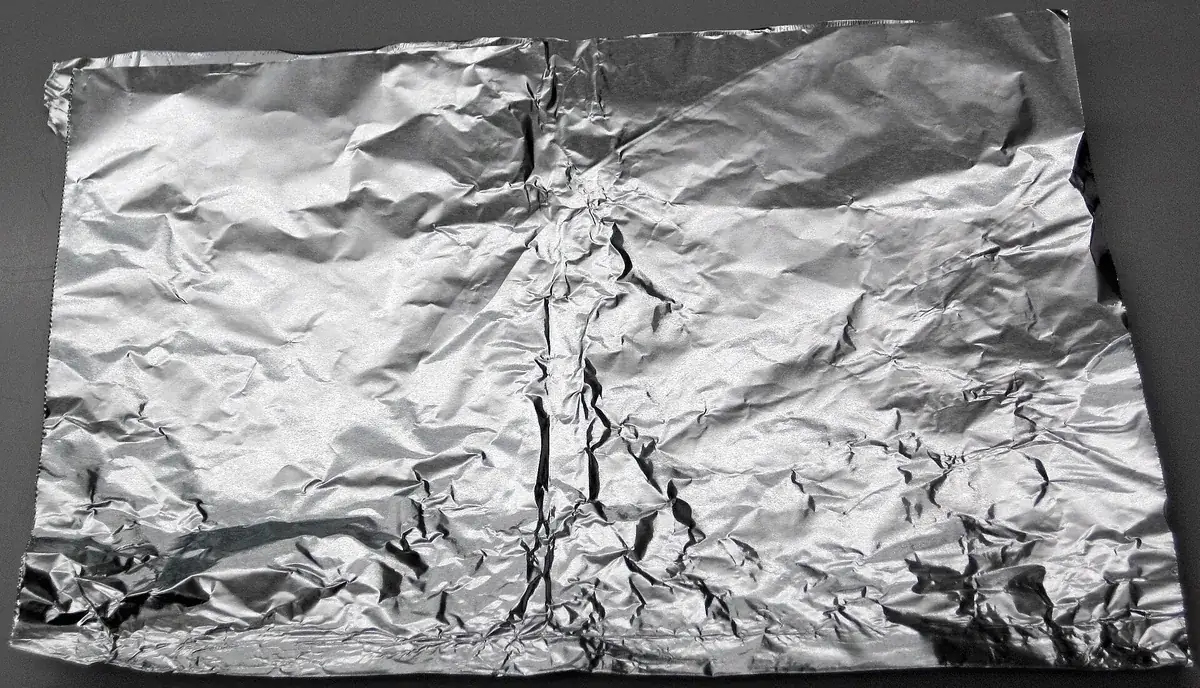
In reflective roof insulation, the foil is a thin functional skin: it gives the product a low-emittance surface to reflect radiant heat and a near-perfect barrier to water vapour. The backing material (kraft paper, glass scrim, woven polyethylene, bubble film or foam) carries the mechanical load.
1100 suits this job because it is soft and ductile in O temper, so it laminates flat, wraps around ducts and folds at seams without cracking, and because its small copper content (0.05 – 0.20 %) adds a little strength and tear resistance over higher-purity grades. It is a familiar grade in North American specifications and is widely available in the thin gauges laminators need.
Compared with the colour-coated, heavier roofing foils covered in our 1050 roofing foil guide, 1100 insulation foil is thinner, usually bare or lightly lacquered, and is rarely exposed to weather; it lives inside the roof build-up.
Foil weight is about 2.71 g/m² per micron: 18 µm weighs about 49 g/m² and 25 µm about 68 g/m².
| Element | Limit % |
|---|---|
| Si + Fe | ≤ 0.95 |
| Cu | 0.05 – 0.20 |
| Mn | ≤ 0.05 |
| Zn | ≤ 0.10 |
| Others, each / total | ≤ 0.05 / 0.15 |
| Al | ≥ 99.00 |
| Temper | Tensile (approx.) | Elongation (approx.) |
|---|---|---|
| O | 75 – 110 MPa | 2 – 6 % at 14 – 30 µm |
| H24 | 120 – 145 MPa | ≈ 2 – 4 % |
| H26 | 135 – 160 MPa | ≈ 1 – 3 % |
Composition per the Aluminum Association registration. Foil properties are indicative: elongation in very thin foil is much lower than in sheet and rises with gauge. Bulk 1100-O sheet typically reaches 90 MPa tensile and about 35 % elongation.
Two properties matter more than tensile strength for insulation: the pinhole count, which rises sharply below about 20 µm and affects vapour resistance, and surface cleanliness, which decides how well adhesives bond. Specify both on the order.
A clean foil face has an emittance of about 0.03 – 0.05, reflecting roughly 95 % of radiant heat across an adjacent air space.
Pinhole-free foil has essentially zero vapour permeance. In the laminate, joints and tears decide real performance, so seal laps with foil tape.
Bare foil is unaffected by UV; lacquers and adhesives in the laminate set the temperature and UV limits.
Aluminium itself does not burn; the laminate's fire classification depends on the backing and adhesive and is tested on the finished product.
1100 is 99.0 % aluminium with 0.05 – 0.20 % copper, giving a little more strength; 1050 is 99.5 % aluminium with tighter impurity limits. Both reflect heat equally well when clean.
Soft foil laminates flat, conforms to backings and folds at edges and seams without cracking. Hard foil is stiffer but more likely to crack when creased.
Most laminators use 14 – 25 µm. Thicker foil has fewer pinholes and better tear resistance; thinner foil costs less but needs a strong backing.
Not always. A thin primer improves adhesive bonding and protects the foil from alkaline or moist environments, but heavy coloured lacquers raise emittance, so keep the radiant face bare or low-e coated.
Yes. Ask Metline for samples in your gauge and width so you can run laminating trials before placing a production order.
Send the gauge, width, temper, core and roll size and quantity. We will confirm availability and a delivered price.






