


8011 Aluminium Foil for Roof Insulation
8011 roofing foil is an iron-silicon aluminium alloy foil, usually 14 – 30 µm thick in soft O temper, laminated to kraft, scrim, woven polyethylene, bubble film or foam to make reflective roof insulation and vapour control layers. Its main advantage over pure 1xxx foil is higher strength and tear resistance at the same gauge, which helps laminators run thin foil at speed with fewer breaks and pinholes. This guide covers bare and coated 8011 roofing foil, specifications, performance and selection.
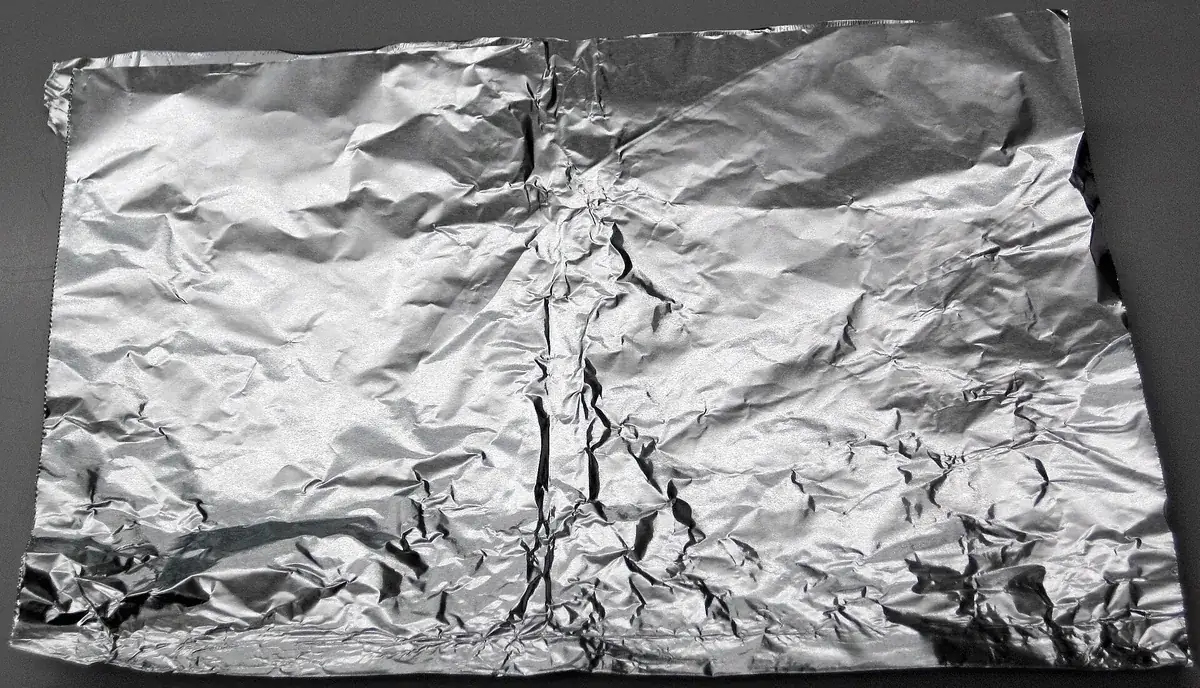
- Alloy
- 8011 / EN AW-8011A
- Temper
- O (soft)
- Bare foil gauge
- 0.014 – 0.03 mm
- Bright-face emittance
- ≈ 0.03 – 0.05
What 8011 roofing foil does
Under a sun-heated roof, most of the heat that reaches the ceiling travels as long-wave infrared radiation across the air gap below the roof covering. A bright aluminium surface emits and absorbs very little of that radiation, so a foil layer facing the gap can cut summer heat gain sharply.
A clean, bare aluminium foil has a thermal emittance of roughly 0.03 – 0.05, meaning it reflects about 95 % of incident radiant heat. ASTM C1313 classes a sheet material as a radiant barrier only if at least one face has an emittance of 0.1 or less, which only bright metal achieves. The foil is also an almost perfect barrier to water vapour, so a well-sealed foil-faced layer doubles as a vapour control layer.
Several alloys are used for roofing foil. 1050, 1100, 1200 and 1235 are high-purity grades with excellent ductility and brightness. 8011 adds about 0.6 – 1.0 % iron and 0.5 – 0.9 % silicon, which raises strength and gives a finer grain. For a laminator, that means thin foil that tears less easily on the line and stands up better to handling on site, while the reflectivity of the bright face is the same.
Bare and coated 8011 roofing foil
Bare 8011 foil
Typical specification
- Temper
- O (fully annealed)
- Thickness
- 0.014 – 0.03 mm (14 – 30 µm)
- Width
- About 20 – 1600 mm, slit to the laminator's line
- Surface
- One side bright, one side matt, or both sides bright; clean and dry-annealed for bonding
- Core
- 76 mm or 152 mm ID steel or aluminium core
Used for radiant barriers, foil-scrim-kraft (FSK) and foil-faced bubble or foam insulation where the foil is protected inside the roof. Uncoated foil should not be left exposed to weather, masonry alkalis or wet timber.
Coated 8011 foil
Typical specification
- Thickness
- 0.015 – 0.2 mm
- Width
- About 20 – 1600 mm
- Coating
- Lacquer, polyester (PE) or PE film, one or both sides, typically 1 – 10 µm
- Colours
- Clear, gold, silver, white, grey, black, red, blue, copper, wood effect or to sample
- Purpose
- Corrosion protection, bond primer, colour and print
A thin clear lacquer protects the foil and keeps emittance low. Heavier coloured coatings improve weathering and appearance but raise emittance, so a coloured face should not be counted as a radiant barrier surface.
8011 foil composition and properties
| Element | Si | Fe | Cu | Mn | Mg | Zn | Ti | Al |
|---|---|---|---|---|---|---|---|---|
| wt % | 0.50 – 0.90 | 0.60 – 1.00 | ≤ 0.10 | ≤ 0.20 | ≤ 0.05 | ≤ 0.10 | ≤ 0.08 | Remainder |
| Property (O temper) | Typical value | Why it matters on a roof |
|---|---|---|
| Tensile strength | Higher than 1xxx foil of the same gauge; limits by gauge in EN 546-2 | Resists tearing during laminating and installation |
| Elongation | Rises with gauge; minimums by gauge in EN 546-2 | Lets the laminate flex over battens and purlins without cracking |
| Thermal emittance (bright face) | ≈ 0.03 – 0.05 | Sets radiant barrier performance |
| Water vapour transmission | Effectively zero for pinhole-free foil | Vapour control in roofs and walls |
| Density | 2.71 g/cm³ | A 25 µm foil weighs about 68 g/m² |
Mechanical values depend on gauge and are specified in EN 546-2; the figures reported on the mill certificate govern.
How to choose 8011 roofing foil
| Decision | Guidance |
|---|---|
| Gauge | Around 20 – 25 µm (about 0.0008 – 0.001 in) is a common balance of cost, pinhole count and handling. Thinner foil relies more on its backing for strength. |
| Width | Slit to suit the laminating line and the finished roll width, so fewer side laps are needed on the roof. |
| Surface | Specify which face is bright if the laminate has one reflective face. Ask for a dyne level or wettability test if you bond with water-based adhesives. |
| Coating | Bare for protected cavities; clear lacquer where moisture or alkalis are possible; coloured coating only where appearance matters. |
| Texture | Smooth foil gives the lowest emittance; embossed or pleated foil hides creases and lies better on uneven decks. |
| Pinholes | Agree a pinhole limit for thin gauges when the layer must act as a vapour barrier. |
Where 8011 roofing foil is used
- Roof underlay: foil laminated to woven PE or kraft, laid under tiles, sheeting or timber as a radiant and vapour barrier
- Foil-faced bulk insulation: facings on glass wool, mineral wool, PIR and phenolic boards
- Metal building insulation: foil-bubble or foil-foam blankets under steel and aluminium roof sheets to cut heat gain and condensation
- Attic radiant barriers: stapled to rafters or laid over joists in warm climates
- Single-ply and membrane roofs: vapour control layers below TPO, PVC or EPDM systems
- Retrofit: upgrading older roofs in hot climates where cooling load dominates
Installation basics: fit foil to a dry deck, keep the bright face towards a ventilated or unventilated air gap, tape every lap with foil tape, and avoid crushing the gap with insulation or battens laid directly on the foil.
Tolerances, inspection and packing
Typical delivery requirements
- Thickness tolerance
- Per EN 546-3 or ASTM B479, commonly about ±8 – 10 % of nominal for thin foil
- Width tolerance
- About ±0.5 – 1 mm on slit rolls
- Surface
- Free of oil stains, corrosion, creases, holes and streaks that affect bonding or appearance
- Wettability
- Brush or dyne test on request for laminating grades
- Certification
- Mill test certificate (EN 10204 3.1) with chemistry and mechanical results
- Packing
- Rolls wrapped in moisture barrier film with desiccant, in wooden cases or on pallets, eye-to-sky or eye-to-wall
References and standards
- ASTM B479 – Standard Specification for Annealed Aluminum and Aluminum Alloy Foil for Flexible Barrier, Food Contact and Other Applications
- ASTM C1313 – Standard Specification for Sheet Radiant Barriers for Building Construction Applications
- EN 546-2 / EN 546-3 – Aluminium and aluminium alloys: foil, mechanical properties and tolerances
- EN 573-3 – Chemical composition and form of wrought products
- The Aluminum Association – International Alloy Designations and Chemical Composition Limits
8011 roofing foil: frequently asked questions
Why use 8011 instead of 1235 or 1100 foil on roofs?
All give the same bright-face reflectivity. 8011 is stronger at the same gauge because of its iron and silicon content, so it tears less during laminating and installation. High-purity foils are softer and may be preferred where deep embossing or maximum ductility matters.
What thickness of foil is used for roof insulation?
Bare foil for laminated facings is usually 14 – 30 µm. Self-supporting or coated weathering foils are thicker, around 0.05 – 0.2 mm.
Does colour-coated foil still reflect heat?
A coloured paint layer raises emittance well above that of bare metal, so it no longer works as a radiant barrier face. Keep a bare or clear-lacquered face towards the air gap if radiant performance is the aim.
Is aluminum roofing foil a vapour barrier?
Pinhole-free foil is practically impermeable to water vapour. In practice the vapour resistance of the installed layer depends on taping laps and penetrations properly.
Which standards cover 8011 roofing foil?
Foil properties are covered by ASTM B479 and EN 546; radiant barrier products are tested to ASTM C1313 and emittance methods such as ASTM C1371. RoHS declarations are available on request.
Need 8011 foil for roofing laminates?
Tell us the gauge, width, surface and coating you need. Our team will reply with a specification and delivered price.






