Standard hexagonal
Regular hexagon cells, the most efficient shape for flat panels and the basis for published data.



5052 aluminium honeycomb core is a hexagonal cellular material made from hard-temper 5052 foil, bonded at the nodes and expanded, that gives sandwich panels very high stiffness and strength for their weight. It is the general-purpose grade for aerospace, rail, marine and industrial panels: stronger and more corrosion-resistant than 3003 core, and more economical than 5056. Densities run from about 1.6 to 12 lb/ft³ (26 – 190 kg/m³) depending on cell size and foil gauge. This guide gives the property data, explains how to select a core and lists what to specify.
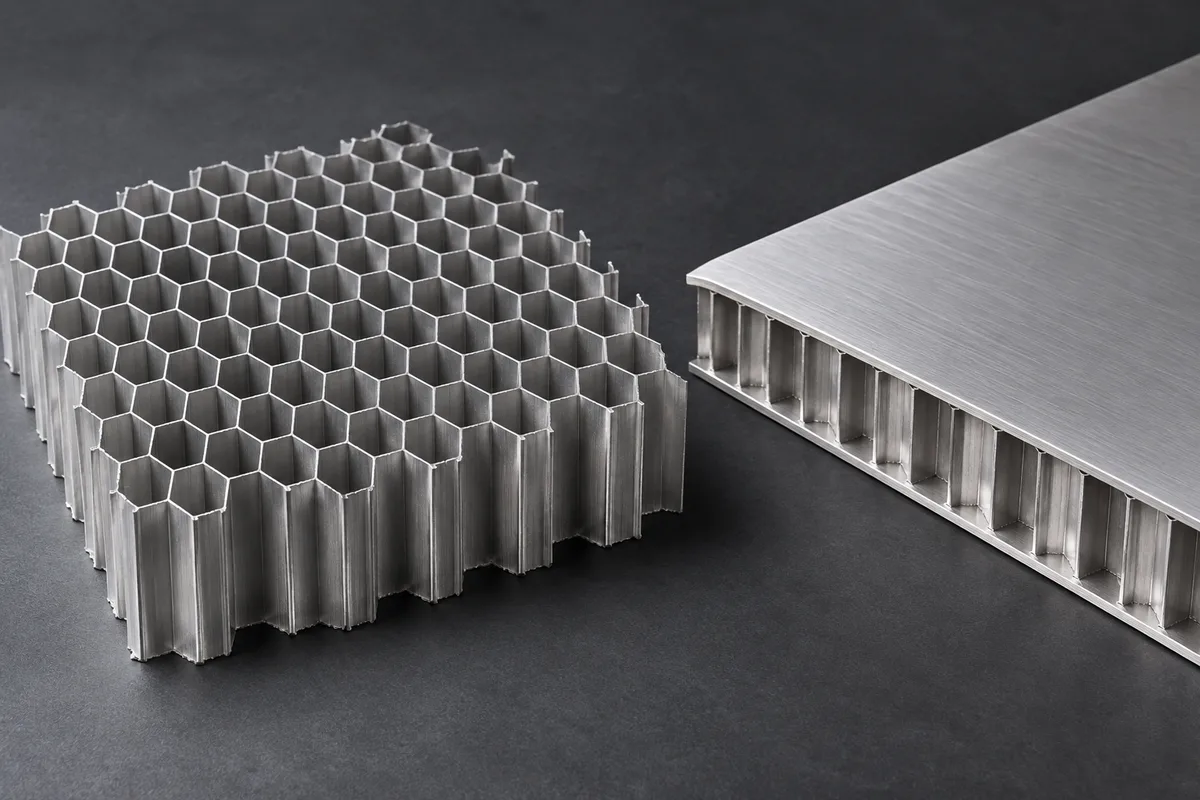
A honeycomb sandwich panel works like an I-beam spread over an area. Two thin, stiff facings carry bending loads as tension and compression, and the lightweight core between them holds the facings apart and carries shear. Doubling the core thickness roughly quadruples panel stiffness for only a small weight increase, which is why honeycomb panels are used wherever stiffness per kilogram matters.
Most aluminium honeycomb is made by the expansion process. Thin 5052 foil, typically 0.0007 – 0.004 in (18 – 100 µm) thick, is printed with parallel lines of adhesive, stacked sheet on sheet with the lines offset by half a pitch, and cured under heat and pressure into a solid block. Slices are cut from this block to the required core thickness, then pulled apart so the unbonded areas open into hexagonal cells. The bonded lines become the double-thickness cell walls, called nodes.
For very high densities and thick foils, the corrugation process is used instead: foil is corrugated into half-hexagons, stacked and bonded or brazed. Either way the result has clear directional properties, and knowing the directions is essential before you design with it.
Aluminium honeycomb is described by four parameters, usually written in this order: alloy, cell size, foil gauge and density, for example 5052 – 1/4 – .0015 – 3.4. That means 5052 foil, 1/4 in cell measured across the flats of the hexagon, 0.0015 in foil, and a nominal density of 3.4 lb/ft³. Coating, perforation and whether the core is supplied expanded or unexpanded are added as separate callouts.
| Parameter | What it means | Effect on performance |
|---|---|---|
| Cell size | Distance across the flats of a hexagonal cell (1/8, 5/32, 3/16, 1/4, 3/8 in common) | Smaller cells support thin facings better and resist face dimpling; larger cells save weight |
| Foil gauge | Foil thickness, typically 0.0007 – 0.004 in | Thicker foil raises density and all strengths |
| Density | Mass of core per unit volume, lb/ft³ (pcf) or kg/m³ | The best single predictor of strength and stiffness |
| Thickness (T) | Slice thickness, from a few millimetres to over 500 mm | Panel stiffness rises with the square of facing separation |
| Coating | Corrosion-resistant conversion coating or phosphoric-acid anodise with primer | Required for most aerospace and marine work; improves bond durability |
| Perforation | Small holes in cell walls | Vents air and volatiles during bonding and in vacuum or space use |
Density follows the ratio of foil thickness to cell size: for the same cell, doubling foil gauge roughly doubles density, and for the same foil, halving cell size roughly doubles it. Strength rises faster than density, roughly with density to the power 1.5 – 1.7 for compression, so a modest increase in density buys a significant gain in strength.
The table lists typical values for coated 5052 hexagonal core at room temperature, as published by honeycomb producers that meet AMS-C-7438. Stabilised compression is measured with facings bonded on (ASTM C365); crush strength is the steady load during progressive crushing, used for energy absorbers; shear is measured by plate shear (ASTM C273) in each direction.
| Density – cell – foil (pcf – in – in) | Stabilised compressive (psi) | Compressive at 350 °F (psi) | Crush (psi) | Shear L (psi) | Shear W (psi) | Shear modulus L (ksi) | Shear modulus W (ksi) |
|---|---|---|---|---|---|---|---|
| 3.1 – 1/8 – .0007 | 305 | 200 | 145 | 215 | 132 | 32 | 16 |
| 4.5 – 1/8 – .0010 | 580 | 380 | 270 | 345 | 225 | 51 | 25 |
| 6.1 – 1/8 – .0015 | 1030 | 660 | 450 | 565 | 345 | 77 | 37 |
| 8.1 – 1/8 – .0020 | 1575 | 1075 | 760 | 810 | 540 | 112 | 50 |
| 10.0 – 1/8 – .0025 | 1875 | 1300 | 1070 | 1075 | 610 | 140 | 60 |
| 2.6 – 5/32 – .0007 | 245 | 150 | 105 | 170 | 102 | 24 | 12 |
| 3.8 – 5/32 – .0010 | 415 | 280 | 210 | 275 | 168 | 41 | 20 |
| 2.0 – 3/16 – .0007 | 180 | 100 | 70 | 122 | 71 | 17 | 9 |
| 3.1 – 3/16 – .0010 | 340 | 200 | 145 | 215 | 128 | 32 | 16 |
| 4.4 – 3/16 – .0015 | 555 | 375 | 270 | 335 | 220 | 50 | 24 |
| 5.7 – 3/16 – .0020 | 870 | 600 | 410 | 465 | 305 | 70 | 34 |
| 6.9 – 3/16 – .0025 | 1185 | 780 | 570 | 600 | 380 | 91 | 42 |
| 8.1 – 3/16 – .0030 | 1735 | 1075 | 760 | 735 | 490 | 112 | 50 |
| 2.3 – 1/4 – .0010 | 215 | 125 | 85 | 145 | 88 | 21 | 11 |
| 3.4 – 1/4 – .0015 | 375 | 235 | 160 | 235 | 145 | 35 | 18 |
| 4.3 – 1/4 – .0020 | 545 | 365 | 250 | 325 | 205 | 48 | 24 |
| 5.2 – 1/4 – .0025 | 770 | 500 | 330 | 415 | 270 | 62 | 31 |
| 6.0 – 1/4 – .0030 | 1110 | 650 | 430 | 535 | 350 | 75 | 36 |
| 7.9 – 1/4 – .0040 | 1505 | 1025 | 720 | 710 | 450 | 108 | 49 |
| 1.6 – 3/8 – .0010 | 98 | 70 | 50 | 88 | 51 | 13 | 6 |
| 2.3 – 3/8 – .0015 | 205 | 125 | 85 | 145 | 88 | 21 | 11 |
| 3.0 – 3/8 – .0020 | 315 | 190 | 135 | 205 | 128 | 30 | 15 |
| 4.2 – 3/8 – .0030 | 565 | 340 | 240 | 315 | 205 | 47 | 23 |
| 5.4 – 3/8 – .0040 | 810 | 540 | 360 | 435 | 285 | 66 | 32 |
The same data in SI units:
| Density – cell – foil | Stabilised compressive (MPa) | Crush (MPa) | Shear L (MPa) | Shear W (MPa) | Shear modulus L (MPa) | Shear modulus W (MPa) |
|---|---|---|---|---|---|---|
| 50 kg/m³ – 3.2 mm – 0.018 mm | 2.10 | 1.00 | 1.48 | 0.91 | 221 | 110 |
| 72 kg/m³ – 3.2 mm – 0.025 mm | 4.00 | 1.86 | 2.38 | 1.55 | 352 | 172 |
| 98 kg/m³ – 3.2 mm – 0.038 mm | 7.10 | 3.10 | 3.90 | 2.38 | 531 | 255 |
| 130 kg/m³ – 3.2 mm – 0.051 mm | 10.86 | 5.24 | 5.58 | 3.72 | 772 | 345 |
| 160 kg/m³ – 3.2 mm – 0.064 mm | 12.93 | 7.38 | 7.41 | 4.21 | 965 | 414 |
| 42 kg/m³ – 4.0 mm – 0.018 mm | 1.69 | 0.72 | 1.17 | 0.70 | 165 | 83 |
| 61 kg/m³ – 4.0 mm – 0.025 mm | 2.86 | 1.45 | 1.90 | 1.16 | 283 | 138 |
| 32 kg/m³ – 4.8 mm – 0.018 mm | 1.24 | 0.48 | 0.84 | 0.49 | 117 | 62 |
| 50 kg/m³ – 4.8 mm – 0.025 mm | 2.34 | 1.00 | 1.48 | 0.88 | 221 | 110 |
| 70 kg/m³ – 4.8 mm – 0.038 mm | 3.83 | 1.86 | 2.31 | 1.52 | 345 | 165 |
| 91 kg/m³ – 4.8 mm – 0.051 mm | 6.00 | 2.83 | 3.21 | 2.10 | 483 | 234 |
| 111 kg/m³ – 4.8 mm – 0.064 mm | 8.17 | 3.93 | 4.14 | 2.62 | 627 | 290 |
| 130 kg/m³ – 4.8 mm – 0.076 mm | 11.96 | 5.24 | 5.07 | 3.38 | 772 | 345 |
| 37 kg/m³ – 6.4 mm – 0.025 mm | 1.48 | 0.59 | 1.00 | 0.61 | 145 | 76 |
| 54 kg/m³ – 6.4 mm – 0.038 mm | 2.59 | 1.10 | 1.62 | 1.00 | 241 | 124 |
| 69 kg/m³ – 6.4 mm – 0.051 mm | 3.76 | 1.72 | 2.24 | 1.41 | 331 | 165 |
| 83 kg/m³ – 6.4 mm – 0.064 mm | 5.31 | 2.28 | 2.86 | 1.86 | 427 | 214 |
| 96 kg/m³ – 6.4 mm – 0.076 mm | 7.65 | 2.96 | 3.69 | 2.41 | 517 | 248 |
| 127 kg/m³ – 6.4 mm – 0.102 mm | 10.38 | 4.96 | 4.90 | 3.10 | 745 | 338 |
| 26 kg/m³ – 9.5 mm – 0.025 mm | 0.68 | 0.34 | 0.61 | 0.35 | 90 | 41 |
| 37 kg/m³ – 9.5 mm – 0.038 mm | 1.41 | 0.59 | 1.00 | 0.61 | 145 | 76 |
| 48 kg/m³ – 9.5 mm – 0.051 mm | 2.17 | 0.93 | 1.41 | 0.88 | 207 | 103 |
| 67 kg/m³ – 9.5 mm – 0.076 mm | 3.90 | 1.65 | 2.17 | 1.41 | 324 | 159 |
| 86 kg/m³ – 9.5 mm – 0.102 mm | 5.58 | 2.48 | 3.00 | 1.97 | 455 | 221 |
Typical values, not design minimums. Design allowables are normally taken as a percentage of typical (often about 75 % for minimum individual values) or from qualification testing. Densities are nominal, usually with a ±10 % tolerance.
At 350 °F (177 °C), 5052 core keeps roughly two-thirds of its room-temperature compressive and shear strength. The adhesive used at the nodes and the facing adhesive usually limit service temperature more than the foil does, so check both when panels run hot.
| Dimension | Standard | Maximum (typical) | Typical tolerance |
|---|---|---|---|
| Ribbon length (L) | 48 in (1219 mm) | about 100 in (2540 mm) | +2.0 / −0 in (+51 / −0 mm) |
| Transverse width (W, expanded) | 96 in (2438 mm) | about 144 in (3658 mm) | +4.0 / −0 in (+102 / −0 mm) |
| Slice thickness (T) up to 4 in (102 mm) | any, to order | — | ±0.005 in (±0.13 mm) |
| Slice thickness over 4 in | any, to order | blocks about 35 in (890 mm) | ±0.062 in (±1.6 mm) |
| Density | nominal by geometry | — | ±10 % |
| Cell size | nominal | — | ±10 % |
Common panel formats include 48 × 96 in, 48 × 120 in, 48 × 144 in and 60 × 120 in, and metric 1220 × 2440, 1220 × 3050 and 1524 × 3050 mm. Cores can be supplied as unexpanded block slices (very compact to ship, expanded by the user on a stretching frame), as expanded sheets, or cut to finished size and profile for direct lay-up.
Regular hexagon cells, the most efficient shape for flat panels and the basis for published data.
Cells stretched in W into a rectangular shape. Easier to bend around the L axis for single-curvature parts, with higher W shear and lower L shear.
Modified cell shapes that drape onto compound curves without anticlastic bending; used for fairings and radomes.
Extra foil layers in the L direction for local high shear, such as around inserts and hinge lines.
Micro-perforated cell walls let air escape during autoclave or vacuum bonding and in space structures.
Cells under about 1/16 in (1.6 mm) for very thin facings, precision parts and high-density energy absorbers.
Core with a pre-initiated crush front to avoid the peak load at the start of crushing; used in crash attenuators and landing systems.
Slices of 150 mm and more, or bonded stacks, for impact pads and large stiff platforms.
Core heat-formed or machined to a contour so it fits curved moulds without stress.
5052 is one of the more corrosion-resistant aluminium alloys, but a honeycomb core has enormous surface area and foils only a few hundredths of a millimetre thick, so even light pitting can consume a cell wall. For this reason aerospace and marine cores use treated foil. Common options are chromate or chromate-free conversion coatings, and phosphoric-acid anodising followed by a corrosion-inhibiting primer, which also gives the most durable adhesive bond.
AMS-C-7438 sets salt-fog limits for coated core, measured as weight loss after exposure in ASTM B117 salt spray. Producers publish results well inside the limit for their coated grades. Uncoated (bare) core is acceptable for dry interior use and many industrial panels, and costs less.
| Point | 3003 aluminium | 5052 aluminium | 5056 aluminium | Aramid (meta-aramid paper) |
|---|---|---|---|---|
| Relative strength at equal density | Lowest | Baseline | Higher than 5052 | Lower stiffness, good toughness |
| Corrosion resistance | Good | Very good | Excellent | Not applicable (non-metallic) |
| Aerospace specification | Commercial grades | AMS-C-7438 | AMS-C-7438 | Producer and programme specifications |
| Electrical behaviour | Conductive | Conductive | Conductive | Dielectric, radar-transparent |
| Thermal conductivity | High | High | High | Low (insulating) |
| Damage behaviour | Dents permanently | Dents permanently | Dents permanently | Recovers from minor impacts |
| Relative cost | Low | Medium | Higher | Higher |
| Typical use | Doors, partitions, signage, facades | General aerospace, rail, marine, industrial | Highest-load aerospace structures | Radomes, interiors, impact-prone parts |
In short: 3003 is the economical choice for building and commercial panels; 5052 covers most structural needs; 5056 is chosen when the last increment of strength matters; aramid when radar transparency, insulation or damage tolerance is needed. See our 3003 vs 5052 comparison and aluminium vs aramid core articles for detail.
| Density band | Typical geometries | Typical use |
|---|---|---|
| Low, about 1.6 – 3.1 pcf (26 – 50 kg/m³) | 3/8 – .0010, 1/4 – .0010, 3/16 – .0007 | Interior panels, partitions, large lightly loaded panels |
| Medium, about 3.1 – 6 pcf (50 – 96 kg/m³) | 1/8 – .0007, 3/16 – .0015, 1/4 – .0020 | Floors, structural panels, rail and marine decks |
| High, over 6 pcf (over 96 kg/m³) | 1/8 – .0015, 1/8 – .0020, 3/16 – .0025 | Heavily loaded floors, insert zones, energy absorbers |
Slice with a band saw or reciprocating knife; profile on CNC with ultrasonic or rotary honeycomb cutters. Holding core on a vacuum table or freezing it with a temporary filler gives clean edges.
Unexpanded slices are stretched evenly on a frame to nominal cell size. Over-stretching changes density and properties, so check cell count per length after expansion.
Bend around the L axis, preferably with over-expanded core; compound curves need flexible-geometry core or pre-formed parts.
Film adhesives with good fillet-forming are standard for aerospace; epoxy or polyurethane for industrial panels. Clean, dry, treated core gives the best bond.
Threaded inserts are potted into the core with a filled epoxy compound. Use higher-density or reinforced core in insert zones; close out edges with extrusions or edge fill.
Join core pieces with expanding foam adhesive along the splice line, keeping L directions aligned.
Our article on honeycomb core joining methods discusses splicing, edge closures and their effect on panel strength.
| Test | Standard | What it measures |
|---|---|---|
| Core density | ASTM C271 | Mass per unit volume |
| Flatwise compression (stabilised) | ASTM C365 | Compressive strength and modulus of the core |
| Plate shear | ASTM C273 | Shear strength and modulus in L and W |
| Node bond (tensile) | ASTM C363 | Strength of the adhesive bond between foils |
| Flatwise tension | ASTM C297 | Core-to-facing bond strength in a finished sandwich |
| Sandwich beam flexure | ASTM C393 / D7249 | Core shear and facing strength in bending |
| Salt-fog corrosion | ASTM B117 (per AMS-C-7438) | Corrosion resistance of coated core |
Each Metline delivery of 5052 core can be documented with density and dimensional results, foil and coating details and lot traceability, with mechanical test reports to the methods above on request.
5052 foil alloy, 1/8 in (3.2 mm) cell size across the flats, 0.0010 in (25 µm) foil, and a nominal density of 4.5 lb/ft³ (72 kg/m³). That geometry has a typical stabilised compressive strength of about 580 psi (4.0 MPa).
Yes. At the same cell size and foil gauge, 5052 core is stronger in compression and shear and more corrosion-resistant. 3003 is chosen mainly for cost in non-structural or architectural panels.
Along the main span or the direction of highest shear, because L shear strength is about 1.6 times and L shear stiffness about twice the W values.
Yes. Unexpanded slices take a fraction of the shipping volume and are expanded on a stretching frame at your plant. Expanded and cut-to-size core is also available.
For aerospace, marine and humid service, yes: coated or anodised foil with sealed panel edges. Bare core is acceptable for dry interior and many industrial panels.
Yes, but isolate the aluminium from the carbon with a glass ply or scrim-supported adhesive to prevent galvanic corrosion.
Typically ±0.005 in (±0.13 mm) for slices up to 4 in thick and ±0.062 in (±1.6 mm) above that, with tighter tolerances possible by sanding.
Send cell size, density, thickness, sheet size, coating and quantity, or the panel requirements. We reply with a matched core and a delivered quote.





