5052-O
Best for deep-drawn tanks, spun parts and pressings with tight radii. Lowest strength; Lüders bands may appear on drawn surfaces.



5052 is the most widely used medium-strength aluminium-magnesium sheet alloy: it bends and draws well, resists road salt and fuel, and welds easily. In vehicles it is used for fuel and fluid tanks, brackets, heat shields, panels, truck and trailer bodies and interior parts. Metline supplies 5052 automotive sheet and coil in O, H32, H34, H26 and related tempers to ASTM B209, EN 485 and GB/T 33227, to buyers worldwide.
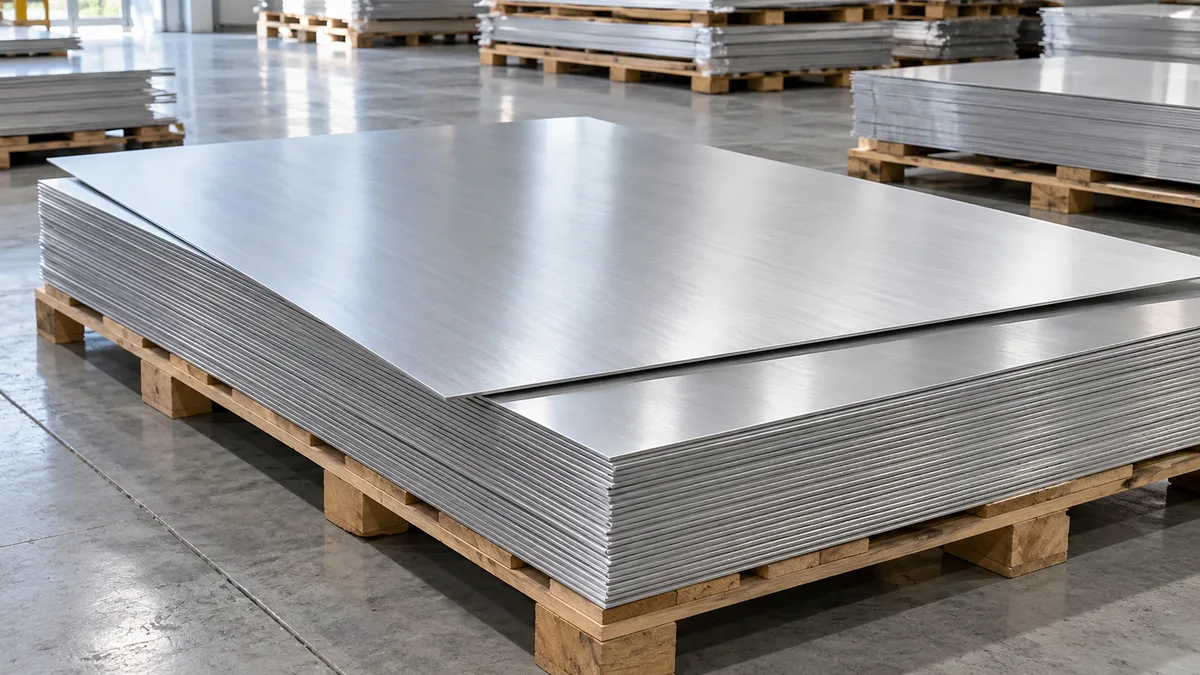
5052 contains 2.2 – 2.8 % magnesium and a small chromium addition. Magnesium gives it roughly twice the strength of 3003 in comparable tempers, and chromium stabilises the grain structure and improves resistance to stress corrosion. It cannot be heat-treated; strength is set by cold rolling and stabilising.
In automotive work 5052 is a general-purpose sheet rather than a dedicated body-panel alloy. Large car body panels use 6xxx outer sheet and 5182 or 5754 inner sheet, chosen for bake-hardening and deep drawing. 5052 fills the wide range of other sheet parts: fuel tanks for trucks and motorcycles, hydraulic and washer tanks, brackets and mounting plates, heat shields, battery covers, step plates, interior panels and complete body panels on trucks, trailers, buses and specialist vehicles.
Its popularity comes from balance. 5052-H32 is strong enough for stiff panels and brackets, ductile enough to bend to about one times thickness, welds without losing much strength, and stands up to salt spray and fuel. It is also available almost everywhere, in a broad range of gauges and widths.
Limits follow the Aluminum Association registration, adopted in ASTM B209, EN 573-3 (EN AW-5052) and GB/T 3190.
| Element | Minimum | Maximum | Role in the alloy |
|---|---|---|---|
| Silicon (Si) | — | 0.25 | Impurity |
| Iron (Fe) | — | 0.40 | Impurity |
| Copper (Cu) | — | 0.10 | Kept low for corrosion resistance |
| Manganese (Mn) | — | 0.10 | |
| Magnesium (Mg) | 2.2 | 2.8 | Main strengthening element |
| Chromium (Cr) | 0.15 | 0.35 | Grain control, stress-corrosion resistance |
| Zinc (Zn) | — | 0.10 | |
| Others, each / total | — | 0.05 / 0.15 | |
| Aluminium (Al) | Remainder | About 96.1 – 97.7 % |
The ranges below are the specified values commonly applied to 0.3 – 3.5 mm 5052 sheet (EN 485-2 and GB/T 33227; ASTM B209 is similar, with slightly different yield minimums). The H3x tempers are strain-hardened and thermally stabilised, which prevents the gradual softening that 5xxx alloys otherwise show at room temperature.
| Temper | Tensile strength Rm | Yield strength Rp0.2 (min) | Elongation A50 (min, typical band) | Character |
|---|---|---|---|---|
| O | 170 – 215 MPa | 65 MPa | 12 – 19 % | Fully annealed; deep drawing |
| H32 | 210 – 260 MPa | 130 MPa (ASTM: 160 MPa) | 5 – 12 % | Quarter-hard, stabilised; the general-purpose temper |
| H34 | 230 – 280 MPa | 180 MPa | 4 – 10 % | Half-hard, stabilised; stiffer panels and brackets |
| H26 | 250 – 300 MPa | 190 MPa | 3 – 6 % | Three-quarter hard, partially annealed |
| H36 | 250 – 300 MPa | 210 MPa | 3 – 6 % | Three-quarter hard, stabilised |
Elongation minimums rise with thickness; the exact value for your gauge is set by the order standard and reported on the certificate. Typical 5052-H32 results are about 230 MPa tensile and 195 MPa yield.
Best for deep-drawn tanks, spun parts and pressings with tight radii. Lowest strength; Lüders bands may appear on drawn surfaces.
The default for brackets, panels, tanks fabricated by bending and welding, and trailer sheet. Bends to about 1 – 1.5 × t.
Higher yield for stiffer flat panels and covers; allow larger bend radii.
Higher strength for flat or lightly formed parts such as covers and heat-shield blanks. Limited formability.
Widths, coil weights and surface combinations are confirmed against your press-line and blanking requirements at quotation.
5052 weighs 2.68 kg per square metre for each millimetre of thickness:
| Thickness (mm) | kg per m² | 1250 × 2500 mm (kg) | 1500 × 3000 mm (kg) |
|---|---|---|---|
| 0.5 | 1.34 | 4.2 | 6.0 |
| 0.7 | 1.88 | 5.9 | 8.4 |
| 0.8 | 2.14 | 6.7 | 9.6 |
| 1 | 2.68 | 8.4 | 12.1 |
| 1.2 | 3.22 | 10.1 | 14.5 |
| 1.5 | 4.02 | 12.6 | 18.1 |
| 2 | 5.36 | 16.8 | 24.1 |
| 2.5 | 6.70 | 20.9 | 30.2 |
| 3 | 8.04 | 25.1 | 36.2 |
A body sheet is judged on more than tensile strength. Automotive sheet standards such as GB/T 33227 and the OEM material specifications that sit above them add forming, surface and processing requirements. The table summarises the points that are usually written into the purchase order.
| Requirement | What it controls | How it is specified |
|---|---|---|
| Hemming / flanging grade | Whether the edge can be folded flat (hemmed) around an inner panel without cracking | Grade agreed on the order; checked with flat-hem or bend tests |
| Paint-brush lines | Fine streaks that become visible after painting on outer panels | Grade agreed on the order for exposed parts |
| Forming limit (FLD) | The strain combinations the sheet can survive before necking | Forming limit curve supplied when the buyer requests it |
| Dent resistance | Resistance of finished panels to local denting | Test data supplied on request |
| High-strain-rate tensile data | Behaviour in crash simulation | Supplied on request for crash-relevant parts |
| Oil amount | Lubricant weight for pressing and corrosion protection in transit | g/m² per side, agreed on the order |
| Passivation / conversion film | Bonding and paint adhesion | Coating type and weight agreed on the order |
| Appearance | Scratches, roll marks, colour variation | Stricter for outer panels; minor marks that do not affect forming are acceptable on inner and structural parts |
| Thickness (mm) | Width ≤ 1,500 mm | Width > 1,500 – 2,000 mm | Width > 2,000 – 2,400 mm |
|---|---|---|---|
| 0.30 – 0.80 | ±0.02 mm | ±0.03 mm | — |
| > 0.80 – 1.20 | ±0.03 mm | ±0.04 mm | ±0.05 mm |
| > 1.20 – 2.00 | ±0.04 mm | ±0.05 mm | ±0.06 mm |
| > 2.00 – 3.00 | ±0.04 – 0.06 mm | ±0.05 – 0.07 mm | ±0.07 – 0.08 mm |
| > 3.00 – 3.50 | ±0.06 – 0.07 mm | ±0.08 mm | ±0.09 mm |
Width tolerances are plus-only (from +0.3 mm on narrow strip to +6 mm on wide heavy-gauge sheet), and flatness is limited to a wave height of about 3 – 8 mm depending on width. General-engineering orders to ASTM B209 or EN 485-4 use those standards' wider tables unless tighter limits are agreed.
H32 bends cold to about 1 – 1.5 × thickness; H34 needs about 1.5 – 2 × t. Bend across the rolling direction where possible.
MIG and TIG with ER5356 or ER5183 filler. Welds in H32 lose some cold-work strength in the heat-affected zone, falling towards O-temper values.
Works well with consistent surface preparation; widely used for tanks and enclosures.
Very good in salt spray and in contact with fuels and oils. Isolate from steel and copper in wet zones.
Takes paint and powder coat after conversion coating; anodises with a slightly yellowish tone.
Fair in H3x tempers; use sharp, high-rake tools to avoid built-up edge.
Brake discs and drums are sometimes listed for 5052 in older literature; those are cast-iron or composite parts, not sheet.
| Property | 5052-H32 | 5754-H22 | 5083-H32 | 6061-T6 |
|---|---|---|---|---|
| Typical tensile strength | about 230 MPa | about 245 MPa | about 315 MPa | about 310 MPa |
| Formability | Good | Good | Fair | Limited |
| Weld strength retention | Good | Good | Very good | Reduced (HAZ) |
| Warm-service sensitisation | Low risk | Low risk | Risk above about 65 °C | n/a |
| Typical market preference | Americas, Asia | Europe | Heavy vehicles, marine | Machined parts |
Not usually for outer panels on modern cars, which use bake-hardenable 6xxx sheet. 5052 is widely used for tanks, brackets, shields, battery covers and truck, trailer and bus body panels.
H34 is cold-worked further: about 20 MPa more tensile and 50 MPa more yield strength than H32, but it needs larger bend radii.
Yes. It resists fuel and salt corrosion, welds well and forms easily, which makes it a standard tank material.
No. It is strengthened by cold work only. Annealing converts it to the soft O temper.
ER5356 is the usual choice; ER5183 or ER5554 are used in some applications. ER4043 is not recommended for high-magnesium joints.
Yes. Metline supplies 5052 sheet and coil worldwide from Mumbai with EN 10204 3.1 certificates, on EXW, FOB, CIF or DAP terms.
Send the temper, gauge, size and volume, and we will confirm availability, certification and a delivered price.





