5052-H32
Quarter-hard, stabilised. The standard marine temper: enough strength for panels and tanks, and bends to tight radii. If a drawing just says "5052 marine sheet", it almost always means H32.



5052-H32 is the most widely used aluminium sheet for small boats, fuel tanks and marine fittings: it resists seawater, bends without cracking and welds easily. It is a moderate-strength alloy and not a class-approved hull grade for ships, so it suits recreational craft, tanks and outfitting rather than primary ship structure. Metline supplies 5052 sheet and plate in O, H32 and H34, plain or tread, worldwide.
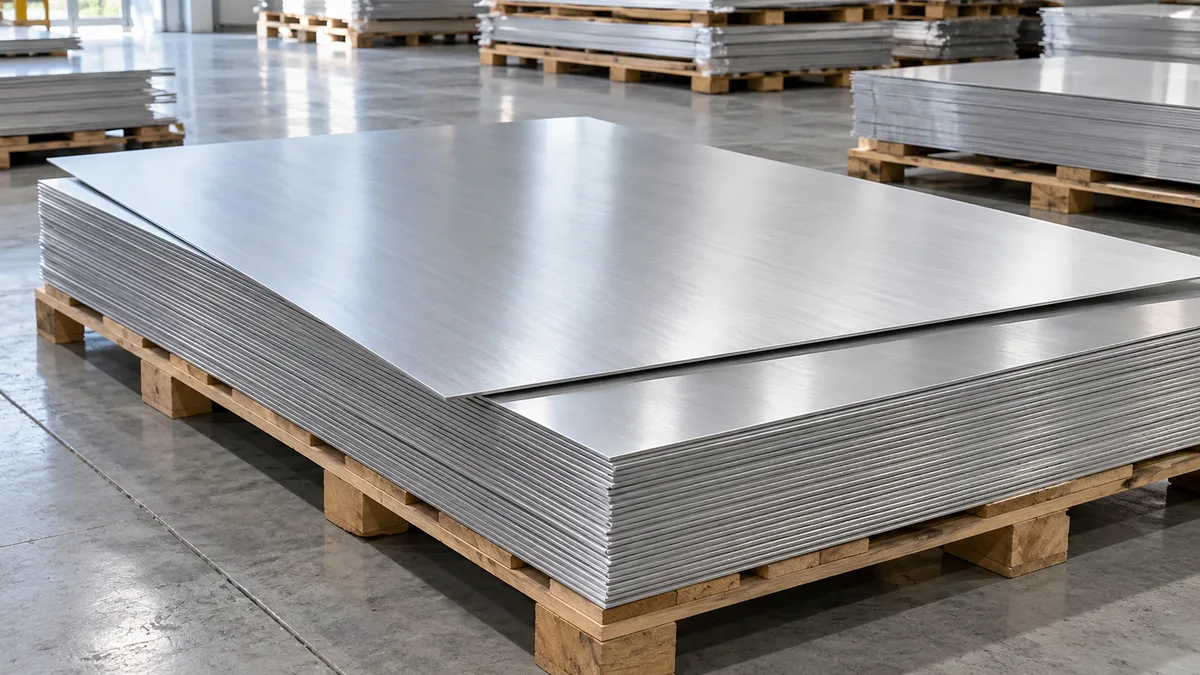
5052 is an aluminium alloy with about 2.5 % magnesium and 0.25 % chromium. It cannot be heat-treated; its tempers come from controlled cold rolling, and the H3x tempers are given a low-temperature stabilising treatment so that properties do not drift over time.
Three properties make it the workhorse of aluminium boat building. It resists seawater and marine atmospheres far better than 3xxx and 6xxx sheet. In H32 it can be folded into chines, tank corners and gunwales without cracking. And it welds by MIG or TIG with almost no loss of strength, because the as-welded condition is not far from the delivered condition.
Its limits matter just as much. 5052-H32 has a minimum yield of about 160 MPa, while 5083-H116 offers 215 MPa and keeps more of it after welding, so ship hulls, workboats and anything built under classification-society rules use 5083, 5086 or 5383 instead. 5052 is not in IACS UR W25, the requirement that governs class-approved hull aluminium.
ASTM B209, EN 573-3 and JIS H4000 all use the registered limits below. Each delivery carries a mill certificate with the actual cast analysis.
| Element (wt %) | 5052 |
|---|---|
| Silicon (Si) | 0.25 |
| Iron (Fe) | 0.40 |
| Copper (Cu) | 0.10 |
| Manganese (Mn) | 0.10 |
| Magnesium (Mg) | 2.2 – 2.8 |
| Chromium (Cr) | 0.15 – 0.35 |
| Zinc (Zn) | 0.10 |
| Others, each / total | 0.05 / 0.15 |
| Aluminium (Al) | Remainder |
Single figures are maximums. Magnesium near 2.5 % keeps the alloy below the threshold at which sensitisation becomes a concern in service.
Design to the specified minimums; typical values show what the material usually achieves. Specified limits below follow ASTM B209 (the EN 485-2 values for EN AW-5052 are similar). Exact elongation minimums depend on the thickness band.
| Temper | Tensile strength, specified | Yield strength, specified min | Typical tensile / yield | Typical elongation | Typical hardness |
|---|---|---|---|---|---|
| O | 170 – 215 MPa | 65 MPa | 193 / 90 MPa | 25 % | 47 HB |
| H32 | 215 – 265 MPa | 160 MPa | 228 / 193 MPa | 12 % | 60 HB |
| H34 | 235 – 285 MPa | 180 MPa | 262 / 214 MPa | 10 % | 68 HB |
| H36 | 255 – 305 MPa | 200 MPa | 276 / 241 MPa | 8 % | 73 HB |
| H38 | 270 MPa min | 220 MPa | 290 / 255 MPa | 7 % | 77 HB |
Typical values from Aluminum Association and ASM data for sheet about 1.6 mm thick. H112 plate is supplied as rolled with properties from hot rolling.
The fatigue strength of 5052-H32 is about 117 MPa at 5 × 10⁸ cycles, unusually high for its static strength. That is one reason it performs well in vibrating applications such as outboard-powered hulls and tanks.
Quarter-hard, stabilised. The standard marine temper: enough strength for panels and tanks, and bends to tight radii. If a drawing just says "5052 marine sheet", it almost always means H32.
Half-hard, stabilised. Higher strength for flat panels and covers that see little forming; bend radii must be larger than for H32.
Annealed for deep drawing, spinning and compound curves. Strength rises a little with the cold work of forming.
As hot-rolled plate, usually thicker gauges. Used for machined parts, base plates and heavier tank ends.
Strain-hardened and partially annealed. Similar strength to H32 / H34 with slightly better formability; common in some markets.
Diamond or five-bar pattern rolled into the surface for slip resistance on decks and steps.
| Standard | What it covers |
|---|---|
| ASTM B209 / B209M (ASME SB-209) | Sheet and plate: chemistry, mechanical properties and tolerances |
| AMS 4015 / 4016 / 4017 | 5052 sheet and plate in O, H32 and H34 for aerospace and defence orders |
| QQ-A-250/8 | Former US federal 5052 plate specification, now replaced by ASTM B209 but still seen on drawings |
| EN 485-1 / -2 / -4, EN 573-3 | European sheet and plate: delivery, properties, tolerances, composition |
| EN 1386 | Tread plate |
| JIS H4000 | Japanese sheet and plate (A5052P) |
| ISO 12215-5 | Scantlings for small craft hulls; the designer uses the alloy's welded properties in this calculation |
| System | Designation |
|---|---|
| Aluminum Association / ASTM | 5052 |
| UNS | A95052 |
| European (EN 573-3) | EN AW-5052 / EN AW-AlMg2.5 |
| German Werkstoff | 3.3523 |
| ISO | AlMg2.5 |
| Japan (JIS) | A5052 |
| China (GB/T 3190) | 5052 |
| Former French (NF) | AG2.5C |
5052 weighs 2.68 kg per square metre for each millimetre of thickness, slightly less than 6061. The table gives weights for common sheet sizes; the plate weight calculator handles any size.
| Thickness (mm) | kg per m² | 1220 × 2440 mm (kg) | 1500 × 3000 mm (kg) |
|---|---|---|---|
| 0.5 | 1.34 | 4.0 | 6.0 |
| 0.8 | 2.14 | 6.4 | 9.6 |
| 1 | 2.68 | 8.0 | 12.1 |
| 1.2 | 3.22 | 9.6 | 14.5 |
| 1.5 | 4.02 | 12.0 | 18.1 |
| 2 | 5.36 | 16.0 | 24.1 |
| 2.5 | 6.70 | 19.9 | 30.2 |
| 3 | 8.04 | 23.9 | 36.2 |
| 4 | 10.72 | 31.9 | 48.2 |
| 5 | 13.40 | 39.9 | 60.3 |
| 6 | 16.08 | 47.9 | 72.4 |
| 8 | 21.44 | 63.8 | 96.5 |
| 10 | 26.80 | 79.8 | 120.6 |
| 12 | 32.16 | 95.7 | 144.7 |
| 16 | 42.88 | 127.6 | 193.0 |
| 20 | 53.60 | 159.6 | 241.2 |
| 25 | 67.00 | 199.4 | 301.5 |
Thickness, width, length, flatness and squareness follow ASTM B209 (ANSI H35.2 tables) or EN 485-4 for cold-rolled sheet and EN 485-3 for hot-rolled plate. For boat building, flatness and surface condition often matter more than thickness tolerance, because distortion and scratches show through paint or bare finishes.
Recommended 90° inside radii for H32 run from almost zero on very thin sheet to about 1 – 2 × thickness at 6 mm. H34 needs larger radii; O can be bent flat on itself. Bend across the rolling direction where possible and allow for springback.
MIG and TIG weld readily with ER5356 filler, which gives the best strength and colour match. ER4043 can be used on 5052 but gives a weaker, darker weld. 5052 is not heat-treatable, so no post-weld heat treatment is used or needed.
Remove oil and the oxide film just before welding with solvent and a stainless brush. Most porosity comes from moisture or contamination on the joint or filler.
Fair. H32 and harder tempers machine better than O. Use sharp tools with high rake, oil-based coolant, and light finishing passes.
Paints well after etch priming, and takes a protective anodic coating. For bright decorative anodising, 5005 is a better choice.
Avoid copper-based antifouling and contact with bronze or stainless fittings without isolation. Keep bilges dry and drained.
| Property | 5052-H32 | 5083-H116 | 5086-H116 | 5754-H111 | 3003-H14 |
|---|---|---|---|---|---|
| Yield strength, specified min | 160 MPa | 215 MPa | 195 MPa | 80 MPa | 115 MPa |
| Seawater resistance | Very good | Excellent | Excellent | Very good | Good |
| Formability | Very good | Fair | Good | Very good | Excellent |
| Class-approved hull alloy (UR W25) | No | Yes | Yes | Yes | No |
| Typical use | Small craft, tanks | Ship hulls | Hulls, decks | Superstructure (EU) | Interiors, trim |
In Europe, 5754 often replaces 5052 for similar uses and is listed in IACS UR W25; in Australia and the UK, 5251 is a close substitute. Move up to 5083 or 5086 when the hull is large, fast or built to class. Choose 3003 or 5005 only for dry, decorative interior parts.
Yes, for small craft built to recreational rules: jon boats, skiffs and many fishing boats use 5052-H32. Larger, faster or class-built hulls use 5083 or 5086, which are stronger after welding and approved by classification societies.
5083 has more magnesium and manganese, giving about a third more yield strength and class approval for hulls. 5052 is easier to bend, cheaper and ideal for tanks, small hulls and outfitting.
Yes. It is chosen for exactly that. Use an inside radius of about 1 – 2 × thickness for plate around 6 mm and less for thin sheet, and bend across the rolling direction.
ER5356 is preferred for strength and appearance. ER4043 can be used but produces a weaker, darker weld. No post-weld heat treatment is required.
2.68 kg per m² per millimetre of thickness. A 1220 × 2440 × 3 mm sheet weighs about 23.9 kg; a 1500 × 3000 × 5 mm sheet about 60.3 kg.
Yes. 5052 is widely used for fuel and water tanks because it resists corrosion, welds well and forms easily. Follow the tank construction rules that apply to your boat.
Yes. Metline ships 5052 sheet and plate worldwide with export packing and EN 10204 3.1 certificates.
Send the temper, thickness, sheet size, quantity and destination. We will reply with availability, certificates and a delivered price.





