Drill centring
A smooth, hard skin stops the drill tip from skating as it touches down, so holes land closer to their programmed positions. This matters more as hole sizes shrink.



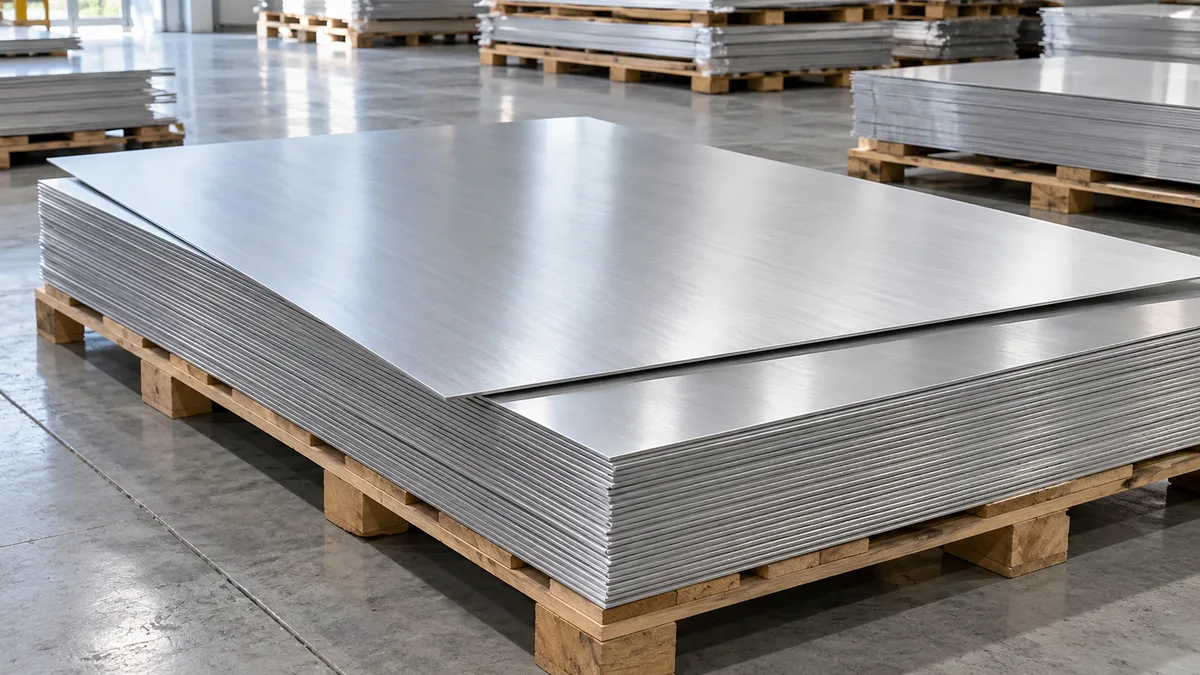
An aluminium entry sheet is a thin, hard aluminium sheet laid on top of a stack of printed circuit board panels before mechanical drilling. The drill passes through it first, which centres the bit, prevents burrs on the top copper, protects the board surface from the pressure foot and draws heat away from the drill. Metline supplies entry sheet in 1xxx, 3xxx and 8011 alloys in H18 and H19 tempers, plain or lubricant-coated, cut to panel size.
In a typical drilling set-up, one to several PCB panels are stacked on a backup board, an aluminium entry sheet is placed on top, and the stack is pinned to the drilling table. The spindle's pressure foot clamps the stack while the drill plunges through entry sheet, panels and into the backup board.
A smooth, hard skin stops the drill tip from skating as it touches down, so holes land closer to their programmed positions. This matters more as hole sizes shrink.
The entry sheet supports the top copper foil as the drill breaks in, preventing raised burrs and torn copper around the hole.
It shields the board from scratches, dents and marks from the pressure foot and from chips dragged across the surface.
Aluminium conducts heat quickly away from the drill tip, reducing resin smear on hole walls and helping drill life.
A clean entry sheet helps the flutes start clearing debris from the first moment of cutting.
Uniform thickness keeps the depth-control references stable from stack to stack.
Entry sheet must be hard enough to centre the drill and resist dents, yet not so hard or abrasive that it wears the drill. That is why it is supplied in full-hard H18 or extra-hard H19 tempers of soft, clean alloys. The choice of alloy mostly trades hardness against drill wear and cost.
| Alloy | Character | Where it fits |
|---|---|---|
| 1060 / 1050 | Very pure (≥ 99.6 / 99.5 % Al), softest of the group even in H18 | Low-cost general drilling where small hole accuracy is less critical |
| 1100 | 99.0 % Al with a little copper; a common all-round entry material | Standard double-sided and multilayer drilling |
| 3003 | Manganese-alloyed, stiffer and harder than 1100 in the same temper | Smaller holes and higher hit densities where better centring is needed |
| 3105 | Mn-Mg alloy with a smooth, hard surface after cold rolling | Precision drilling and as a base for coated entry sheets |
| 8011 | Fe-Si alloy with good strength at thin gauges | Cost-effective alternative at thin gauges |
Typical tensile strength rises from roughly 150 – 165 MPa for 1100-H18 to about 200 MPa for 3003-H18, with 3105 and H19 tempers higher again. Very hard sheet is not automatically better: a sheet that is too hard can deflect fine drills and accelerate wear, so many shops settle on 1100 or 3003 H18 for general work and coated sheet for microvias and small holes.
| Element | 1050 | 1060 | 1100 | 3003 | 3105 | 8011 |
|---|---|---|---|---|---|---|
| Si | 0.25 | 0.25 | 0.95 (Si + Fe) | 0.6 | 0.6 | 0.50 – 0.9 |
| Fe | 0.40 | 0.35 | — | 0.7 | 0.7 | 0.6 – 1.0 |
| Cu | 0.05 | 0.05 | 0.05 – 0.20 | 0.05 – 0.20 | 0.30 | 0.10 |
| Mn | 0.05 | 0.03 | 0.05 | 1.0 – 1.5 | 0.30 – 0.8 | 0.20 |
| Mg | 0.05 | 0.03 | — | — | 0.20 – 0.8 | 0.05 |
| Cr | — | — | — | — | 0.20 | 0.05 |
| Zn | 0.05 | 0.05 | 0.10 | 0.10 | 0.40 | 0.10 |
| Ti | 0.03 | 0.03 | — | — | 0.10 | 0.08 |
| Al | 99.50 min. | 99.60 min. | 99.00 min. | Remainder | Remainder | Remainder |
Limits from the Aluminum Association registrations and EN 573-3. Each lot ships with a mill test certificate.
Sheet weight is 2.71 g/m² per micron of thickness. The table helps plan packs and freight.
| Thickness (mm) | Weight (g/m²) | Sheets of 1245 × 1092 mm per 100 kg |
|---|---|---|
| 0.12 | 325 | 226 |
| 0.15 | 406 | 181 |
| 0.18 | 488 | 151 |
| 0.20 | 542 | 136 |
| 0.25 | 678 | 109 |
Coated entry sheets carry a thin layer of water-soluble lubricant or resin on an aluminium base, usually 3105 or 1100. The coating lubricates and cools the drill, grips the drill tip to stop it wandering and helps clear chips, which reduces drill breakage and improves hole wall quality.
| Type | Benefit | Typical use |
|---|---|---|
| Plain aluminium | Lowest cost; good centring and burr control for standard holes | General double-sided and multilayer boards |
| Water-soluble lubricant coated | Reduces heat and friction, extends drill life; residues wash off in water | Small holes, high-layer-count boards |
| Resin coated | Very good tip location and hole position accuracy | HDI, fine-pitch and IC-substrate drilling with small drills |
| Laminated (aluminium with paper or film) | Cushions the board surface, low cost | Boards with sensitive surface finishes |
As a rule of thumb, coated entry becomes worthwhile when drill diameters drop to a few tenths of a millimetre, when stacks are thick relative to hole size, or when hole position accuracy and drill breakage are the limiting factors.
The same thin, hard, flat sheet is also used as protective cover sheet in PCB lamination, as separator plates, and as base stock for heat-spreading and shielding parts. For metal-core PCB substrates, thicker 5052 or 6061 plate is used instead; those are different products from entry sheet.
0.15 – 0.20 mm suits most drilling. Thinner sheet saves cost on large holes; thicker or coated sheet helps with small drills and thick stacks.
Full-hard tempers give a firm surface that centres the drill and resists dents from the pressure foot, while the soft base alloy keeps drill wear low.
3003 is stiffer and harder in the same temper, which helps hole position accuracy with smaller drills. 1100 is softer and gentler on drills. Many shops use 1100 for general work and 3003 or coated sheet for finer holes.
When drilling small holes, high-layer-count boards or HDI designs where drill breakage, hole position accuracy or resin smear are problems. The water-soluble coating cools and lubricates the drill.
No. Once drilled, the sheet has holes in the previous pattern that would deflect new drills. It is single-use and is collected as clean aluminium scrap for recycling.
Yes. Metline supplies entry sheet cut to your panel dimensions or in coil, plain or coated, with mill certificates and export packing, worldwide.
Send the alloy, temper, thickness, sheet size and monthly volume. We will reply with a sample offer and delivered price.





