1100-O
Fully annealed, the softest condition. Order O for cold heading, upsetting, deep bending, spinning or swaging, where the rod must accept heavy deformation without cracking.



1100 aluminium rod is commercially pure aluminium (at least 99.0 % Al) with a small, controlled copper addition. It is soft, very ductile, highly conductive and resistant to corrosion, but not strong, so it is chosen for formed, spun, cold-headed and electrical or chemical-service parts rather than load-bearing components. Metline supplies 1100 rod and bar in annealed, strain-hardened and as-extruded tempers to customers worldwide.
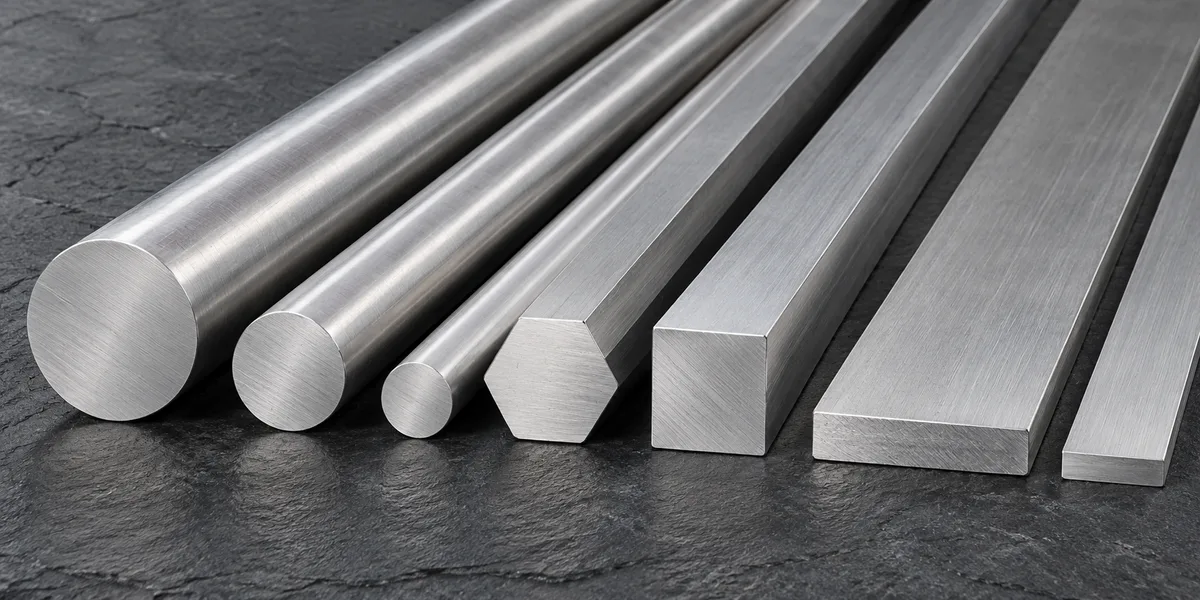
1100 is the most common grade in the 1xxx series of commercially pure aluminium. Unlike 1050 or 1060, it carries a deliberate 0.05 – 0.20 % copper addition, which gives slightly higher strength and a finer, more even response to cold working while keeping conductivity and corrosion resistance high.
Because 1100 contains almost no alloying elements, it cannot be strengthened by heat treatment. Its strength comes only from cold work: the bar is drawn or rolled, and the amount of reduction sets the temper (H12, H14, H16, H18). Annealing returns it to the soft O temper. Even fully hard 1100 is weaker than annealed 6061, so the grade is used where formability, purity, conductivity or appearance matter more than load-carrying capacity.
In rod form, 1100 is typically supplied as extruded bar (H112 or F), cold-finished drawn rod in H12 to H18, or annealed rod for heavy cold forming. It is a common feedstock for cold heading, spinning, impact extrusion, rivets for non-structural use, electrical connectors, chemical equipment fittings, reflectors and decorative turned parts.
Limits are the registered Aluminum Association values, which ASTM B211, ASTM B221 and EN 573-3 (EN AW-1100, Al99,0Cu) follow. The actual analysis of your lot appears on the mill test certificate.
| Element | Limit | Comment |
|---|---|---|
| Silicon + Iron (Si + Fe) | 0.95 max (combined) | Main impurities; kept low for ductility and finish |
| Copper (Cu) | 0.05 – 0.20 | Deliberate addition; raises strength slightly |
| Manganese (Mn) | 0.05 max | Impurity |
| Zinc (Zn) | 0.10 max | Impurity |
| Others, each / total | 0.05 / 0.15 max | Beryllium is further limited (0.0008 % max) when used for welding wire |
| Aluminium (Al) | 99.00 min | Balance |
1100 is sometimes compared with 1050A or 1200. 1200 has no copper requirement and allows up to 1.0 % Si + Fe; 1050A is purer (99.5 % Al) and slightly more conductive but softer.
Typical values below are long-established Aluminum Association / ASM figures for wrought 1100. The guaranteed minimums depend on the product standard, temper and diameter, and are what you should design to.
| Temper | Tensile strength (typical) | Yield strength (typical) | Elongation | Brinell hardness |
|---|---|---|---|---|
| O (annealed) | 90 MPa / 13 ksi | 34 MPa / 5 ksi | 35 – 45 % | 23 HB |
| H12 | 110 MPa / 16 ksi | 105 MPa / 15 ksi | 12 – 25 % | 28 HB |
| H14 | 125 MPa / 18 ksi | 115 MPa / 17 ksi | 9 – 20 % | 32 HB |
| H16 | 145 MPa / 21 ksi | 140 MPa / 20 ksi | 6 – 17 % | 38 HB |
| H18 | 165 MPa / 24 ksi | 150 MPa / 22 ksi | 5 – 15 % | 44 HB |
| H112 extruded, specified minimum | 75 MPa / 11 ksi | 20 MPa / 3 ksi | — | — |
Elongation ranges reflect specimen size and product form; drawn wire and small rod sit at the lower end. The H112 row is a specified minimum for extruded bar, not a typical value.
Fully annealed, the softest condition. Order O for cold heading, upsetting, deep bending, spinning or swaging, where the rod must accept heavy deformation without cracking.
Quarter-hard and half-hard. A good balance for turned parts, light bending and general fabrication; H14 is the most commonly stocked drawn temper.
Three-quarter hard and full hard. Highest strength and stiffness the grade can reach, used for straight rod, pins and parts that must resist bending in handling.
As-extruded bar with only incidental work hardening. Economical for larger diameters, flats and shapes that will be machined or formed further.
Strain-hardened tempers soften if heated. Welding, brazing or service above roughly 200 °C will anneal the affected area towards O temper, so do not rely on H-temper strength near heat-affected zones.
State the product standard on your order, not just the alloy number. Cold-finished rod and extruded bar are covered by different specifications with different tolerances.
| System | Designation | Bar and rod standard |
|---|---|---|
| Aluminum Association / ASTM | 1100 | ASTM B211 (cold-finished), ASTM B221 (extruded), ASTM B316 (rivet and cold-heading rod) |
| UNS | A91100 | — |
| European (EN) | EN AW-1100 / EN AW-Al99,0Cu | EN 754-2 (drawn), EN 755-2 (extruded), EN 573-3 (chemistry) |
| ISO | Al99,0Cu | ISO 209 (composition) |
| Japan (JIS) | A1100 | JIS H4040 (bar and wire) |
| China (GB) | 1100 | GB/T 3190 (composition), GB/T 3191 (extruded bar) |
Availability depends on diameter and temper; confirm the exact size and temper when you enquire.
Round bar weight is the cross-section area multiplied by density (2.71 g/cm³). Quick reference weights for solid round 1100 rod:
| Diameter (mm) | kg per metre | 3 m bar (kg) | 6 m bar (kg) |
|---|---|---|---|
| 6 | 0.077 | 0.23 | 0.46 |
| 8 | 0.136 | 0.41 | 0.82 |
| 10 | 0.213 | 0.64 | 1.28 |
| 12 | 0.306 | 0.92 | 1.84 |
| 16 | 0.545 | 1.63 | 3.27 |
| 20 | 0.851 | 2.55 | 5.11 |
| 25 | 1.33 | 3.99 | 7.98 |
| 30 | 1.92 | 5.75 | 11.49 |
| 40 | 3.41 | 10.22 | 20.43 |
| 50 | 5.32 | 15.96 | 31.93 |
| 60 | 7.66 | 22.99 | 45.97 |
| 80 | 13.62 | 40.87 | 81.73 |
| 100 | 21.28 | 63.85 | 127.71 |
| 150 | 47.89 | 143.67 | 287.34 |
For cold-heading stock, tell us the heading ratio and whether the rod will be annealed before forming; it affects the temper and surface quality we recommend.
Outstanding cold formability in O temper. Can be headed, upset, swaged, spun and bent to very tight radii. Strain hardens as it is worked, so intermediate anneals help on severe parts.
Soft and gummy; produces long, stringy chips. Use sharp, polished high-rake tools, high speeds and lubricant. Harder tempers (H14 – H18) machine more cleanly than O.
Excellent weldability by TIG, MIG, resistance and gas methods. ER1100 filler matches the base metal; ER4043 is used where better fluidity is needed.
Readily brazed and soldered, which is why 1100 appears in heat-exchanger and electrical assemblies.
Gives a clear, bright protective anodic film; suitable for decorative and reflective parts.
Very good resistance in the atmosphere, fresh water, food products and many chemicals, owing to the stable oxide film on high-purity aluminium.
| Property | 1050A | 1100 | 3003 | 6061-T6 |
|---|---|---|---|---|
| Al content / type | 99.5 % pure | 99.0 % pure + Cu | Al-Mn | Al-Mg-Si, heat-treatable |
| Typical tensile, harder temper | ~140 MPa (H18) | ~165 MPa (H18) | ~200 MPa (H18) | ~310 MPa |
| Electrical conductivity | ~61 % IACS | ~57 – 59 % IACS | ~40 – 50 % IACS | ~43 % IACS |
| Cold formability | Excellent | Excellent | Very good | Fair (in T6) |
| Machinability | Poor | Poor–fair | Fair | Good |
| Typical use | Electrical, chemical | General pure-Al parts | Formed parts needing more strength | Structural, machined parts |
Choose 1050A when conductivity or purity is the priority, 3003 when you need about 20 % more strength with similar formability, and 6061 bar when the part carries load or will be machined in volume.
It is commercially pure: at least 99.0 % aluminium, with 0.05 – 0.20 % copper added and limits on iron, silicon and other impurities. For higher purity, 1050A (99.5 %) or 1070 / 1350 electrical grades are used.
No. 1100 is non-heat-treatable. Strength is raised only by cold work (H12 to H18). Heating it softens the bar back towards O temper.
O is fully annealed, with about 90 MPa tensile strength and very high elongation, ideal for heading and bending. H14 is half-hard, at about 125 MPa, stiffer and easier to machine, but less formable.
Yes for connectors, terminals and grounding parts, with conductivity around 57 – 59 % IACS. For busbars and conductors where maximum conductivity is specified, 1350 or 6101 are the usual grades.
A 1 m length of 25 mm diameter rod weighs about 1.33 kg, and 50 mm rod about 5.32 kg, based on a density of 2.71 g/cm³.
Yes. Metline ships 1100 rod and bar worldwide from Mumbai with mill test certificates, export packing and EXW, FOB, CIF or DAP terms.
Send the temper, diameter, length, quantity and destination, and our team will reply with availability and a delivered quotation.





