Deep drawing and spinning
1100-O has high elongation and a low yield-to-tensile ratio, so it flows well in dies and on spinning lathes. Intermediate anneals allow very deep draws.



1100 sheet and plate is 99.00 % pure aluminium with a small copper addition, supplied annealed (1100-O, AMS 4001) or half hard (1100-H14, formerly AMS 4003, now ASTM B209). Aerospace programmes use it for spun and drawn parts, ducts, shims, closures, heat shields and interior parts that carry little load. Metline supplies 1100 sheet and plate in O, H12, H14, H16 and H18, cut to size and certified, worldwide.
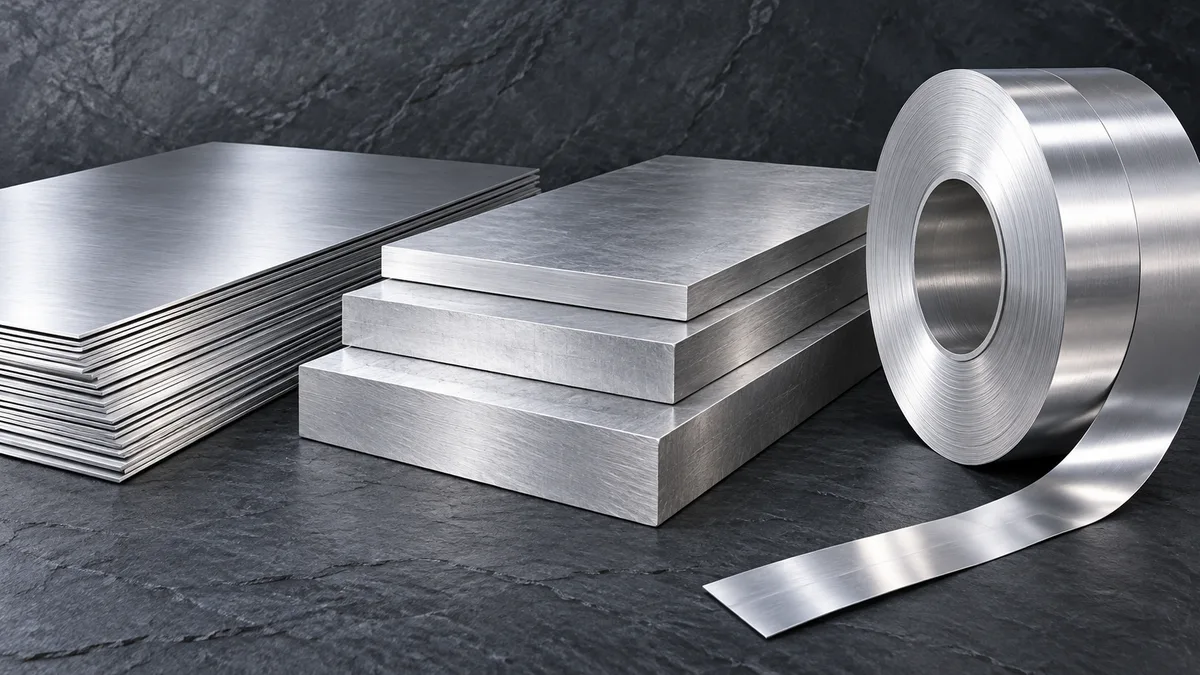
Every aircraft contains formed sheet parts that see almost no structural load but must be made in awkward shapes and must not corrode. 1100 is the US aerospace default for that job.
Annealed 1100-O can be deep drawn, spun, stretched and bent flat on itself. It welds and brazes easily and anodises to a clean, bright finish. Typical parts are air ducts and plenums, spun nose caps and covers, shims and packers, lightly loaded closures and access covers, heat and radiation shields, liners, and interior trim. Half-hard 1100-H14 is chosen for flat or lightly formed parts that must stay flat and resist dents in handling.
For structural skins, aircraft use clad 2024 or 7075 instead. 1100 is far too weak for primary structure: its annealed yield strength is only about 25 – 35 MPa. It also differs from the cladding layer on Alclad sheet, which is a separate pure-aluminium or Al-Zn layer metallurgically bonded to a strong core.
| Element | Limit (wt %) | Comment |
|---|---|---|
| Silicon + iron (Si + Fe) | 0.95 max combined | The two main impurities are controlled together |
| Copper (Cu) | 0.05 – 0.20 | Deliberate small addition; raises strength slightly over 1050/1060 |
| Manganese (Mn) | 0.05 max | |
| Zinc (Zn) | 0.10 max | |
| Others, each / total | 0.05 / 0.15 max | |
| Aluminium (Al) | 99.00 min | By difference |
AMS 4001 and AMS 4003 both use the standard 1100 limits. Their titles refer to "0.12 Cu", which is simply the nominal copper content within the 0.05 – 0.20 % range.
The table lists the specified tensile limits used in ASTM B209 for 1100 sheet in the common thickness range; elongation minimums vary with thickness. These are the values to design to and to check certificates against.
| Temper | Tensile strength | Yield strength min | Elongation min (typical sheet gauge) |
|---|---|---|---|
| O | 75 – 105 MPa (11.0 – 15.5 ksi) | 25 MPa (3.5 ksi) | about 25 – 30 % |
| H12 | 95 – 130 MPa (14 – 19 ksi) | 75 MPa (11 ksi) | about 6 – 12 % |
| H14 | 110 – 145 MPa (16 – 21 ksi) | 95 MPa (14 ksi) | about 4 – 10 % |
| H16 | 130 – 165 MPa (19 – 24 ksi) | 115 MPa (17 ksi) | about 3 – 4 % |
| H18 | 150 MPa (22 ksi) min | — | about 3 – 4 % |
Values summarised from ASTM B209; check the current edition and your thickness band for exact limits.
| Document | Covers | Status / comment |
|---|---|---|
| SAE AMS 4001 | Sheet and plate, 1100-O annealed | Current aerospace specification for annealed 1100 |
| SAE AMS 4003 | Sheet and plate, 1100-H14 | Cancelled; SAE refers to ASTM B209, 1100-H14 |
| ASTM B209 / B209M (ASME SB-209) | Sheet and plate, all tempers | Main commercial specification |
| QQ-A-250/1 | Federal sheet and plate, 1100 | Superseded by ASTM B209; still seen on older drawings |
| EN 485-2, EN 573-3 | Sheet and plate; chemistry (EN AW-1100) | European route |
| JIS H4000 | A1100P | Japanese equivalent |
Equivalent designations: UNS A91100, EN AW-1100 (Al99.0Cu), ISO Al99.0Cu, JIS A1100. The UK grade 1200 is close but is not a direct substitute where AMS or ASTM 1100 is specified.
Weight in pounds of a 48 × 144 in sheet = thickness (in) × 48 × 144 × 0.098. Metric: 2.71 kg per m² per mm.
| Thickness (in) | Thickness (mm) | lb/ft² | 48 × 144 in sheet (lb) | 48 × 144 in sheet (kg) |
|---|---|---|---|---|
| 0.016 | 0.41 | 0.226 | 10.8 | 4.9 |
| 0.020 | 0.51 | 0.282 | 13.5 | 6.1 |
| 0.025 | 0.64 | 0.353 | 16.9 | 7.7 |
| 0.032 | 0.81 | 0.452 | 21.7 | 9.8 |
| 0.040 | 1.02 | 0.564 | 27.1 | 12.3 |
| 0.050 | 1.27 | 0.706 | 33.9 | 15.4 |
| 0.063 | 1.60 | 0.889 | 42.7 | 19.4 |
| 0.080 | 2.03 | 1.129 | 54.2 | 24.6 |
| 0.090 | 2.29 | 1.270 | 61.0 | 27.7 |
| 0.125 | 3.17 | 1.764 | 84.7 | 38.4 |
| 0.160 | 4.06 | 2.258 | 108.4 | 49.2 |
| 0.190 | 4.83 | 2.681 | 128.7 | 58.4 |
| 0.250 | 6.35 | 3.528 | 169.3 | 76.8 |
| 0.375 | 9.52 | 5.292 | 254.0 | 115.2 |
| 0.500 | 12.70 | 7.056 | 338.7 | 153.6 |
1100-O has high elongation and a low yield-to-tensile ratio, so it flows well in dies and on spinning lathes. Intermediate anneals allow very deep draws.
O temper bends 180° flat; H14 needs an inside radius of roughly 0 – 1 × thickness depending on gauge.
TIG, MIG and resistance welding with 1100 or 4043 filler; brazing with Al-Si fillers.
Soft and gummy. Shear and punch with sharp, close-clearance tools; machine with high-rake, polished cutters.
Clear and coloured anodising, chemical conversion coating, painting and bright dipping.
Excellent in air and fresh water. Isolate from carbon fibre, copper and steel in damp areas.
| 1100-H14 | 1050A-H14 | 3003-H14 | 5052-H32 | |
|---|---|---|---|---|
| Typical tensile | 124 MPa | ~110 MPa | 150 MPa | 230 MPa |
| Formability | Excellent | Excellent | Excellent | Very good |
| Weldability | Excellent | Excellent | Excellent | Excellent |
| Main specs | AMS 4001, ASTM B209 | EN 485, BS 1B | AMS 4006, ASTM B209 | AMS 4015/4016/4017, ASTM B209 |
For a little more strength with the same forming behaviour, move to 3003. For fuel tanks, fairings and other parts that carry moderate load, 5052-H32 is the usual aerospace step up.
SAE AMS 4001 is the aerospace specification for 1100-O (annealed) aluminium sheet and plate, intended for parts that need high formability.
No. AMS 4003 (1100-H14 sheet and plate) was cancelled and SAE refers to ASTM B209, alloy 1100, temper H14. We certify to B209 for these orders.
Not for structural skins; it is far too weak. Skins use clad 2024 or 7075. 1100 suits ducts, shims, covers and other lightly loaded formed parts.
The specified minimum is 25 MPa (3.5 ksi); typical values are about 34 MPa.
About 42.7 lb (19.4 kg).
Yes. We supply blanks, strips and circles cut by shear, saw or waterjet, with PVC film on request.
Send thickness, size, temper and specification. We reply with availability, certification and a delivered price.





